 Review101
What Is a Vibration Plate Exercise Machine? A Beginner’s Guide
A vibration plate moves beneath you while you stand or exercise. Here’s what that motion adds, how to make sense of the labels, and when you’re better off on solid ground.
Read the article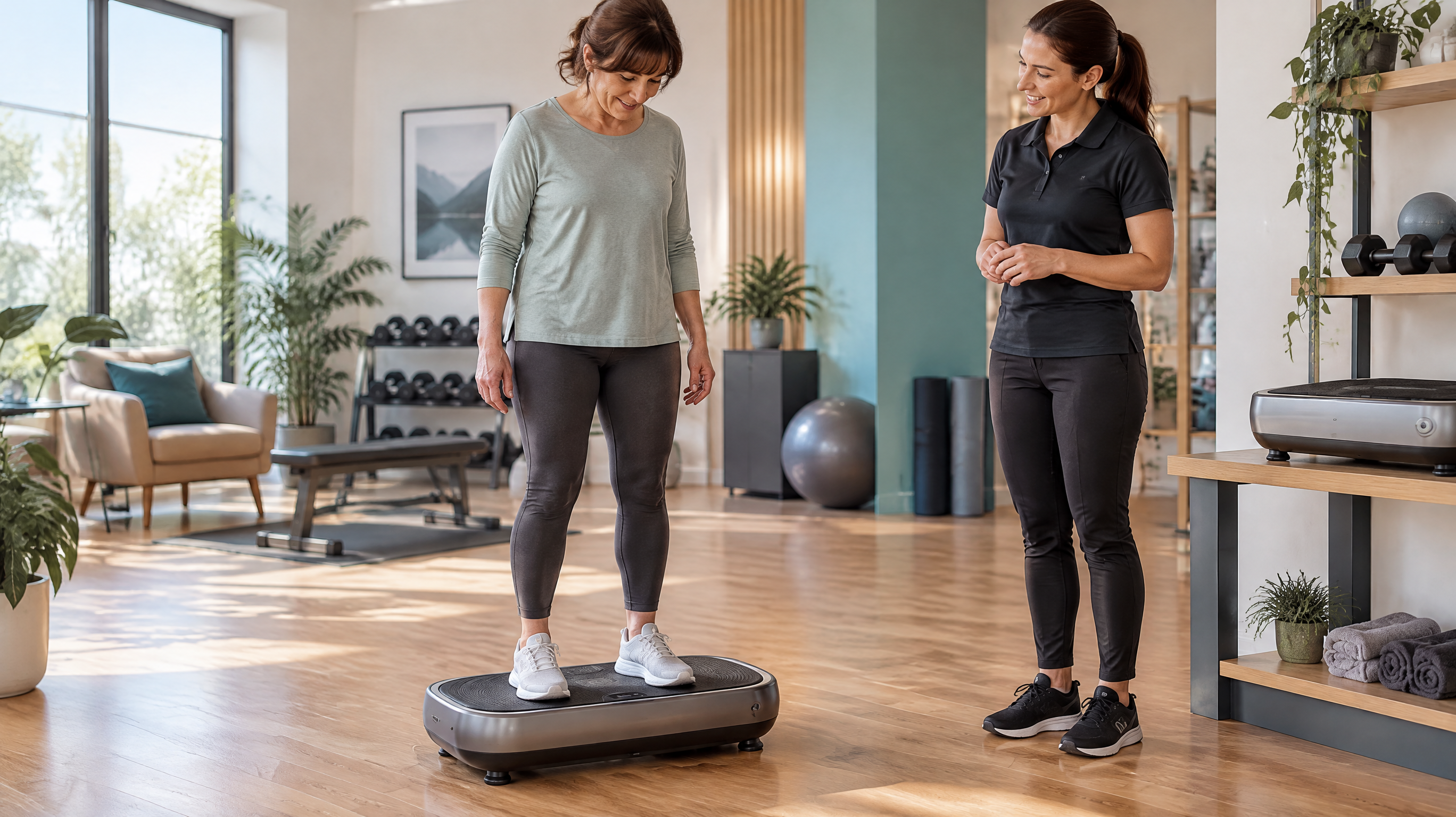
Some links may earn us a commission, at no extra cost to you. How we’re supported
In this article 8 sections
- What a vibration plate actually does
- Oscillating, high-frequency, 3D, and 4D: What the labels mean
- Speed levels, presets, and controls are different things
- Do vibration plates work? Start by asking what for
- When a stable floor makes more sense
- What owning a vibration plate involves
- Questions before you commit
- Your next step
Start with your needs
A supervised demo can tell you whether the vibration feels engaging or distracting.
If you only want more resistance, use bands or weights on solid ground.
Don’t buy for a promised therapeutic effect or weight-loss result based on a listing.
As an Amazon Associate, we earn from qualifying purchases. Research-based analysis; no hands-on testing.
The short answer
You don’t need a vibration plate to start exercising. It’s an optional way to add a moving-surface challenge to familiar exercises, not a substitute for walking or strength training.
Worth considering if
- People who want to vary a movement they already know.
- People who enjoy a moving-surface challenge and have a practical place to set up the plate.
Hold off if
- Stepping onto a raised deck or staying steady on it is difficult.
- Your only setup spot is cramped or shares a floor where vibration may disturb others.
- An advertised health outcome is your main reason for trying one.
Choose your next step
Ready to compare?
See the differences, tradeoffs and who each model suits.
Compare the products →


What a vibration plate actually does
A vibration plate is a powered exercise platform that moves in short, repeated cycles. Whole-body vibration means the platform’s motion is transmitted into your body through the points of contact, such as your feet when you stand on the deck. It doesn’t mean every muscle is doing the same amount of work.
The plate supplies the movement underfoot; you supply the stance or exercise. In a squat, you still lower and raise yourself. The moving surface adds a position-control task because your muscles have to respond to small shifts beneath your feet. Standing still on a running plate can feel active, but it isn’t the same task as doing a squat.
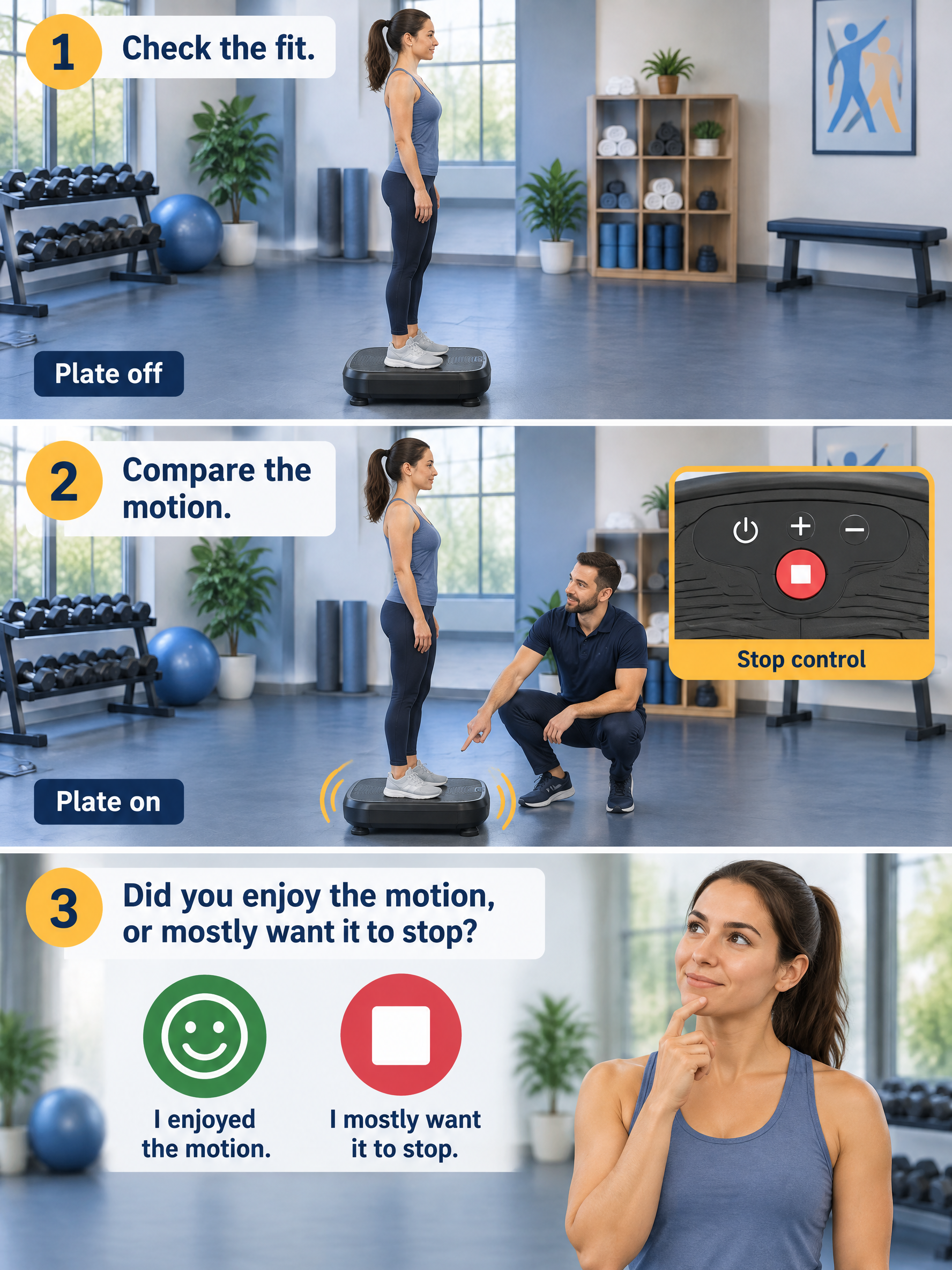
A three-step demo to see whether you like the motion
See the movement
Use a fixed-camera off/on comparison with the same stance and framing. Show the stop control before the running shot, and use footage of the actual model rather than exaggerated shake or body movement.
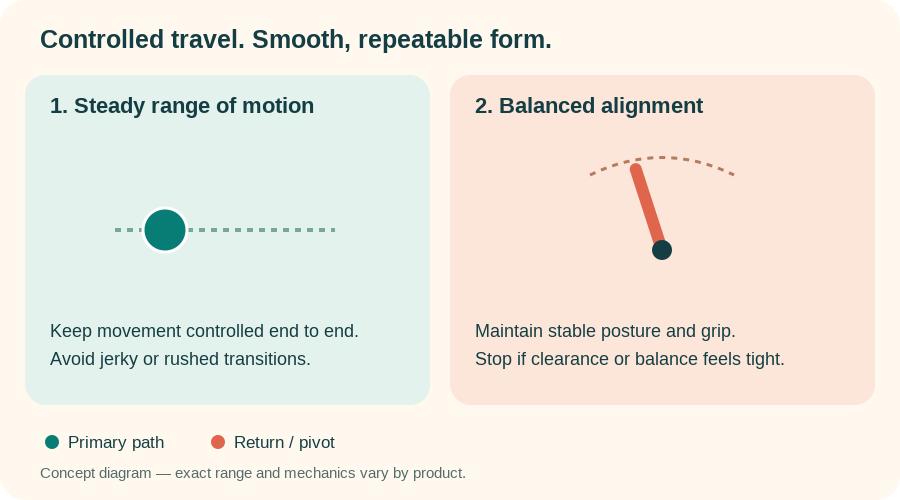
Simplified motion diagram. Exact range and mechanics vary by product.
- Start with the plate off
At a supervised demo, use the stationary deck to judge the step height and whether your feet fit comfortably.
- Compare the same stance
Ask the demonstrator to show you the stop control. If you feel steady and the setup is appropriate, compare the same stance with the plate running, without adding bands or an exercise.
- Decide what it added
Notice whether you enjoyed adjusting to the motion or spent most of the demo wanting it to stop.
Oscillating, high-frequency, 3D, and 4D: What the labels mean
An oscillating plate, like the one described in the AXV listing, rocks like a seesaw: one side rises as the other falls. A foot farther from the pivot travels farther than one near the center. A platform that moves straight up and down, by contrast, lifts both sides together.
Direction tells you where the deck moves. Frequency tells you how often it repeats the movement, measured in hertz (Hz), or cycles per second. Amplitude describes how far it moves. The VT007’s “high-frequency” name refers to the rate, not the direction or size of the movement. If a listing gives amplitude in millimeters, check where on the deck it was measured and whether the figure describes travel from the middle position or the full distance between extremes.
The FitMaxx 3D XL and Rumblex 4D illustrate a different kind of naming. “3D” and “4D” alone don’t tell you which motions the deck can make or whether it can combine them. Look for a plain-language description of each motion in the manual for the exact model.
Choose your next step
Which model fits your needs?
See the differences, tradeoffs and who each model suits.
Compare the products →Speed levels, presets, and controls are different things
A level is a setting you select. A preset is a program that runs with preconfigured settings and may change them along the way. The AXV listing reports 120 levels and five programs; those are two different counts. It also lists a maximum speed of 120 RPM, or revolutions per minute, without saying what is rotating or how that relates to the deck’s motion. Neither the RPM field nor the level count tells you the vibration frequency in hertz.
Control layout matters when you want to stop or change a setting without reaching down toward a moving deck. The Lifepro Waver lists a remote and control panel; the MERACH V33 Pro lists remote and touch controls. Check which controls you can reach from your usual stance and how to stop the machine before you step off.
How to tell whether the included bands suit your exercise
- Choose the movement
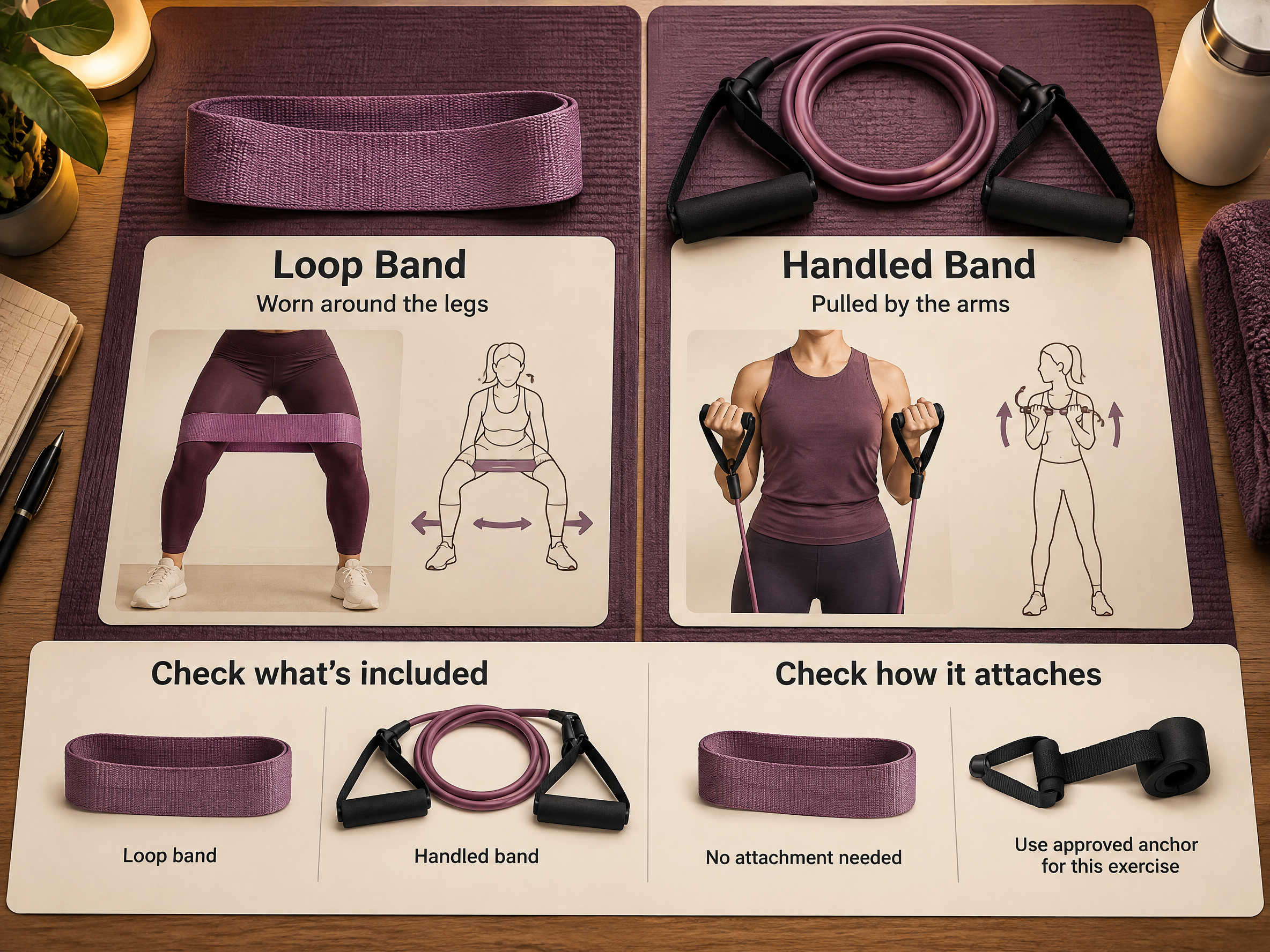
A loop around your legs and a handled band you pull with your arms serve different purposes. Start with the movement you want to do.
- Read the parts list
Check for the specific band you need. A model may list mini bands separately from longer resistance bands.
- Check how it attaches
If the movement requires an anchored band, look for a manufacturer-approved attachment point and setup instructions. Don’t assume every band clips to the deck.
Do vibration plates work? Start by asking what for
If you want a familiar movement to feel different, a vibration plate can add variety without changing the exercise itself. Some models, including the Lifepro Waver and Waver Mini, list resistance bands in the box. Those give you another way to exercise, but the pulling resistance comes from the band, not the vibrating deck.
Feeling the motion right away doesn’t tell you what will happen over time. Product listings advertise weight loss, body toning, and lymphatic drainage, but the listings don’t substantiate those outcomes. A calorie number on the display isn’t proof that the machine measured how much energy you used.
When a stable floor makes more sense
If your goal is to make a strength exercise harder, bands or weights on a stable floor let you add resistance without changing the surface. If you mainly want to move more often, a walk or an activity you already enjoy may fit your day with less setup.
If stepping onto a raised surface or holding your balance is already difficult, skip the moving deck in favor of a stable surface and suitable support. If you’re considering vibration for a health condition or during injury recovery, ask a clinician whether it’s appropriate for you rather than relying on a product listing.
What owning a vibration plate involves
Measure the space you’ll use, not just the spot where you’ll store it. Leave room to step off without bumping furniture or crossing the power cord on a corded model. Allow room for your arms to move if you’ll use bands. Check the machine’s weight as well as its dimensions: a plate that fits under the sofa can still be a chore to pull out every time.
Think about who shares the room or lives below it. Even if the motor sounds quiet, vibration can travel through the floor or make nearby objects rattle. Check the manual for approved flooring and whether the manufacturer permits a mat.
Questions before you commit
Should I wear shoes or go barefoot?
Follow the footwear guidance in the manual for your exact model. Don’t assume regular socks will give you enough grip on a moving deck.
Can I put a vibration plate on carpet?
Only if the manufacturer allows it and the base sits level without wobbling. Thick carpet can let the feet sink unevenly, so don’t count on a carpeted room until you’ve checked the flooring instructions.
Do the batteries listed in the specs mean the plate is cordless?
No. The Lifepro Waver, for example, lists AAA batteries but also specifies corded-electric power and includes a power cord. Check what powers the deck before planning a spot away from an outlet.
Can two people share one vibration plate?
Yes, by taking turns, provided each person is within the model’s user weight limit and can get on and off comfortably. A listed weight limit doesn’t mean the deck is designed for two people to stand on it together.
Choose your next step
Put your shortlist side by side
See the differences, tradeoffs and who each model suits.
Compare the products →Your next step
- Name one exercise you already do that you’d like to try on a moving surface.
- Check the manual for motion type, stop controls, and approved flooring.
- Check the user weight limit and measure both step-off clearance and storage space.
- Verify which accessories come in the box and whether you’ll use them.
Before making room for a plate, see whether you enjoy the motion enough to use it on an ordinary day.