Review101
Is a Vibration Plate Worth Buying for Your Home?
A vibration plate is worth considering if you enjoy exercising on a moving surface and have a spot where you’ll use it. If you mainly want more variety or a way to build a regular exercise habit, try a simpler option first.
Read the article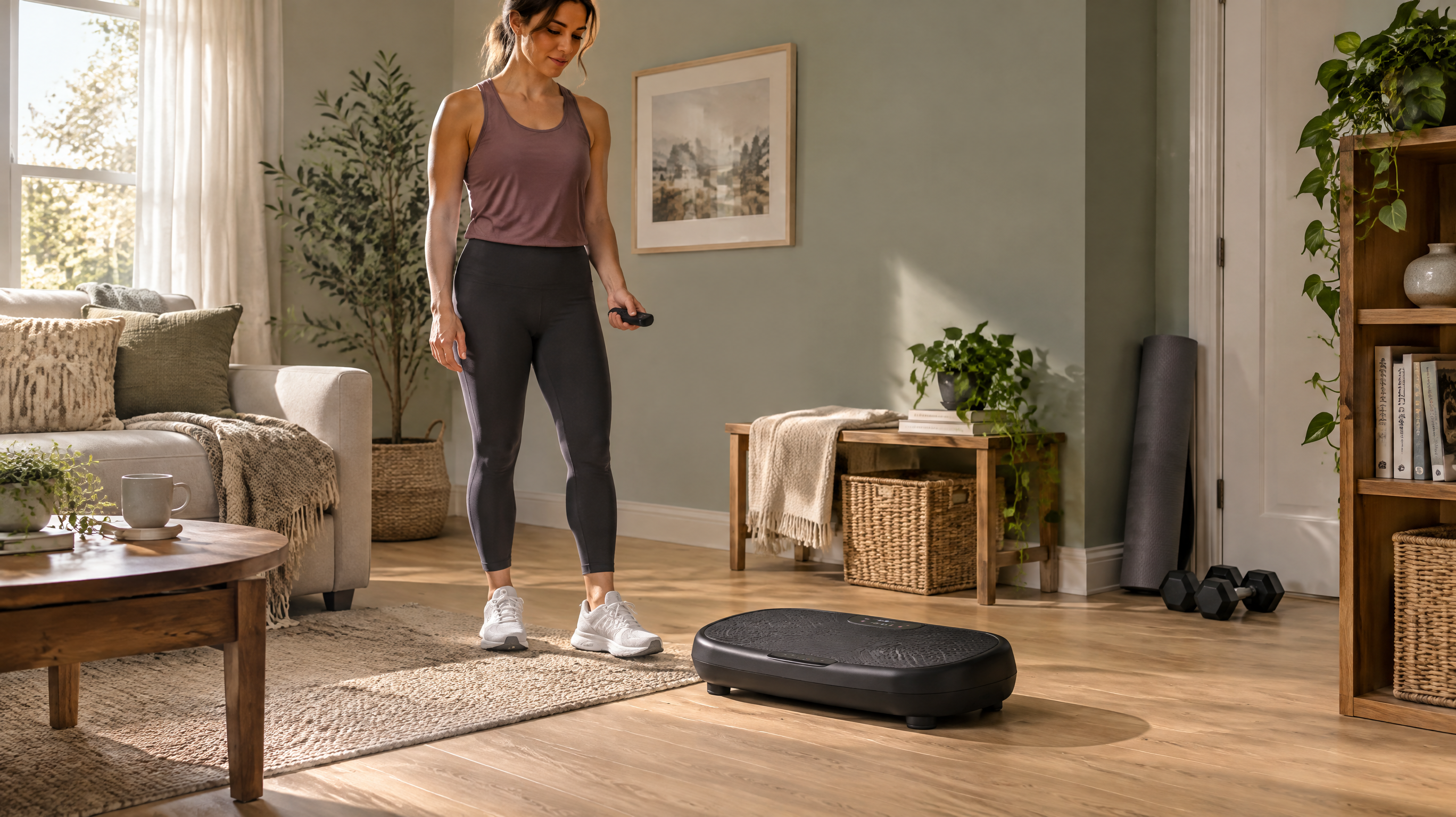
Some links may earn us a commission, at no extra cost to you. How we’re supported
In this article 7 sections
Start with your needs
You’ve tried the motion, know when you’ll use it, and have a practical setup and clear return terms.
You’re curious about the motion but don’t yet know what it adds to an exercise you already do.
Safe access, storage, noise, or returns are unresolved, or you’re buying on the strength of an unverified health promise.
As an Amazon Associate, we earn from qualifying purchases. Research-based analysis; no hands-on testing.
The short answer
Buy for a session you’ve tried and want to repeat. If you can’t say what the moving platform adds to your routine, try one before spending money.
Worth considering if
- People who enjoy the moving surface and can name a session they’d repeat.
- Households with a clear exercise area and an easy way to leave the plate out or put it away.
Hold off if
- You want general exercise variety but haven’t tried simpler options you already have.
- You’re relying on a handle to solve a balance or access concern.
- You can’t confirm that the plate fits your home or that returning it would be affordable.
Choose your next step
Ready to compare?
See the differences, tradeoffs and who each model suits.
Compare the products →


What gap would a vibration plate fill in your routine?
A vibration plate is a powered platform with a deck that moves beneath you. You stand on it or do an exercise the manual permits while the deck moves. Some machines let you choose a setting manually or run an automatic program. The moving surface is what you’re paying for; resistance bands work without it.
Name the activity, the days you’d do it, and where it fits in your week. “I’d use it after my Tuesday and Thursday workouts” gives you a plan you can test. “It might get me to exercise more” doesn’t tell you when you’ll pull it out. If your goal is general strength, balance practice, or a change of pace, start by asking whether a familiar exercise on a stable floor would meet it.
Check whether you can stop the plate comfortably
See the movement
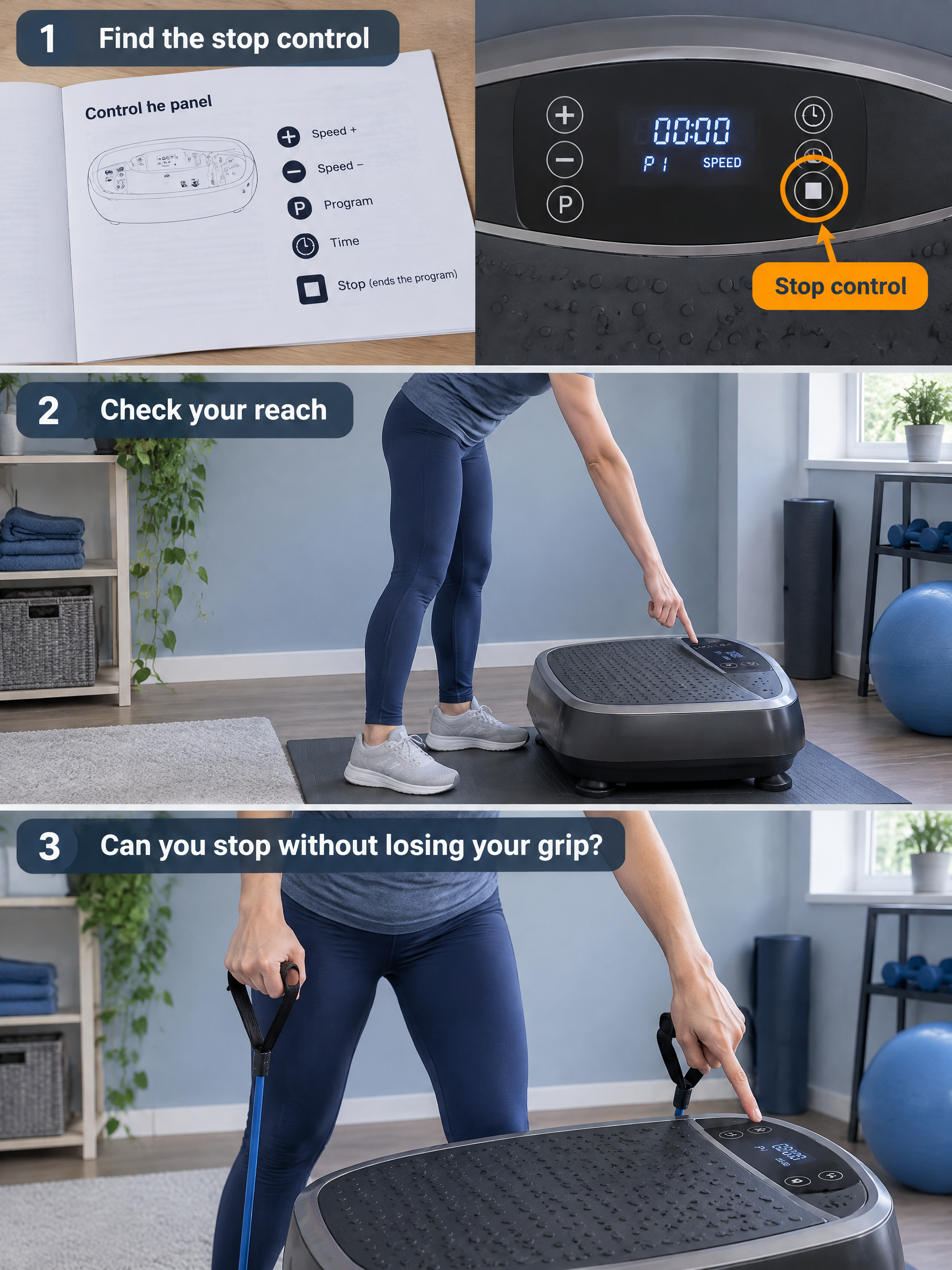
Use a short, side-on power-off rehearsal to show whether the user can reach the stop control from their intended stance without awkward bending or losing needed support. Keep the return plan static so the dates and conditions are easy to scan.
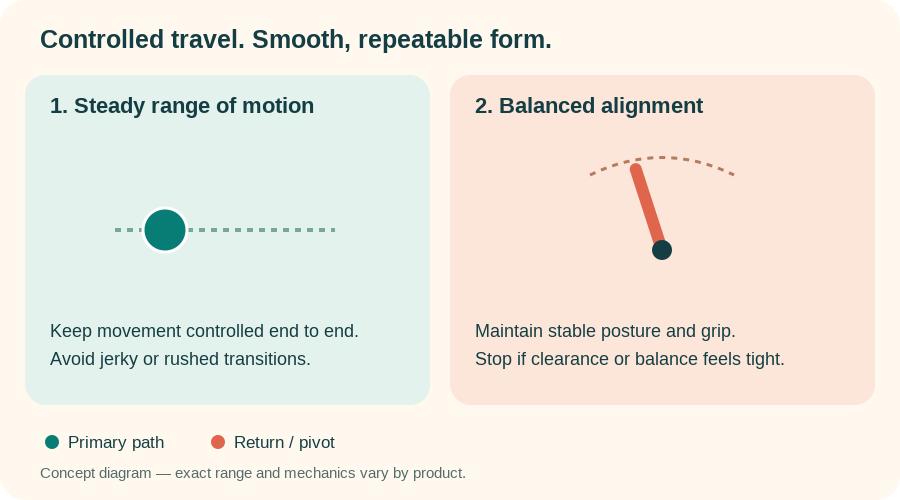
Simplified motion diagram. Exact range and mechanics vary by product.
- Locate the stop control
Find it in the manual or ask for a demonstration before you step onto the deck.
- Rehearse with the power off
From the position you’d use, check whether you can reach the panel or operate the remote without awkward bending or reaching.
- Account for occupied hands
If you’ll hold bands or a rail, work out how you’ll stop the machine without losing your grip. Rule out a setup that makes this awkward.
Measure the exercise area, not just the storage spot
Mark the plate’s listed exterior footprint on the floor. Leave a clear approach and enough room to step off without backing into furniture. If you’ll use bands, allow for arm movement too. For a corded plate, check that the cord reaches an outlet without crossing that path. Use the manual to confirm floor and clearance requirements, and check the usable standing area separately: the outside dimensions aren’t the size of the deck you can stand on.
Low-profile doesn’t mean light. The MERACH CV30 is listed at 4.7 inches high and 13.2 pounds, while the Lifepro Rumblex 4D is listed at 6.3 inches high and 38.5 pounds. The upright MERACH Vibration Plate with Handle is listed at 42.1 inches high. With an upright model, check clearance through the handle’s adjustment range and measure the spot where it’ll sit when assembled.
Picture setup on a busy day. A plate that fits under the bed may still be awkward to pull out and carry. If it’ll stay out, make sure it won’t block a walkway. In a shared home, consider what someone in the next room or downstairs might feel through the floor as well as what you hear beside the machine. A listing that says “quiet” doesn’t tell you how it’ll sound in your home.
Choose your next step
Which model fits your needs?
See the differences, tradeoffs and who each model suits.
Compare the products →Set a budget around features you’ll actually use
Start with the exact model’s listed maximum weight recommendation, usable deck space for your intended activity, and controls you can reach comfortably. The MERACH V33 Pro, for example, lists both touch and remote controls. A remote can spare you from bending down to reach a panel, but it may be less convenient if your hands are already holding bands. Pay extra for presets, Bluetooth, or lighting only if you can say how you’ll use them. More settings or higher wattage doesn’t tell you whether you’ll like the motion or how much noise it’ll make.
Budget for delivery and anything you’ll need that isn’t included. Then price the possibility that it doesn’t work out. A return window isn’t much help if the seller won’t take opened equipment or if return freight and a restocking fee eat up the savings.
Read the written warranty separately from the return policy. The standard Lifepro Waver lists “Lifetime Support,” which isn’t the same as a promise of lifetime repairs. The MERACH V33 Pro lists a one-year warranty, but the duration alone doesn’t tell you which failures qualify or who pays to ship it for service.
Plan a return before you unpack
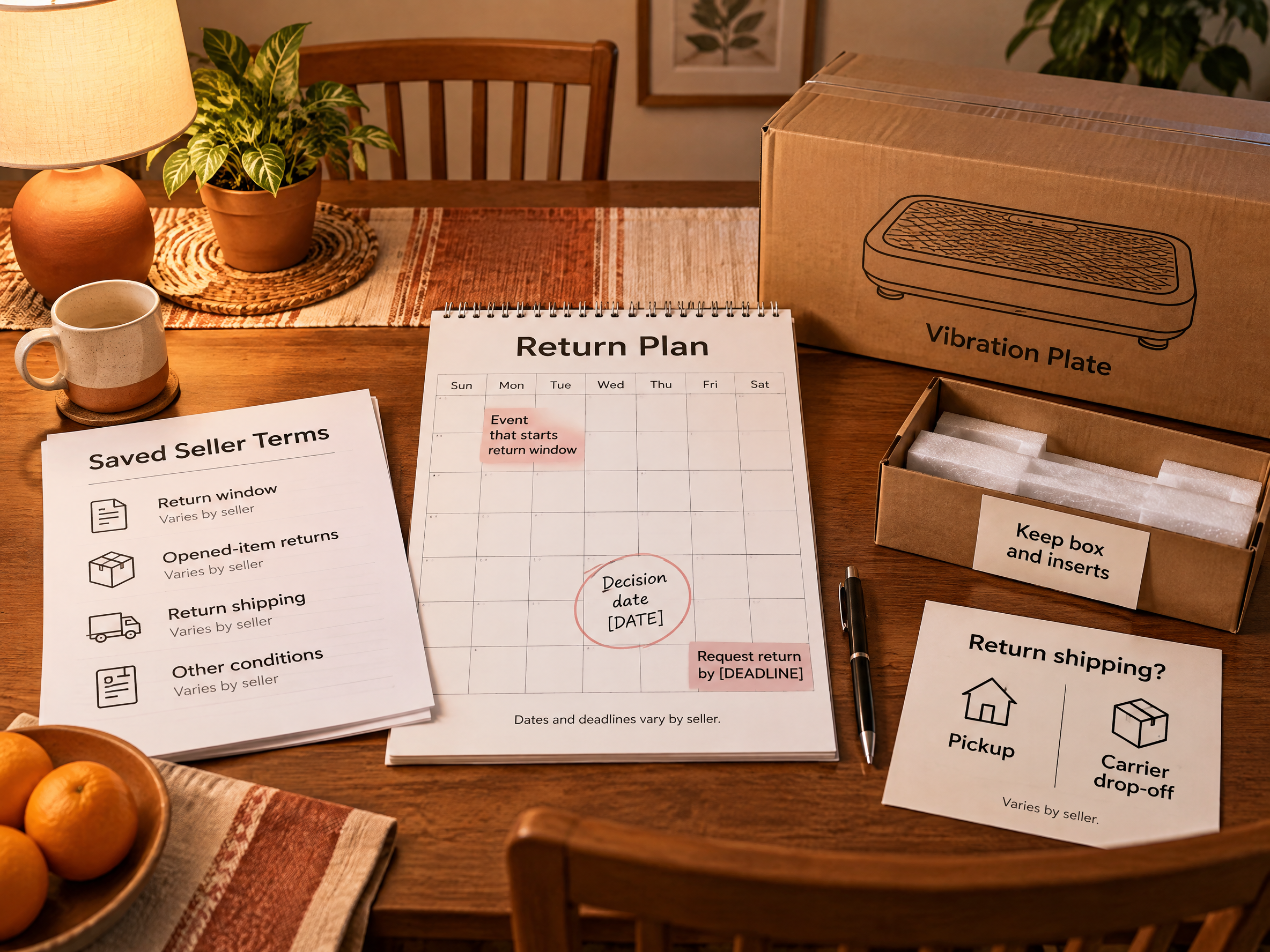
- Save the seller’s terms
Keep a copy of the policy and note what starts the return clock: the order date, delivery, or another date.
- Set a decision date
If opened-item returns are allowed, leave enough time to try the plate in your normal routine and request a return before the deadline.
- Keep the packaging
Save the box and inserts until you decide. Find out whether the seller offers pickup or expects you to take the machine to a carrier.
Try the lower-cost alternative first
Use one of the time slots you picked for a familiar floor-based or resistance-band session. You don’t need to buy bands if you already know bodyweight movements you’re comfortable doing. If that session gives you the variety you wanted, skip the machine. If you keep missing the time slot, adjust your schedule before spending money on equipment.
If the motion is still the draw, ask a gym or studio whether you can try a plate. If it’s appropriate for you, ask staff to show you how to get on and off and operate the controls. Judge whether you’d look forward to repeating the session after the novelty wears off. Occasional access may be enough, even if you like it.
When it’s better to hold off
Don’t order while safe access, storage, noise tolerance, or return terms are still open questions. If balance or medical suitability is a concern, check with a qualified clinician before trying or buying one. An adjustable handle gives you something to hold; it doesn’t establish that stepping onto a moving platform is appropriate for you.
If the purchase only makes sense because you expect a particular health outcome, wait. A seller’s health claim isn’t enough to establish that the machine will deliver the result you’re counting on.
Questions before you commit
Can I use a vibration plate on carpet?
Use it on carpet only if the manual allows it and the plate sits flat without rocking. Don’t assume a rug or soft mat is an acceptable way to cut noise; check what the manufacturer permits for that model.
Does a remote mean the plate itself runs on batteries?
No. The standard Lifepro Waver, for example, lists a remote and a corded power supply. If the listing mentions batteries without saying what they power, check the manual before planning an outlet-free setup.
Can I use a vibration plate while I work at a standing desk?
Don’t assume a regular plate is suitable for use while typing. Check the manual for permitted activities and make sure the desk doesn’t block your step-off path. If you need to steady yourself or watch your footing, use the plate separately from work.
Is a used vibration plate a sensible way to save money?
It can be if you can see it working and the savings are worth potentially giving up returns or warranty coverage. Ask the seller to show that it starts, changes settings, and stops, then inspect the deck, feet, and cord for damage. Confirm that any needed remote is included and check whether the warranty transfers.
Choose your next step
Put your shortlist side by side
See the differences, tradeoffs and who each model suits.
Compare the products →Your next step
- Name the activity you’ll do and when you’ll do it.
- Measure the usable deck, clear step-off area, cord route, and storage spot.
- Decide whether the machine is light enough for your setup and whether noise could be a problem.
- Confirm the listed weight recommendation and that you can comfortably reach the controls.
- Check the full purchase cost, opened-item return terms, and written warranty.
If you’re ready to buy, take your measurements, must-have features, and spending limit to the model roundup. Rule out anything that doesn’t fit those constraints before comparing settings.