Review101
Do You Need a Kettlebell? What to Consider Before Buying
A kettlebell is worth considering if you want to practice swings at home or need several specific loads without storing several weights. If your dumbbells already cover your workouts, you may not need one.
Read the article
Some links may earn us a commission, at no extra cost to you. How we’re supported
In this article 6 sections
Start with your needs
Stick with your dumbbells if they cover the movements and loads you’ve planned.
Borrow a bell or use one at the gym if you’re unsure about the grip, load, or movement.
Once you have a clear use and a suitable training spot, rule out options that skip a working load or don’t give you the pair you need.
As an Amazon Associate, we earn from qualifying purchases. Research-based analysis; no hands-on testing.
The short answer
Buy when you know what you’ll train, which load you’ll use, and where you can move safely. Keep your current weights if they cover the plan. If the grip, load, or movement is still a question, try a kettlebell before buying.
Worth considering if
- Home exercisers who want to practice kettlebell swings or cleans regularly.
- People who’ve tried a kettlebell and prefer its grip or balance for a movement they already train.
- People who need several specific loads and have room for one adjustable but not several fixed bells.
Hold off if
- Your current weights cover the program you follow.
- You don’t have clear training space or a secure place to store the bell.
- You’re tempted by a bundle but don’t know which weights you’d use.
Choose your next step
Ready to compare?
See the differences, tradeoffs and who each model suits.
Compare the products →


Which exercises would you use it for?
Look at the workout you’re likely to do next week. For goblet squats, one-arm rows, and suitcase carries, a dumbbell is enough if it gives you a suitable load and a grip you can control. A kettlebell may feel different in those exercises, but that alone isn’t a reason to replace equipment you already use.
A kettlebell’s handle sits above its body, so the weight hangs below your hand when you pick it up. A handle with enough room for both hands can suit two-handed swings, while the offset weight changes how the bell moves and how it rests against your forearm in a clean. If you want to learn those skills, practice with a kettlebell. If you simply want to train a hip hinge, a dumbbell Romanian deadlift can do that without teaching you the swing.
Find a starting weight for your main exercise
See the movement
Follow the controlled hip-hinge swing arc and steady vertical press path.
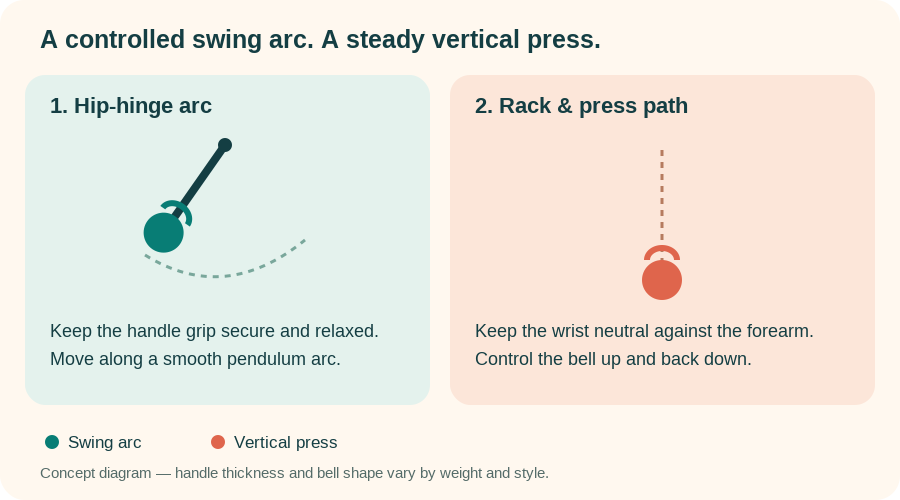
Simplified motion diagram. Handle thickness and bell shape vary by style.
- Choose the movement
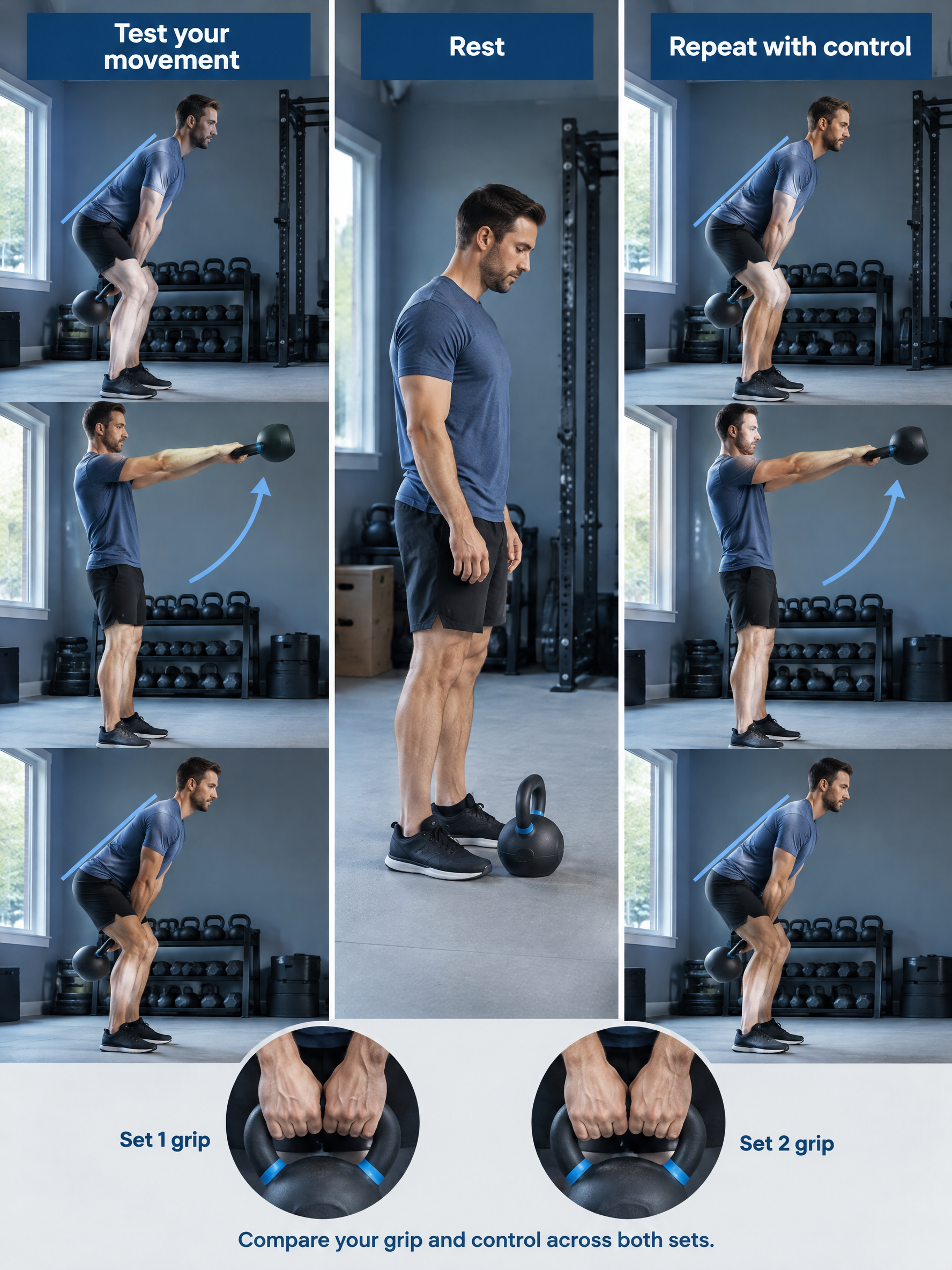
Test the exercise that’s driving the purchase. A load you can row isn’t automatically the right load to swing.
- Try a short set
Start with a manageable weight. Check whether your grip and control stay steady from the first rep through the set-down.
- Repeat after a rest
See whether you can repeat the set with the same control. Choose a load that fits the sets you plan to do, not the heaviest bell you can lift once.
Do you have room to train, not just to store it?
Walk through each planned movement without a weight. For swings, check the space in front of you and behind your legs. For carries, check the route and where you’ll turn. For overhead work, look up for light fixtures or fans. Leave room for the bell itself and choose a spot where people and pets won’t cross its path.
Use a level surface with secure footing and somewhere to set the bell down under control. If you need to protect the floor, use a firm mat that stays put. Don’t count on a coating or soft shell to protect the floor if you drop the weight.
Use listing dimensions to check storage, not exercise clearance. One fixed bell is listed at 7.9 × 4.6 × 9 inches; a light adjustable is about 8 × 8 × 13 inches. The adjustable takes one storage spot, but it’s wider and taller than that fixed bell. A five-piece cast-iron set totaling 75 pounds poses a different problem: you need room for all five on a surface that can support them, without blocking a walkway.
Choose your next step
Which model fits your needs?
See the differences, tradeoffs and who each model suits.
Compare the products →What does each buying route cost you?
Compare the delivered cost of getting the loads you’ll actually use. One fixed bell keeps the purchase simple if it covers your main exercise. Several fixed bells let you switch loads without adjusting anything, but each needs a place to go. An adjustable can save space compared with several separate bells, though changing the load can interrupt a fast circuit.
- One fixed bell: A listing for one 25-pound bell gives you one working load. If it suits your squat but is too heavy for your press, keep using a dumbbell for the press rather than buying another bell by default.
- Several fixed bells or a set: One listed set includes 5, 10, 15, 20, and 25 pounds. A low price per pound won’t save you money if you only use one or two of those weights. A set of different weights also isn’t a matched pair: if your program calls for two equal bells at once, price both at the load you need.
- One adjustable bell: A dial model advertised with six settings across 8–40 pounds offers six choices, not every load in between. Check the exact settings for the version you’re buying and look at the jumps. A broad range isn’t much help if it skips the next weight your program calls for.
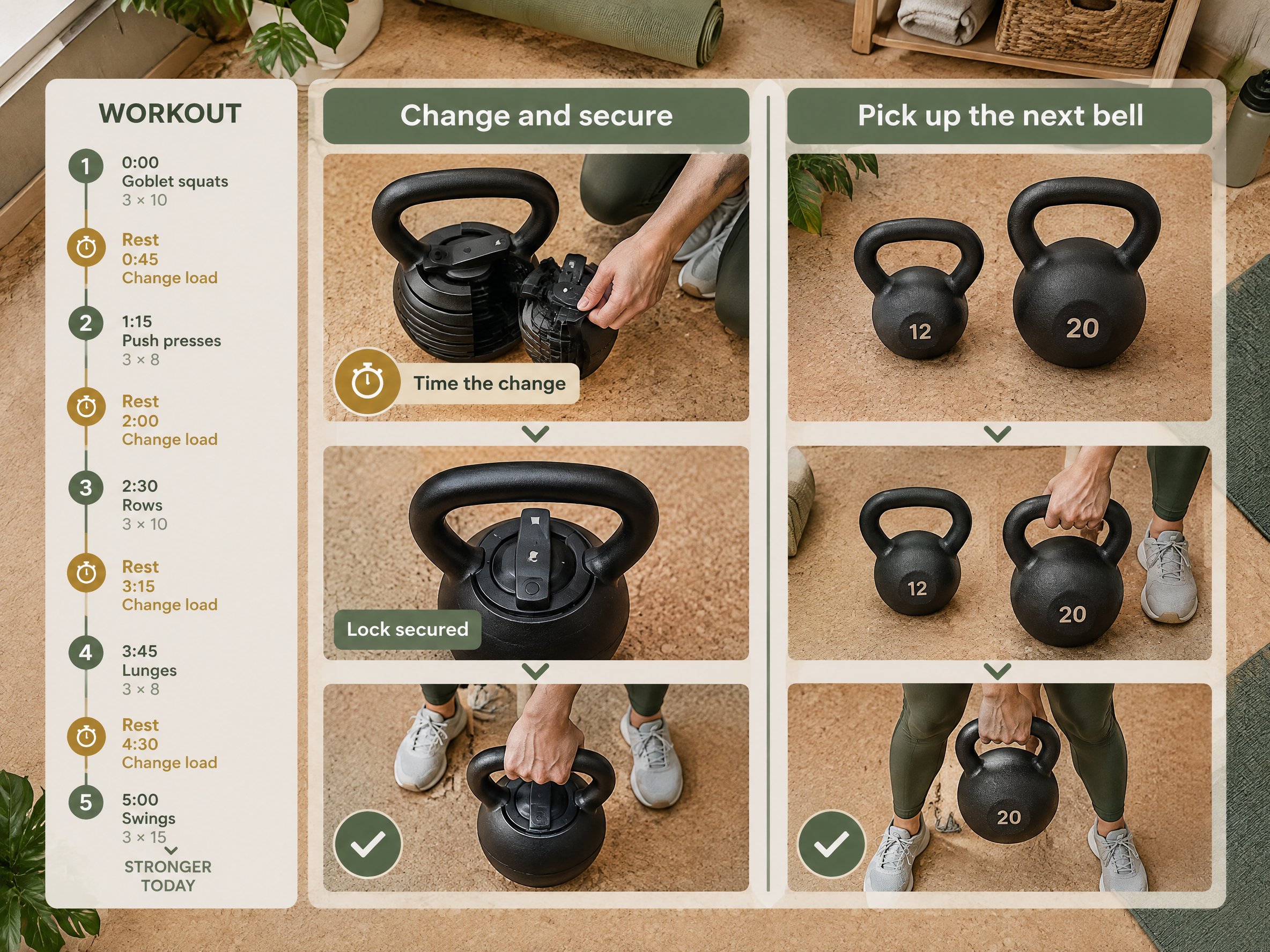
Test whether an adjustable fits your workout
- Mark the load changes
Look at one normal session and mark each time you’d need to change the weight. Note which changes fall during a rest and which happen mid-circuit.
- Try a transition
If you can test the bell, follow the maker’s instructions to change and secure the load. See whether it fits the time you normally take between those exercises.
- Choose what to keep ready
If the changes fit your pace, one adjustable may be enough. If you want two loads ready to pick up, price those two fixed bells before looking at a bigger set.
When to make do, borrow, or wait
You don’t have to choose between an all-dumbbell routine and buying kettlebells. Keep your dumbbells for the work they already cover and use a gym bell for occasional swing practice. If you already have gym access, buying for home makes sense only if having the bell there would help you train more regularly.
Borrow a bell or use a day pass if you’re unsure about the grip or load. A handle that feels comfortable for a one-arm row can feel crowded with both hands on it. If the swing itself is new to you, a coached intro session can help you get familiar with the movement before you judge the weight.
Wait if your only training spot is a busy walkway or you can’t point to a place for the bell in your weekly routine. If you’re ready to shop, use the roundup’s comparison chart to narrow your options by the loads you need, the number of bells, and the room you have.
Questions before you commit
Is it worth buying a used kettlebell?
Yes, especially if you can inspect a fixed bell in person. Pass on a bell with cracks, sharp burrs on the handle, or a base that rocks. For a used adjustable, check that all parts are present and that the mechanism locks as the maker describes before lifting it.
Does a wider handle automatically feel better?
No. The opening inside the handle and the thickness of the part you wrap your fingers around are different measurements. If you can’t try the bell in person, check both measurements rather than relying on the words “wide handle.”
What if my first kettlebell starts to feel too light?
Keep it if it still suits other exercises. On controlled movements such as rows or squats, adding reps or a brief pause may be enough if it fits your program. When you do need more load, buy the next weight you’ll use rather than replacing the whole setup.
How much maintenance does a kettlebell need?
For a fixed bell, wipe the handle dry after training and store it somewhere dry. For an adjustable, follow the maker’s care instructions and check that the selector or fastener is secure before lifting. Stop using it if the weight no longer locks as intended.
Choose your next step
Put your shortlist side by side
See the differences, tradeoffs and who each model suits.
Compare the products →Your next step
- Name the exercise you’ll use the bell for regularly.
- Check movement clearance, footing, and where you’ll set it down.
- Measure the storage spot and make sure it can support the weight.
- Verify the exact loads and whether you need one bell or a matched pair.
- Compare the delivered cost with a day pass, borrowing, or using what you own.
A single bell that fits your routine is more useful than a set you have to build a routine around.