 Review101
Kettlebells for Beginners: What They Are and How They Work
A kettlebell is a weight with a loop handle. The weight hangs below your hand, which helps explain why the same bell can hang by your side in a carry, sit close to your chest in a squat, or travel in an arc during a swing.
Read the article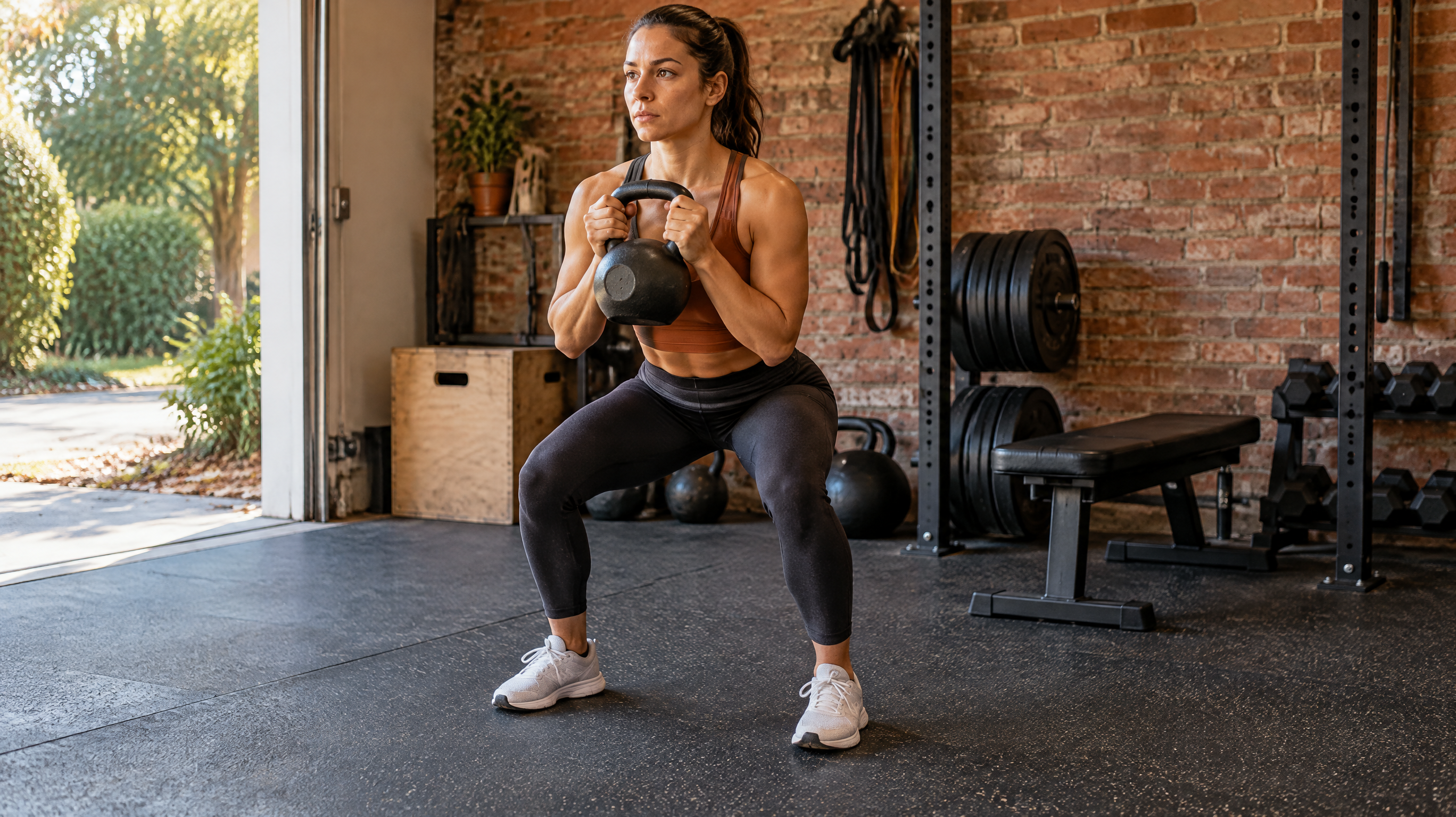
Some links may earn us a commission, at no extra cost to you. How we’re supported
In this article 7 sections
Start with your needs
Try the movement at a gym or in an introductory class before bringing a bell home.
Stick with dumbbells if they already feel comfortable for those exercises.
Judge the space by where the bell and your feet will travel, not where the bell will sit.
As an Amazon Associate, we earn from qualifying purchases. Research-based analysis; no hands-on testing.
The short answer
You don’t need a kettlebell to start strength training. It’s worth trying if you want one compact weight for several kinds of exercise or you’re curious about swings. If dumbbells already cover the exercises you enjoy, there’s no need to switch.
Worth considering if
- Beginners who want to try hinges, squats, rows, and carries with one compact weight.
- People who want to explore a hip-driven swing as well as slower strength exercises.
Hold off if
- Your current equipment covers the exercises you enjoy and swings don’t interest you.
- You can store a bell but can’t reliably clear enough room to use it.
- You’re unsure how the offset weight will feel and have an opportunity to try one first.
Choose your next step
Ready to compare?
See the differences, tradeoffs and who each model suits.
Compare the products →


What is a kettlebell?
A traditional kettlebell has a rounded, weighted body, a flat base, and a loop handle. The gap between the handle and the body is called the handle opening. It gives your fingers room to wrap around the handle; a wider opening can give both hands room to grip side by side.
Hold a kettlebell by the top of the handle with your arm at your side, and most of the weight sits below your hand. A dumbbell puts weight at both ends of a short handle, on either side of your hand. The kettlebell’s offset weight can hang beneath your grip or pivot around it as the bell changes direction.
Handle diameter tells you how thick the part you grip is, not how wide the opening is. For example, a fixed cast-iron bell may list a 1.5-inch handle diameter without telling you whether both hands will fit comfortably.
What changes when you carry weight on one side?
See the movement
Follow the controlled hip-hinge swing arc and steady vertical press path.
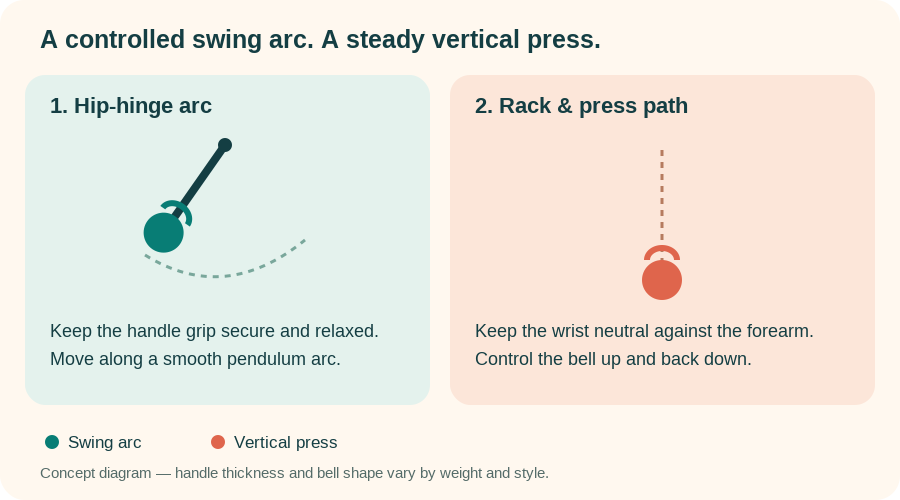
Simplified motion diagram. Handle thickness and bell shape vary by style.
- Picture an even load
With equal weights at your sides, each weight pulls down and their sideways tipping effects balance.
- Remove one weight
The remaining bell still pulls straight down, but it’s off-center, so it tends to tip your torso toward that side.
- Add a few steps
As your feet alternate support, your trunk keeps working to resist the tilt. That’s the core work in a suitcase carry.
Why a kettlebell swing feels different from a deadlift
In a deadlift, the bell starts on the floor, rises mostly straight up as you stand, and returns under control. It’s a hip hinge: your hips bend as your torso tips forward, then straighten as you stand.
A swing uses a hip hinge too, but the hips accelerate the bell so it travels forward in an arc. The bell carries momentum as it rises and swings back between your legs. That change in direction is what makes a swing feel different from a faster deadlift or an arm raise.
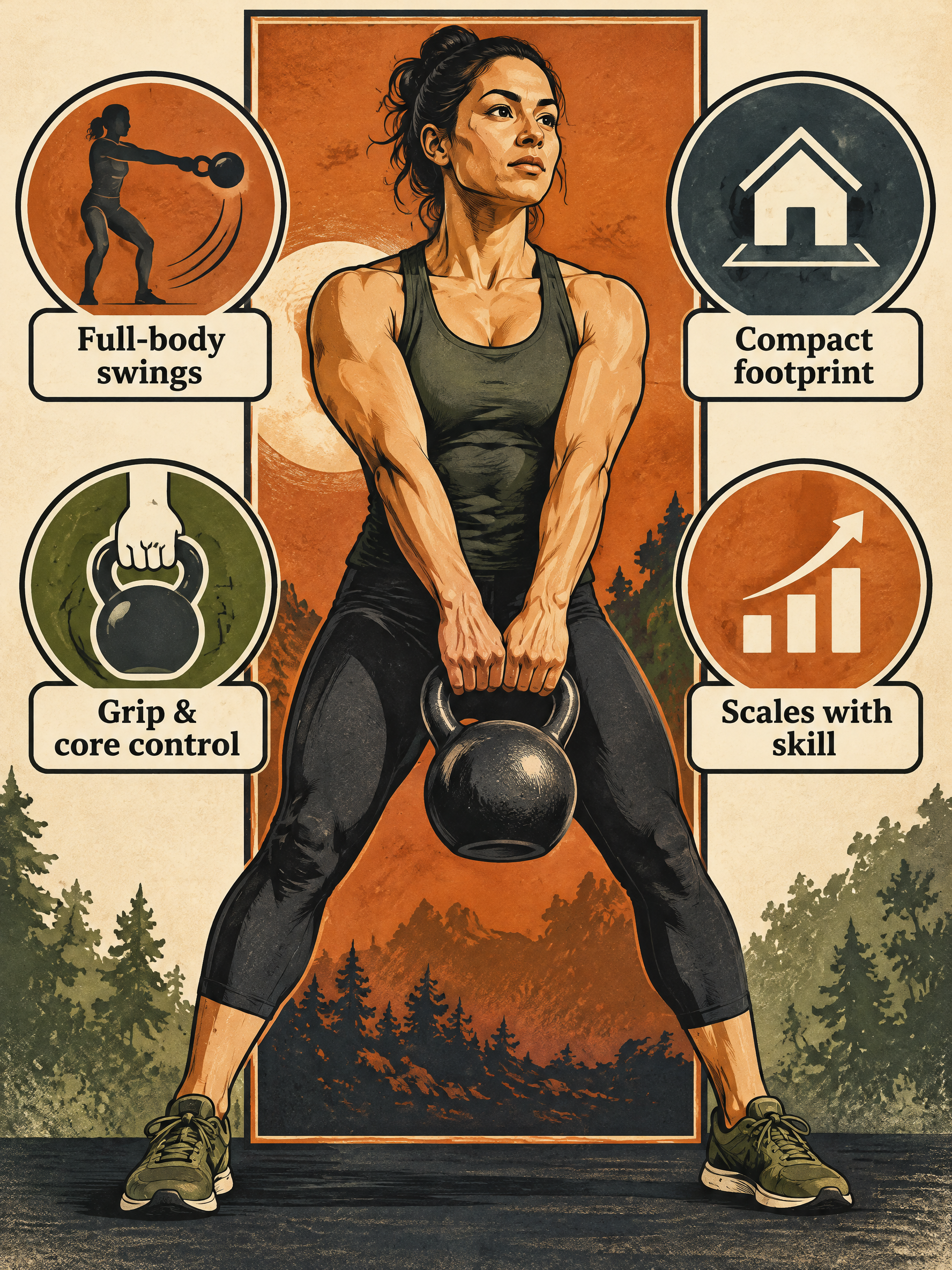
A goblet squat puts the weight in a different place. The bell stays close to your chest as you lower and stand, rather than hanging beneath your hands or swinging away from you.
Choose your next step
Which model fits your needs?
See the differences, tradeoffs and who each model suits.
Compare the products →Fixed kettlebells, sets, and adjustable kettlebells
A fixed kettlebell has one weight. A set bundles separate bells, usually at different weights, so changing the load means picking up a different bell. An adjustable kettlebell offers several loads in one unit. It can save storage space, but changing the weight means using a mechanism, such as a dial, before you lift.
How the bell is built is a separate question. Vinyl can be a coating over solid cast iron. Other bells get their weight from fill: a rigid plastic shell can hold sand, while a soft-sided body can hold iron sand. The outside tells you what you’ll touch, not necessarily what provides the weight.
How to tell whether the handle works for you
- Match the grip to the exercise
A carry can use one hand; a two-handed deadlift gives you a reason to check room for both.
- Check the fit at rest
With the bell supported, see whether your fingers can wrap comfortably without crowding each other or pressing into the body.
- Notice where the weight hangs
If a light bell is available, try a brief hold. You’re finding out how the hanging weight feels without having to learn a swing at the same time.
What can you do with one kettlebell?
A kettlebell lets you practice several movement patterns without switching equipment. A deadlift or swing is a hinge, while a goblet squat is a squat with the load in front of you. In a one-arm row, you pull the bell toward your side. In a carry, you walk with the weight instead of lifting and lowering it on each rep.
A carry with the bell in one hand is called a suitcase carry. It gives your trunk work to do even though you aren’t bending or twisting on purpose. The practical limit of using one bell for everything is that the same load won’t feel the same across exercises: a weight you can deadlift comfortably may be too heavy for a one-arm row.
What using a kettlebell at home involves
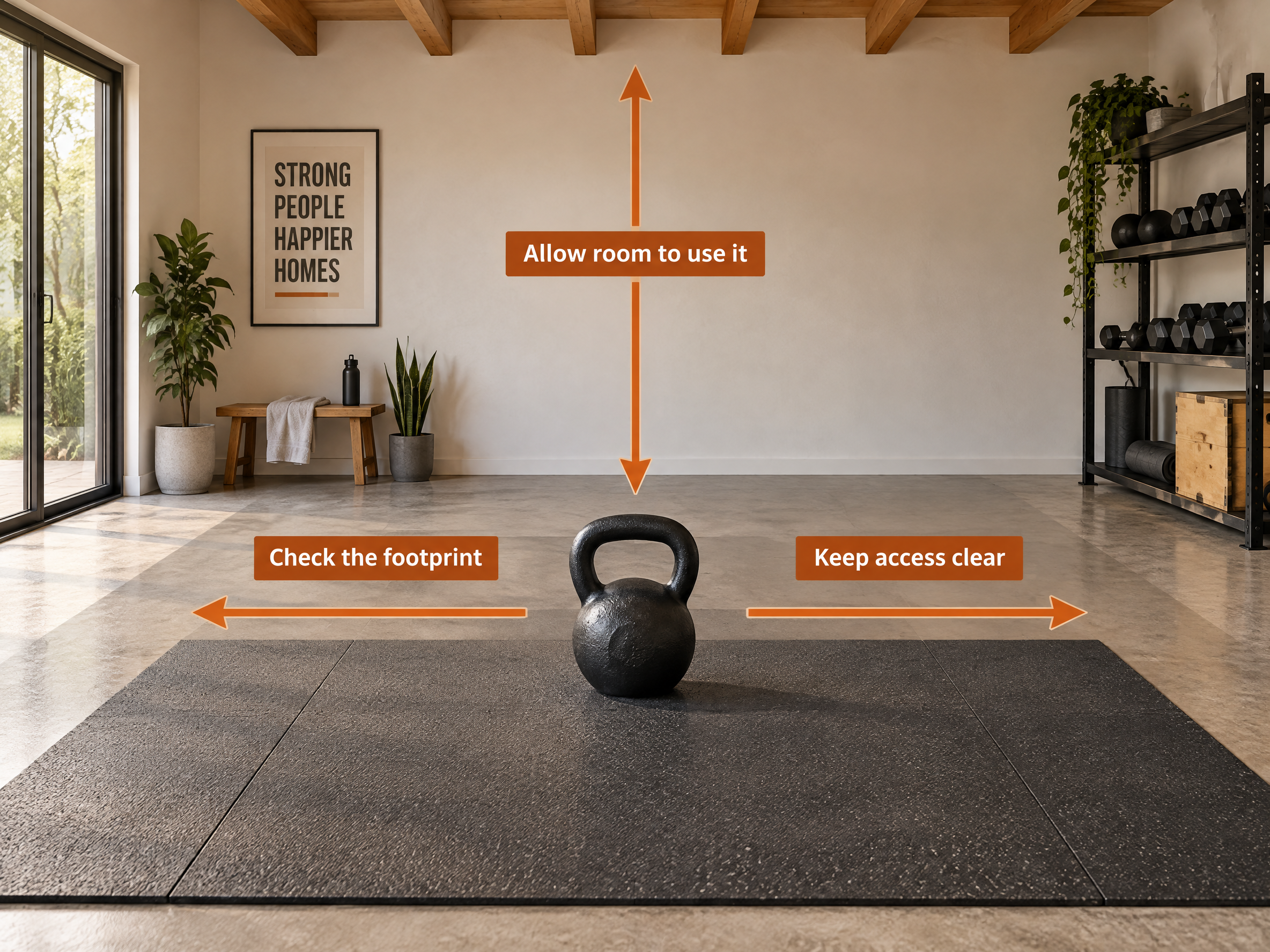
A bell takes up little room in storage, but the exercise determines how much floor space you need. A deadlift needs a stable spot to set the weight down. A carry needs a clear walking path, and a swing needs open space in front of and behind you. In a shared room, think about who might walk through while you’re moving the bell.
If you already have dumbbells, you can use them for deadlifts, goblet squats, rows, and suitcase carries. Resistance bands are another compact option for controlled movements such as rows, though a band pulls as it stretches rather than hanging from your hand. If swings are the main attraction but home space is tight, a gym or introductory class gives you a place to explore the movement without owning a bell.
Questions before you commit
Do I need two kettlebells that match?
No. One bell is enough for a two-handed deadlift or a one-arm row. A matching pair is useful when an exercise calls for a separate, equal weight in each hand at the same time.
Can I use a kettlebell on a hardwood floor?
Yes, if you have a stable surface and set the bell down gently. A firm exercise mat can help prevent scuffs, but don’t count on a mat, a coating, or a soft-sided bell to protect the floor from a drop.
Do kettlebells need much maintenance?
A fixed bell usually needs little upkeep: wipe off sweat and put it away dry. With an adjustable bell, follow the maker’s care instructions and confirm the selected load is secured before lifting.
Can I tell what weight will feel right from my dumbbells?
Use a familiar dumbbell weight as a reference, not a rule. The same number on a kettlebell can feel different because the weight sits farther from your grip in some positions. If you can try a bell, judge the load by how manageable it feels in the exercise you actually want to do.
Choose your next step
Put your shortlist side by side
See the differences, tradeoffs and who each model suits.
Compare the products →Your next step
- Name two exercises you’d actually put in your routine.
- Note which ones you can already do with your current equipment.
- Find a stable place to set the bell down and check the space the movement needs.
- Identify a dry storage spot out of walkways.
Think about a workout you’d actually do next week. That’s a better test of whether a kettlebell belongs in your routine than a long list of exercises it could do.