 Review101
What Is a Power Rack? A Beginner’s Guide to Home-Gym Racks and Cages
A power rack holds a barbell at a convenient starting height and gives it a place to land if you miss a rep. You still move and balance the bar. Here’s how that setup works and when it’s worth making room for one.
Read the article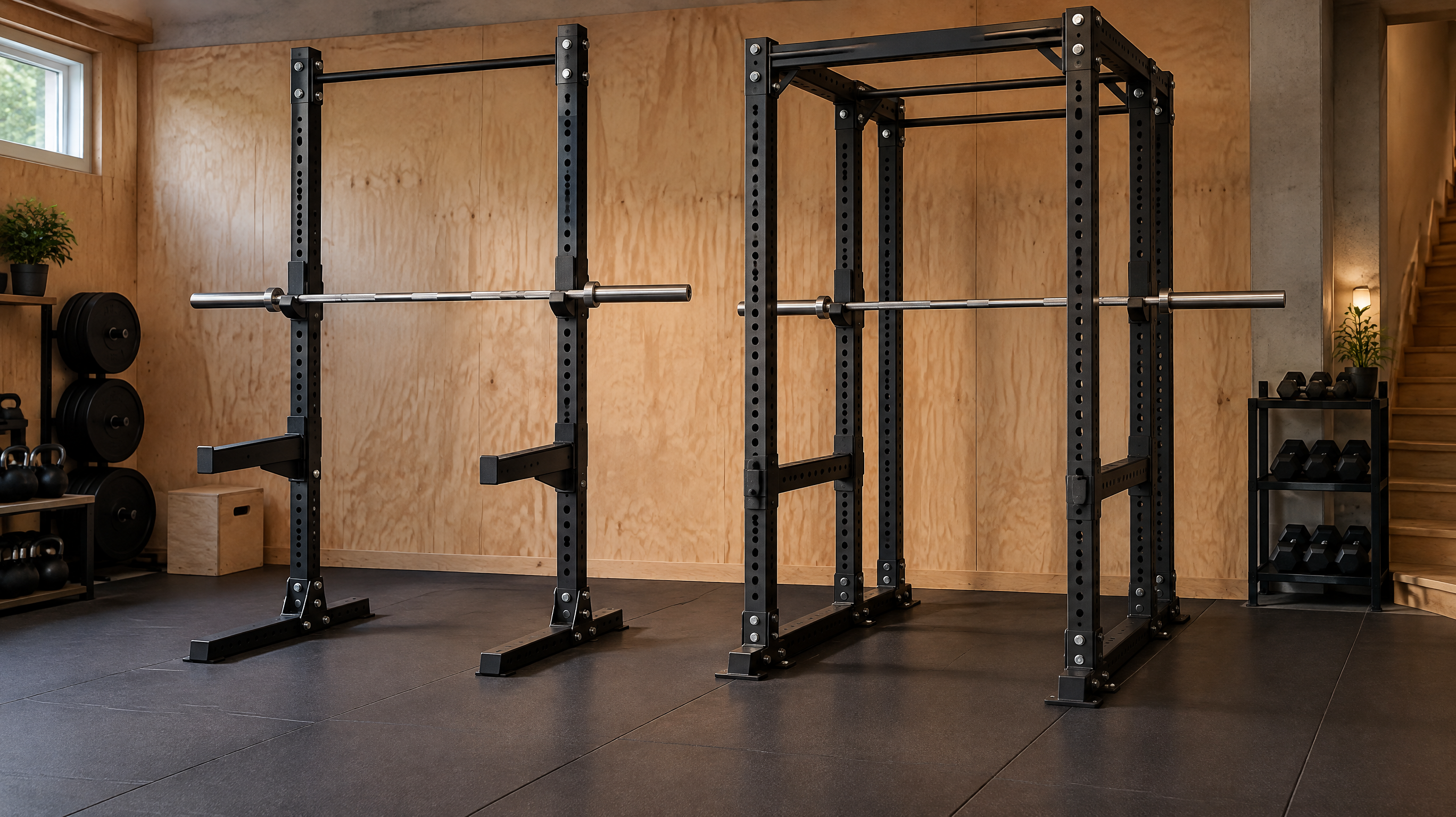
Some links may earn us a commission, at no extra cost to you. How we’re supported
In this article 7 sections
Start with your needs
Consider one if you already squat or press with a barbell regularly and want the same setup at home.
Run your planned routine at a gym and notice which catches, hook settings, and attachments you actually use.
Keep the floor space if dumbbells and a bench already cover your workouts.
As an Amazon Associate, we earn from qualifying purchases. Research-based analysis; no hands-on testing.
The short answer
A power rack is worth considering if barbell squats or presses are a regular part of your home workouts. If dumbbells already cover your routine or you’re new to barbell training, try a rack at a gym before giving one space at home.
Worth considering if
- Home lifters who regularly squat or press with a free barbell
- Solo lifters who can install the rack as directed and set catches that work for their lifts
- People who want barbell and cable exercises at one station and have room to use both
Hold off if
- You’re still finding out whether you like barbell training.
- You can’t confirm the required anchoring or working clearance.
- You mainly want one cable exercise and wouldn’t use the barbell station.
Choose your next step
Ready to compare?
See the differences, tradeoffs and who each model suits.
Compare the products →


What a power rack does—and what it doesn’t
A power rack is a frame with two sets of supports that do different jobs. Adjustable J-hooks hold the bar before and after a set so you don’t have to lift it from the floor to get into position. Lower supports, called safeties or catches, can receive the bar if you can’t finish a rep and it comes down within their reach. Depending on the rack, those catches may be bars, straps, or projecting spotter arms.
Once you unrack the bar, you control its path and balance. A Smith machine, by contrast, guides its bar along rails. A power rack doesn’t steer a free barbell, and even properly set catches don’t make every missed rep safe.
Check whether an open rack covers your lifting area
See the movement
Use a locked-off clip to show the rack moving from open to folded as directed, with required gear removed first. End on the remaining wall projection and a car-door clearance check.
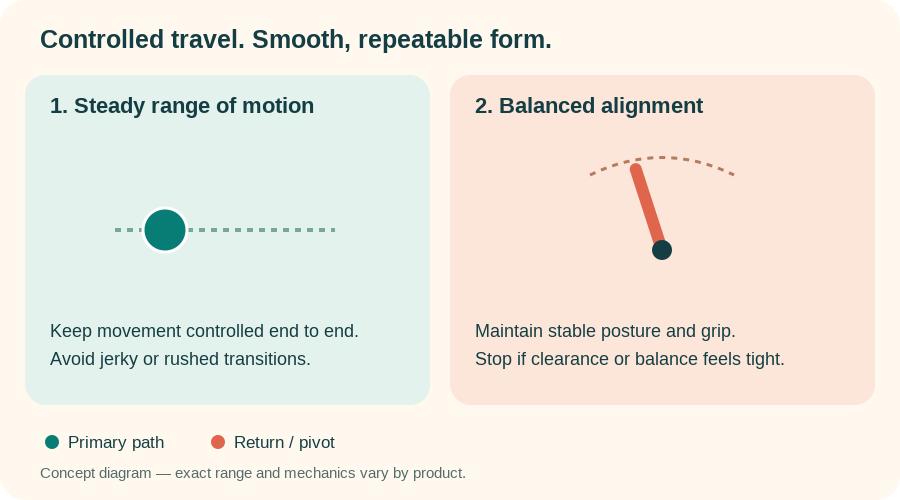
Simplified motion diagram. Exact range and mechanics vary by product.
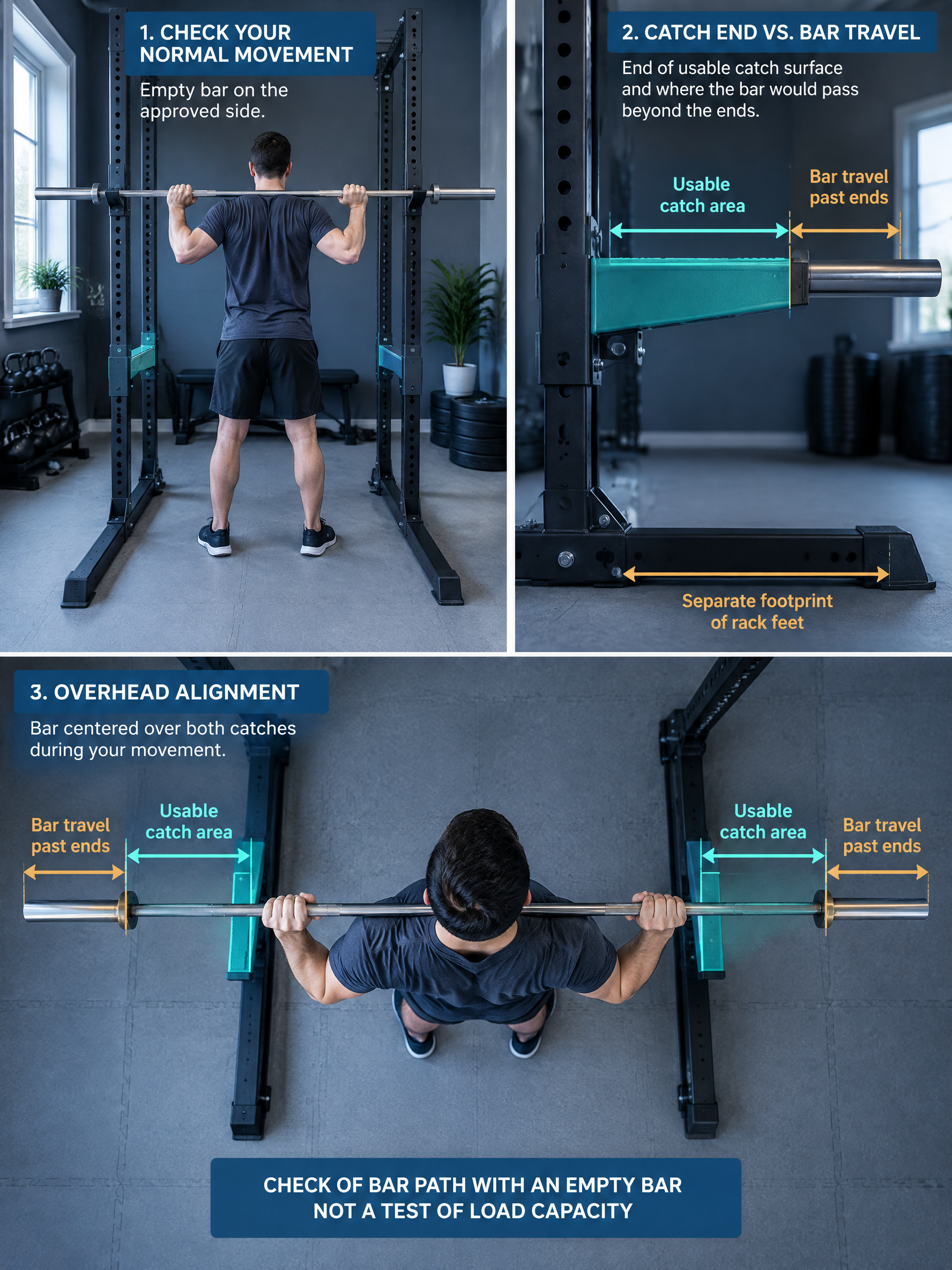
- Find the approved lifting side
Use the manual to identify where the catches mount and which side of the uprights the manufacturer intends you to lift on.
- Look at the catch itself
Check how far its usable surface projects from the upright. The rack’s feet may extend farther than the catch.
- Check your bar path unloaded
With the rack installed as directed, see whether the empty bar stays over both catches during your normal movement. If it travels past the ends, don’t count on those catches in that position.
Follow the bar through a squat or bench press
For a squat, the hooks hold the bar just below where it sits when you stand upright. You lift it clear of the hooks, move into the area covered by the catches, and return it to both hooks at the end of the set. The catches sit just below the lowest point the bar reaches in a normal rep so it doesn’t hit them unless it goes lower.
For a bench press, you bring a bench into the lifting area and lower the hooks so you can unrack and rerack the bar while lying down. The catches need to let the bar complete a normal rep while still giving it a place to rest clear of you if you can’t rerack it. Check both with an unloaded bar and the bench you’ll actually use. If no setting does both jobs, don’t rely on that setup for solo benching.
Choose your next step
Which model fits your needs?
See the differences, tradeoffs and who each model suits.
Compare the products →Full cage, half rack, or folding wall rack?
Look at where you’ll lift relative to the uprights. That tells you more about where the bar can land than the words “rack” or “cage” on a listing.
- Full cage: You typically lift inside four main uprights, with catches spanning from front to back on each side. The Goimu DP01 is an example of a cage listed with J-hooks and a safety bar.
- Half rack: You typically lift in front of the main uprights, over spotter arms that project into the lifting area. Rear posts may hold plates without enclosing the space where you lift. SunHome labels one model a half power cage, but that label doesn’t tell you which catches are included.
- Folding wall rack: The frame folds toward the wall when you’re done. Folding describes how it stores, not where the catches reach or what they can support. Mikolo lists a folding variant with safety catches; confirm the hardware, catch limits, and approved wall installation for the exact version you’re considering.
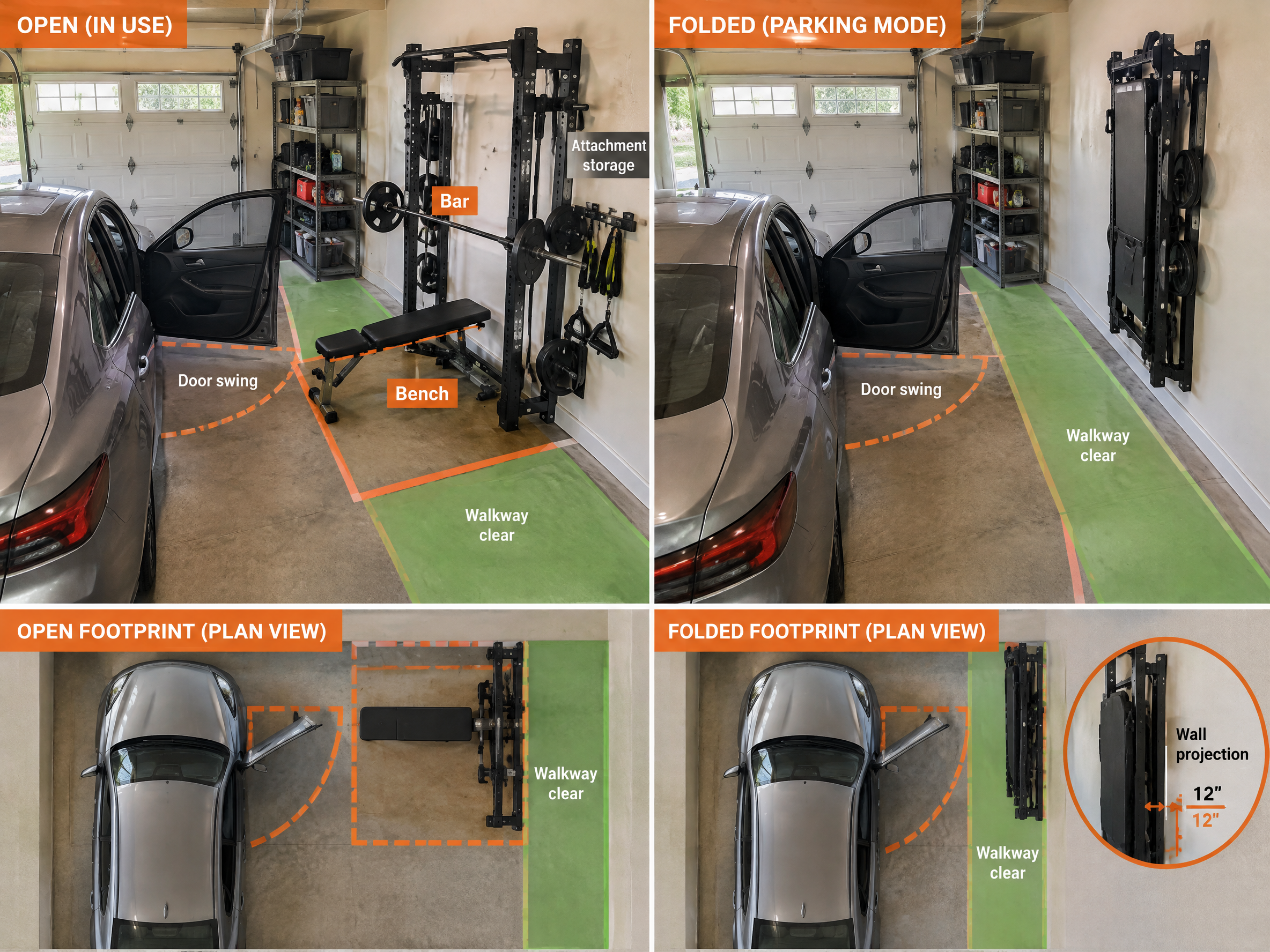
Find out whether folding will free up the room
- Mark both positions
Use the manufacturer’s dimensions to tape out the open footprint and the space the frame still occupies when folded.
- Try the room’s other job
Check whether a car door can swing open or whether you can still reach storage and use the walkway with the rack folded.
- Give loose gear a home
Decide where the bench, bar, and any attachments you need to remove will go. The frame can fold away without freeing the room.
What changes when you add pulleys?
A pulley redirects the cable so you can pull a handle down or toward you while lifting resistance elsewhere on the rack. A lat pulldown usually uses one overhead outlet. A cable crossover uses two separated outlets so you can pull a handle from each side toward the middle.
With independently loaded sides, either hand can move its own resistance without moving the other handle, and you can set different loads on each side. Two tracks may simply guide one shared weight carriage, and two included handles aren’t proof of separate loading. SPORTSROYALS lists a lat pulldown bar and two cable handles; OPPSDECOR explicitly lists a dual-pulley crossover. To tell whether either side loads independently, check the cable routing in the manual for the exact model.
What a rack adds to a home gym
The everyday benefit is repeatability. Note the hook and catch positions for each lift and you won’t have to find them from scratch every time. Numbered heights, like those listed on the Sunny Health & Fitness Power Zone rack, make those settings easier to record. A pull-up bar, dip handles, or pulleys can add exercises at the same station, but they’re only worth paying for if you’ll use them.
Ownership means assembly, any required anchoring, and periodic checks that hardware is tight, catches seat properly, and cables aren’t worn or out of their tracks. Follow the manual for your model. Measure the space you’ll use, not just the space the frame occupies: you need room to move the bench and stand at both ends of the bar to load plates.
If you mainly want more exercise options, adjustable dumbbells and a bench may be enough. If you want to do barbell lifts but only occasionally, gym access may make more sense. Once you know which lifts you want to do at home, use the rack evaluation guide to check room fit, installation, and component limits before you buy.
Questions before you commit
Will the barbell I already own fit a power rack?
Check the distance between the bar’s inner sleeve collars against the span across the outside edges of the J-hooks. The shaft needs to rest securely on both hooks with the collars clear of them. Overall bar length alone won’t tell you, especially with a shorter bar.
Do I need to buy the barbell, plates, and bench separately?
Budget for them separately unless the exact bundle lists them. A lat pulldown bar is a cable attachment, not the barbell you squat with. If you’re only setting up for squats, you don’t need a bench.
Can I put a rack on rubber mats instead of bolting it down?
No, mats aren’t a substitute for anchoring when the manufacturer requires it. Check the instructions for the exact rack and the floor or wall you plan to attach it to. If you rent and can’t get permission, look for a setup approved for use without that anchoring or train elsewhere.
Can I add another brand’s spotter arms later?
Only if you can confirm both compatibility and approved use. Matching upright dimensions aren’t enough: check the hole size, pin fit, and how the arm seats against the post. Confirm that the rack manufacturer permits that type of arm in the position where you’ll lift.
Choose your next step
Put your shortlist side by side
See the differences, tradeoffs and who each model suits.
Compare the products →Your next step
- Name the barbell lifts you expect to do regularly.
- Measure the ceiling and working clearance, including room at both ends of the bar.
- Confirm what’s included and check separate limits for hooks, catches, and any cables.
- Read the installation instructions before committing to a wall or floor location.
Choose where you’ll lift and what will catch the bar before deciding whether folding hardware or cables are worth adding.