Review101
What Is a Plyometric Jump Box? How It Works and What the Different Types Do
A plyo box gives you a raised place to land or step. Here’s what that changes about the movement, how the main designs work, and when the floor or a stair will do.
Read the article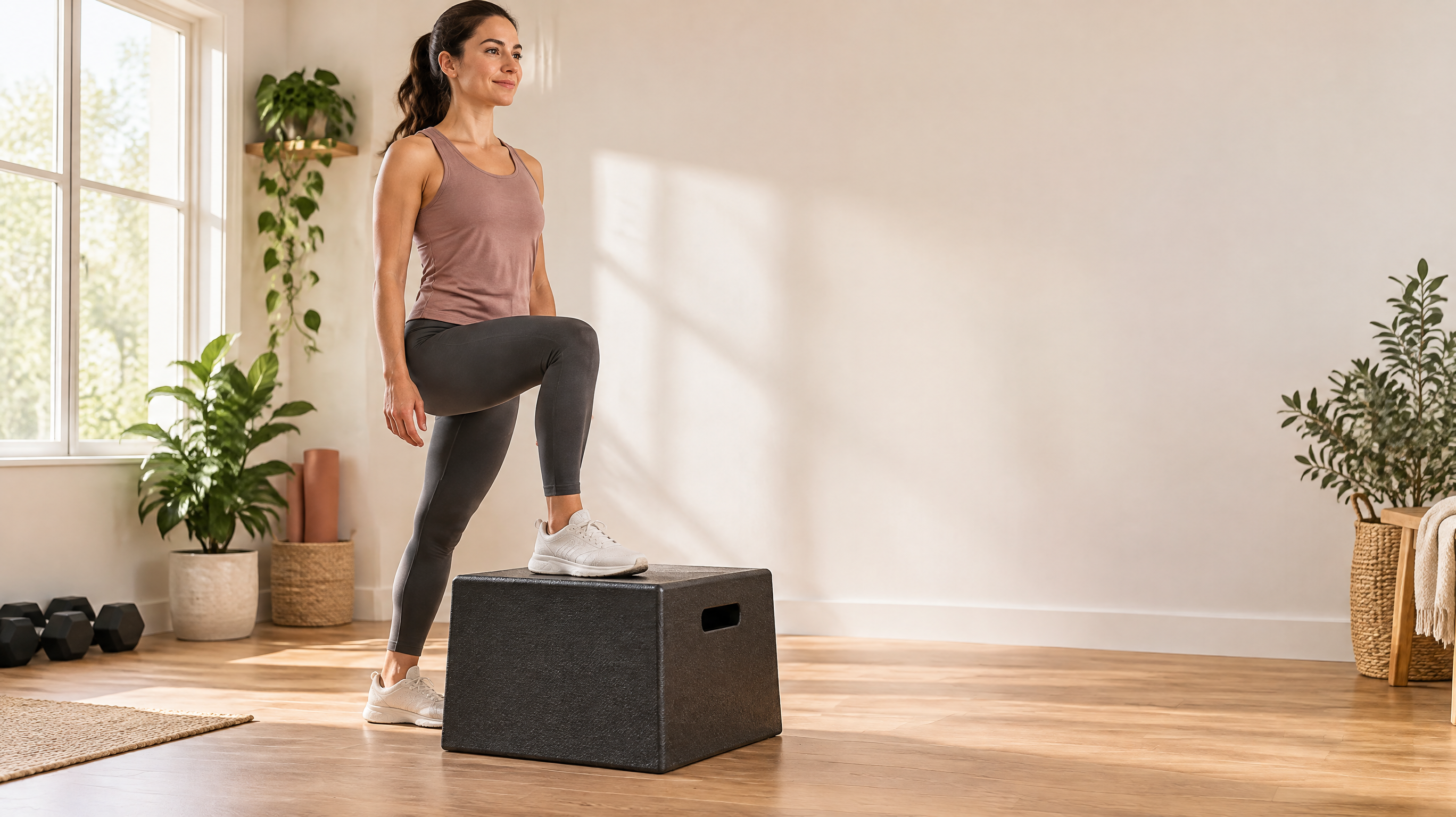
Some links may earn us a commission, at no extra cost to you. How we’re supported
In this article 8 sections
Start with your needs
Use the floor for basic jumps or a suitable bottom stair for controlled step-ups.
Find out whether landing on a raised target is a movement you want to keep doing.
A dedicated platform makes sense if you’ll use it often and can set it up without rearranging the room.
As an Amazon Associate, we earn from qualifying purchases. Research-based analysis; no hands-on testing.
The short answer
You don’t need a plyo box to learn to jump. It’s useful when you regularly want to land above floor level or need a consistent step height and don’t already have a suitable platform.
Worth considering if
- People who already do box jumps and want a consistent landing target at home.
- People who regularly do step-ups but don’t have a suitable stair or platform.
- People who use both movements and have space for one shared platform.
Hold off if
- You’re still finding out whether jumps or step-ups fit your routine.
- You already have easy access to a suitable platform.
- Your available space doesn’t leave a clear path onto and off the box.
Choose your next step
Ready to compare?
See the differences, tradeoffs and who each model suits.
Compare the products →
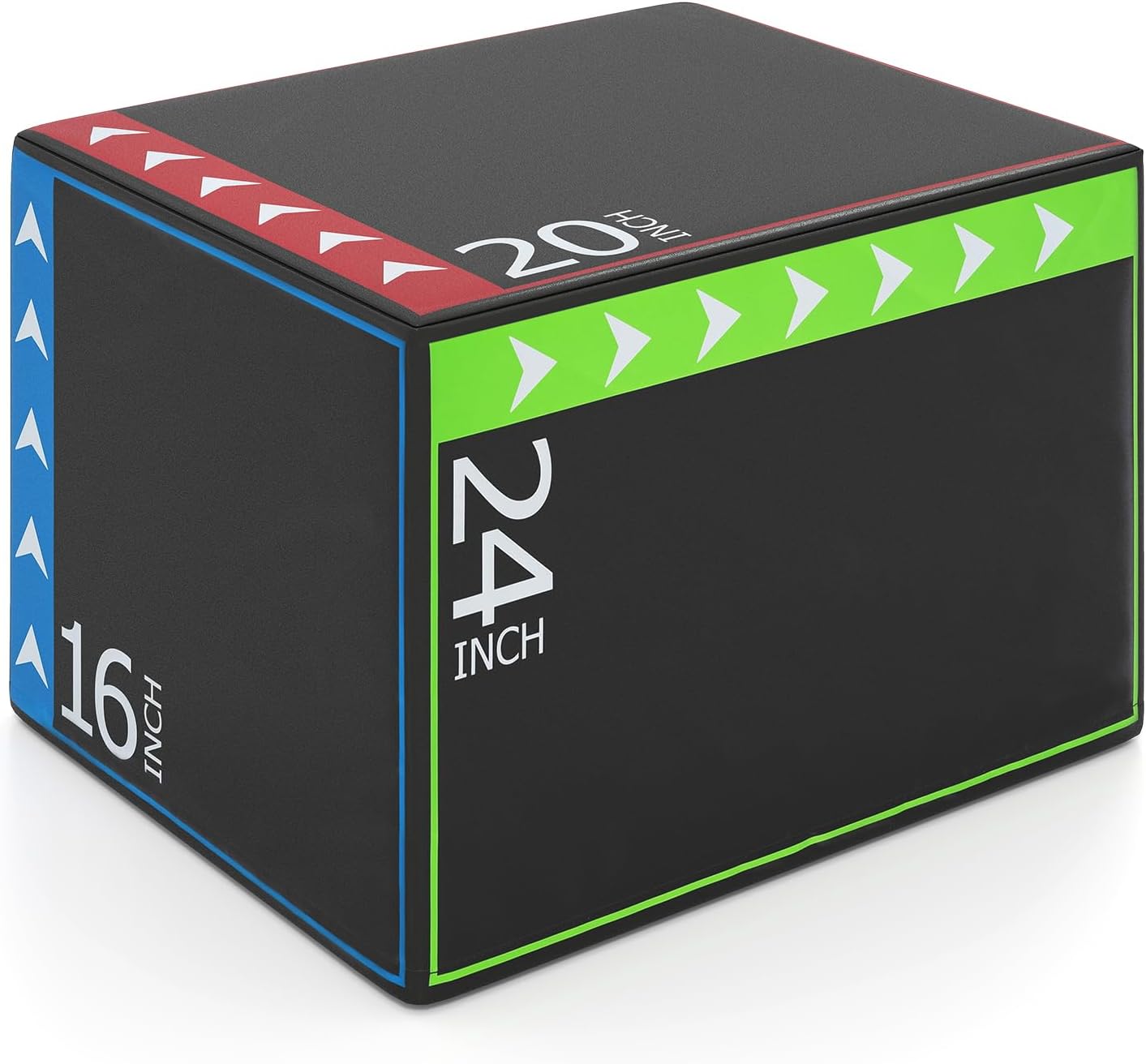

What does a plyometric jump box do?
A plyometric jump box, or plyo box, is a raised exercise platform. It doesn’t push you upward or add resistance like a weight or band. You supply the force. For a jump, the box gives your feet an edge to clear and a surface to land on. For a step-up, it gives your lead foot a place to start.
Height and landing area are separate. Height is the distance from the floor to the top. The width and depth of the top determine how much room you have to place your feet. Two boxes at the same height can give you quite different amounts of room underfoot.
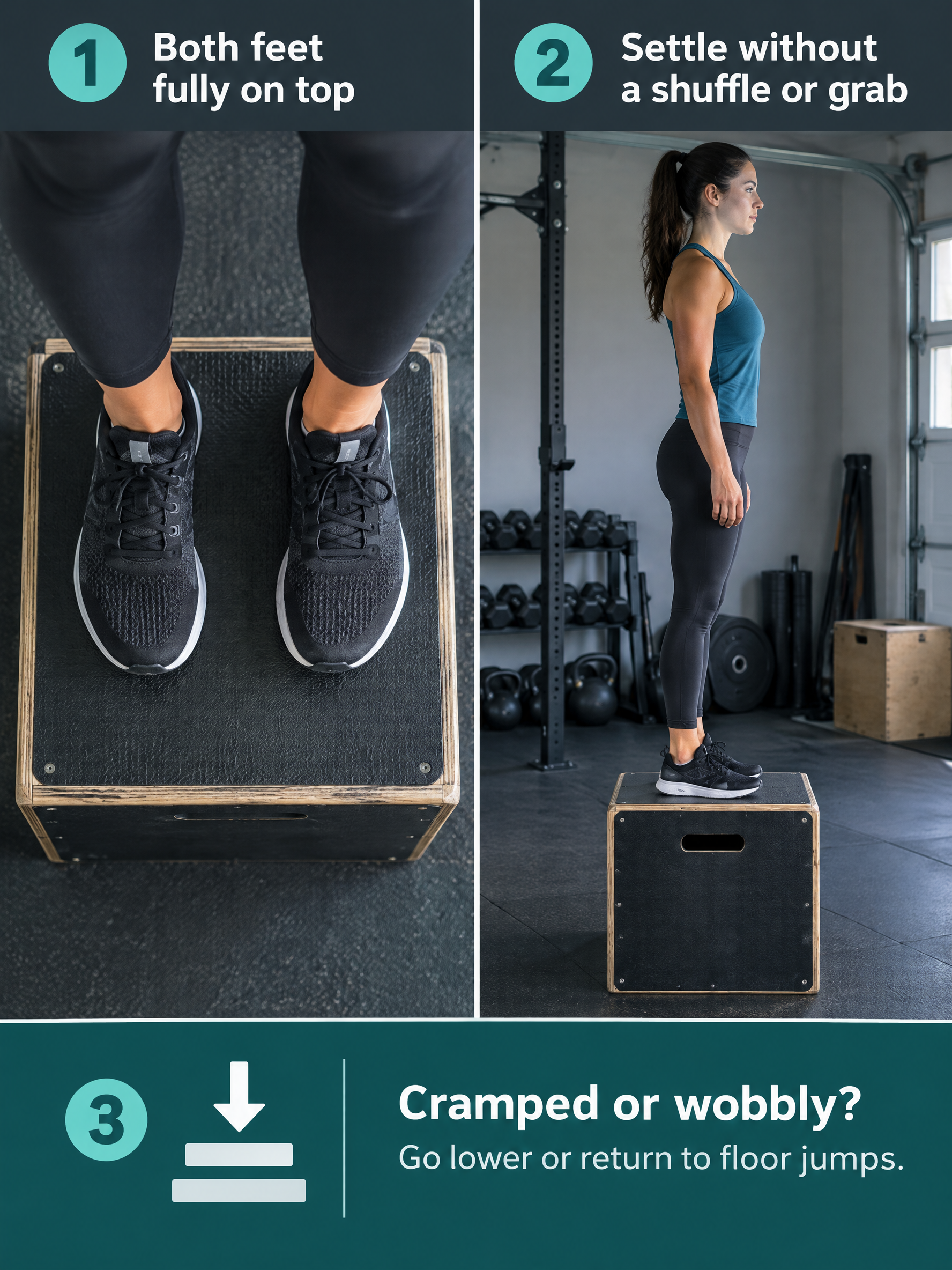
How to judge a box-jump landing
See the movement
Use one continuous three-quarter view of a low box jump: take off, land with both feet fully on top, pause long enough to show a steady finish, then step down into clear floor space. Hold briefly on the landing so viewers can check foot placement.
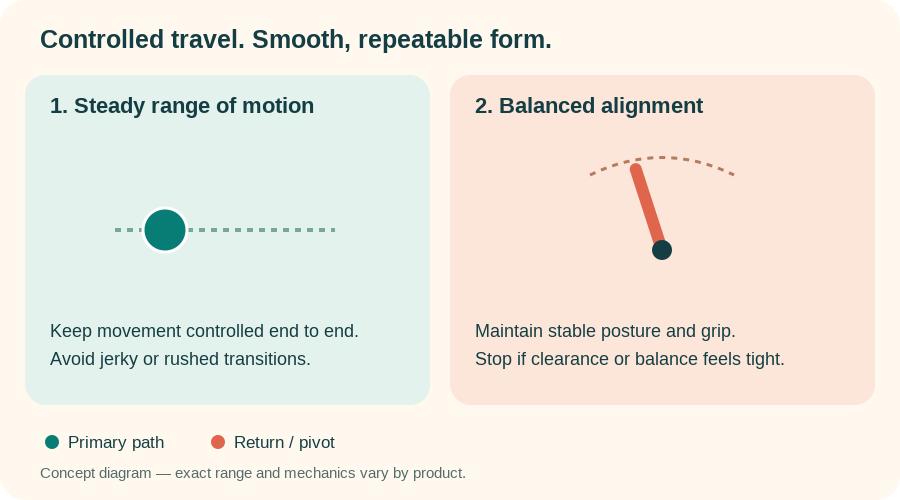
Simplified motion diagram. Exact range and mechanics vary by product.
- Check foot placement
Look for both feet fully supported on top, without toes or heels hanging over an edge.
- Check the finish
Notice whether you can settle without shuffling your feet or grabbing something for balance.
- Choose the next attempt
If the landing is cramped or unsteady, use a lower target or return to floor jumps instead of counting clearance as success.
Box jumps and step-ups are different movements
In a basic two-foot box jump, you dip, push off the floor, and spend a moment in the air. Both feet clear the front edge and come down on the platform. The quick reversal from the dip into an explosive takeoff is the plyometric part; the box is simply where you land.
In a controlled step-up, you place one foot on the platform first, then push through that leg to bring your body up. You don’t need to leave the ground with both feet at once. The same box can be used for both movements, but using it doesn’t make an ordinary step-up plyometric.
Choose your next step
Which model fits your needs?
See the differences, tradeoffs and who each model suits.
Compare the products →Flip, adjust, or stack: three ways to change height
A flip-style 3-in-1 box has three different dimensions. Turn it onto a different side and a different dimension becomes the height. That also changes which face is on top, so a higher setting can give you less landing room.
An adjustable platform changes height through built-in settings rather than by turning the whole box over. You move the platform to the desired position and secure it as directed. With a modular foam system, you change the height by adding or removing compatible sections designed to be used together.
Some sets instead give you separate platforms, each with a fixed height. They may stack to save storage space, but that doesn’t make them a training stack. Use them separately unless the manufacturer explicitly approves a stacked setup for exercise.
How to check whether a room can fit box jumps
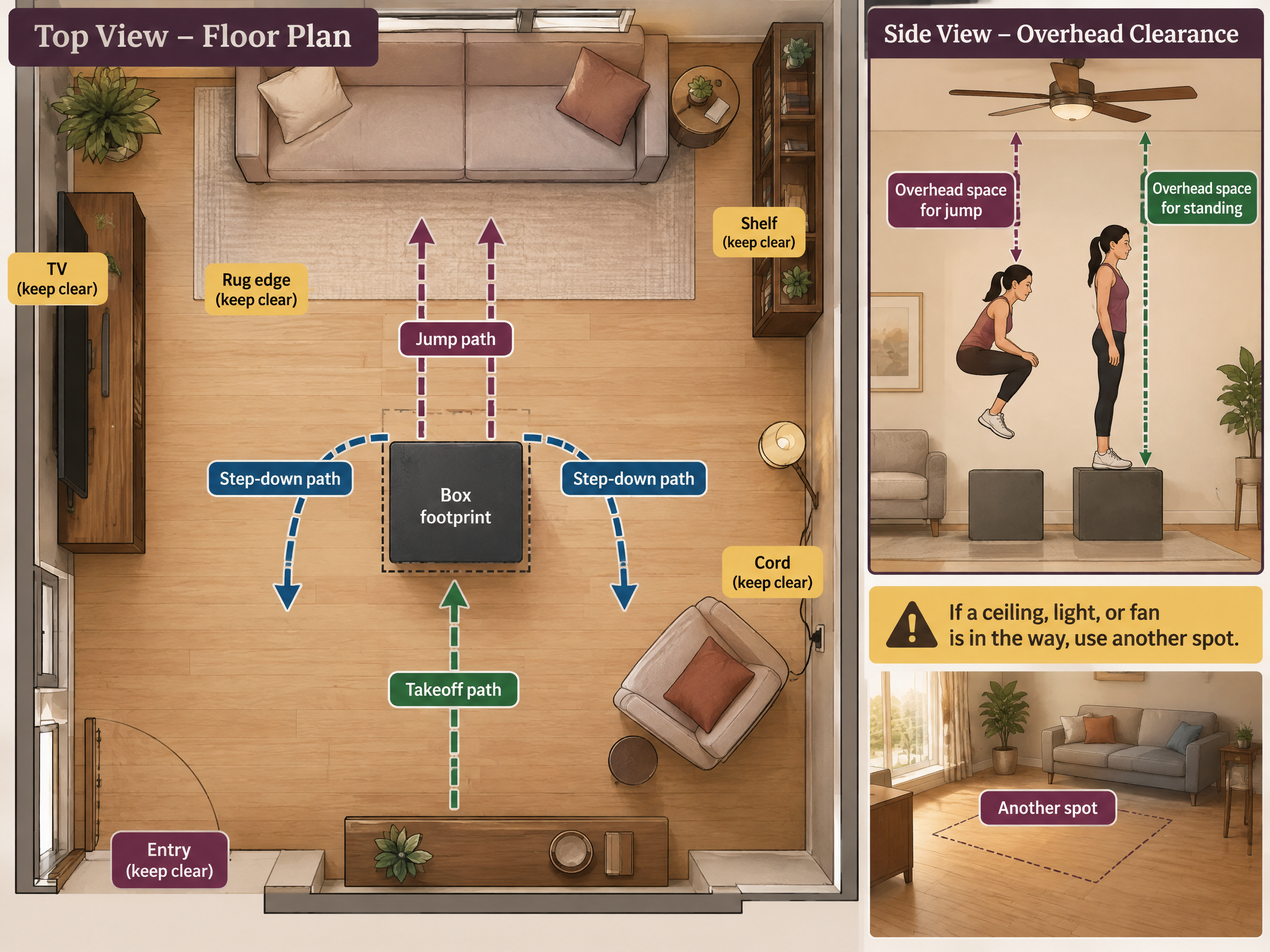
- Mark the footprint
Mark where the base would sit on a level floor. Make sure the spot isn’t crossed by cords or interrupted by a rug edge.
- Trace the path
Leave space to take off and step down without backing into furniture or a wall.
- Look overhead
Account for the height you’ll gain during the jump and when standing on the box. If a ceiling, light, or fan is in the way, use a different spot.
Foam, padded wood, bare wood, and steel
A material label may describe the structure, the padding, or just the surface. A foam box can have a separate outer cover. A padded wood box has a rigid wooden core beneath the padding, while an unpadded wood box has no cushioning layer over its panels. A steel platform can have a metal frame, a separate grip surface on top, and rubber feet underneath.
Your shoes meet the top, your shin might clip an edge, and the base meets the floor. Those are three different points of contact. The word “foam” doesn’t tell you how firm the top feels, and “steel” doesn’t tell you whether the base will grip your floor.
What a raised target adds to a workout
A box makes the target repeatable. You can step or land at the same height from one session to the next, or change it deliberately while keeping the same basic movement. One platform can serve both jumps and step-ups.
Clearing a taller box doesn’t necessarily mean you jumped higher. Tucking your knees lifts your feet relative to your torso, and landing in a deeper crouch can help you get onto the platform. Box height tells you what you cleared, not how far your body rose.
Try the movement before making room for a box
If you want to get comfortable taking off and landing, floor jumps let you explore the movement without clearing an edge. For controlled step-ups, a sturdy bottom stair with room for your whole foot may already do the job. If what interests you is landing on a raised target, try a purpose-built box at a gym rather than improvising with furniture.
At home, think about how the box fits into your routine: will it stay out, or will you move it every session? A box that has to come out of a crowded closet may see less use than one you can set up easily. Keep the contact surfaces clean and check for damage such as a torn cover, loose fasteners, or worn feet before using it.
Questions before you commit
Do I have to jump back down after a box jump?
No. Step down under control if you can comfortably reach the floor. Jumping down adds a separate landing and isn’t required to finish the jump onto the box.
Can I use a weight bench instead?
Skip the weight bench for box jumps unless it’s explicitly designed for them. A bench can support you during a lift and still be too narrow for a two-foot landing or shift if you land near an edge.
Does a listed weight capacity tell me whether I can jump onto the box?
Not by itself. Landing loads the platform differently from standing on it. Check that the manufacturer specifies box jumps as an intended use, and follow its limits rather than guessing how a generic weight rating was tested.
Can I put a mat under a plyo box to make it quieter?
A firm mat may soften noise where the box meets the floor, but it won’t necessarily keep the landing thud from carrying to another room. If the mat bunches or compresses enough for the box to rock or slide, don’t jump on that setup.
Choose your next step
Put your shortlist side by side
See the differences, tradeoffs and who each model suits.
Compare the products →Your next step
- Name the movement you want to do: floor jumps, box jumps, step-ups, or a mix.
- Try it on a suitable surface you already have access to.
- Notice what’s missing, if anything: a raised landing target, a repeatable step height, or simply convenient access.
If a stair or a gym box already fits your routine, there’s no need to make room for another platform at home.