Review101
What Is a Plate-Loaded Smith Machine? A Home Gym Beginner’s Guide
You add weight plates to the bar, and the rails decide where it can go. Here’s what that changes about a lift and what it means to have one at home.
Read the article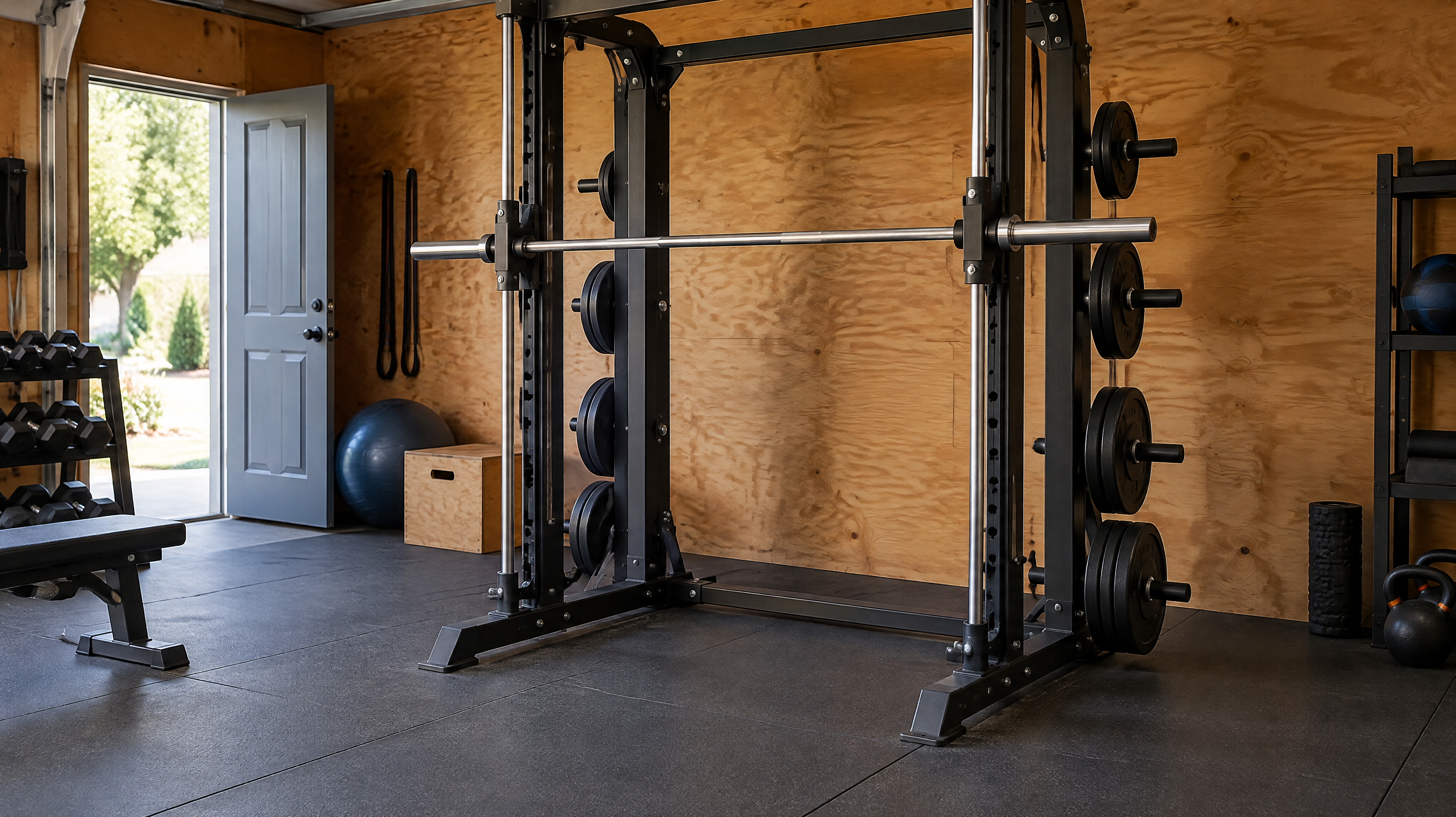
Some links may earn us a commission, at no extra cost to you. How we’re supported
In this article 8 sections
- What makes a Smith machine plate-loaded?
- How the bar moves, hooks in, and stops
- Why an empty Smith bar still has resistance
- Standalone machines, half racks, and all-in-one cages
- What a guided bar changes about a squat or bench press
- What ownership involves in a home gym
- Questions before you commit
- Your next step
Start with your needs
Use a gym’s Smith machine to find out whether you like lifting without steering the bar.
Use a barbell and rack if you want to practice controlling a free bar.
Use dumbbells and a movable bench if the room needs to serve another purpose between sessions.
As an Amazon Associate, we earn from qualifying purchases. Research-based analysis; no hands-on testing.
The short answer
You don’t need a Smith machine to strength train at home. Its main draw is a repeatable bar path that takes some of the work of balancing the bar out of a lift. That can be useful if the path feels natural to you, but it isn’t a substitute for practicing with a free barbell.
Worth considering if
- Lifters who prefer a repeatable path and can find comfortable positions for their usual lifts.
- Home gyms with a dedicated lifting area and room to work around the frame.
Hold off if
- The unloaded bar may already be too heavy, or you can’t confirm its starting resistance.
- Your usual lifts feel awkward when the bar can’t shift with you.
- You need to clear the floor after each session.
Choose your next step
Ready to compare?
See the differences, tradeoffs and who each model suits.
Compare the products →


What makes a Smith machine plate-loaded?
A Smith machine has a built-in bar that travels along guide rails. On a plate-loaded model, you slide removable weight plates onto the loading sleeves at either end of the bar. The sleeves and plates move with the bar. Storage pegs, like those listed on the RitFit half-Smith rack, stay on the frame. Plates parked there don’t make the bar heavier.
A lat pulldown or cable crossover on the same frame is a separate station. It may get resistance from plates on a moving carriage or from a weight stack you adjust with a pin. The phrase “plate-loaded Smith bar” tells you how the bar is loaded, not how any attached cables are loaded.
Trace one rep from the side
See the movement
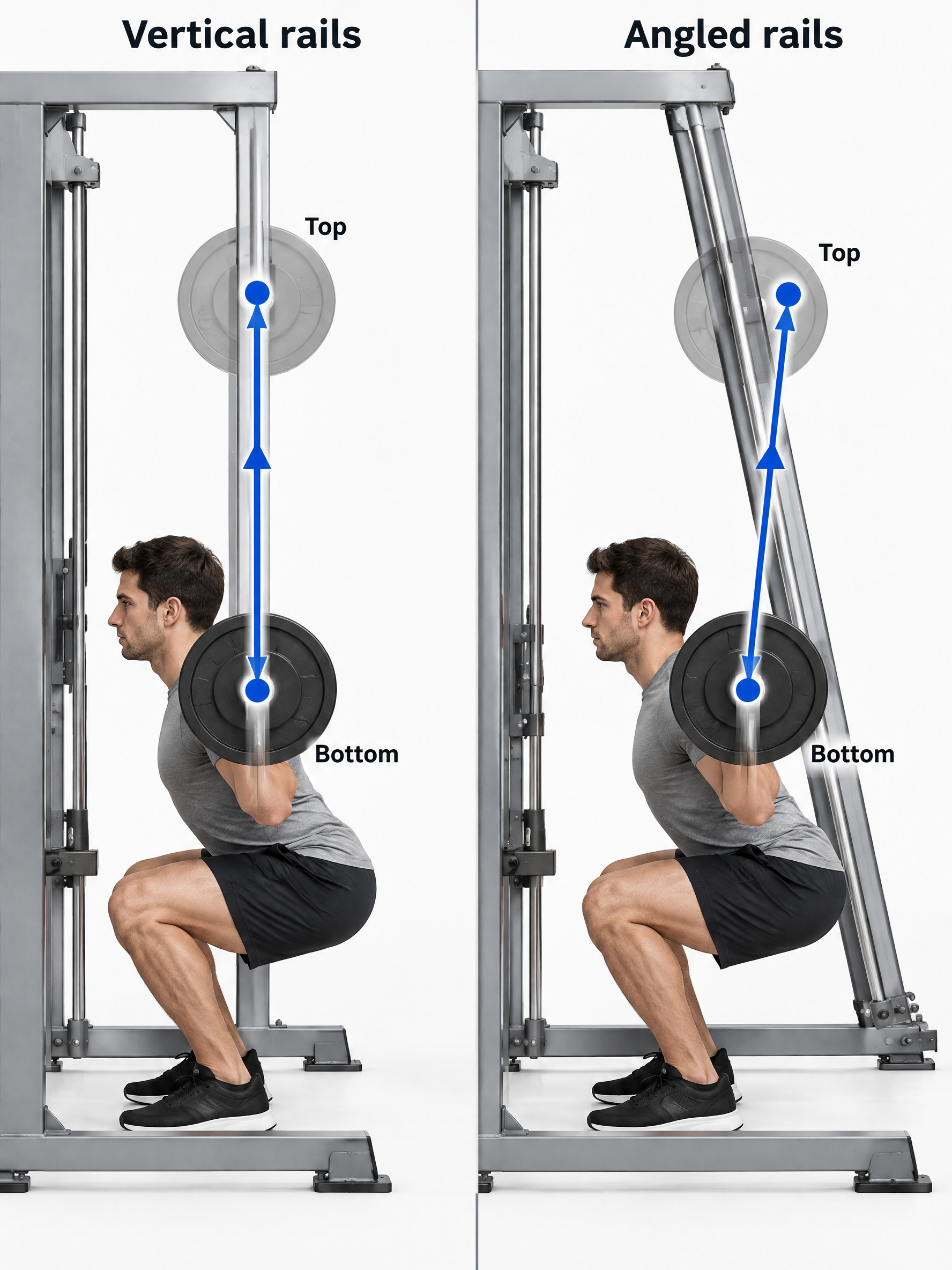
Loop one side-view rep: pause at the bottom dot, move the bar-center marker to the top along the straight rail path, then reverse along the exact same line. Repeat in a separate panel for angled rails.
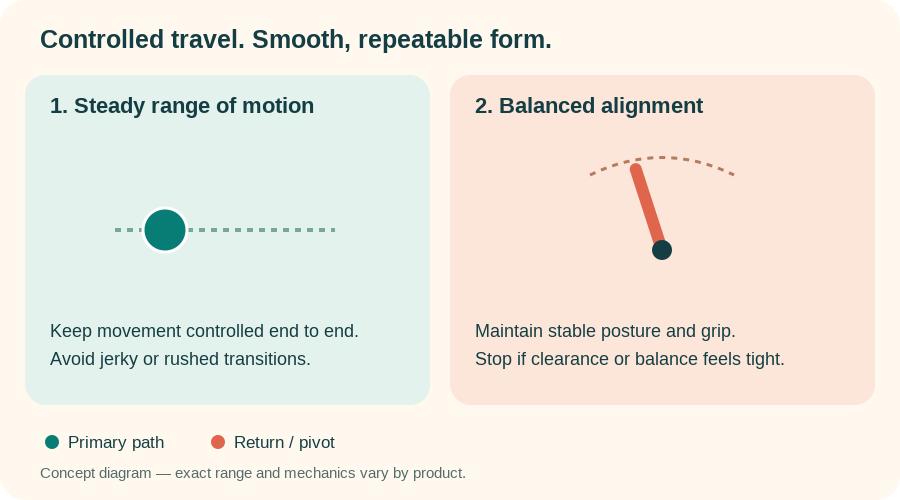
Simplified motion diagram. Exact range and mechanics vary by product.
- Mark the bottom
Start with a dot at the center of the bar at the bottom of the rep.
- Trace the ascent
Place the top dot directly above the first for vertical rails, or higher and offset to one side for angled rails.
- Trace the return
Follow the same line back to the bottom dot. There’s no separate curve on the way down.
How the bar moves, hooks in, and stops
The guide rails set a straight path, either vertical or angled depending on the machine. Linear bearings let the parts that carry the bar slide along the guides. Powertec and the Marcy MD-9010G both list linear bearings, but the term alone doesn’t tell you how smoothly either machine will move.
On a typical Smith machine, a short twist releases the bar’s hooks from the frame. Twist the bar back at a rack point to park it. Separate adjustable stops, on models that have them, set how far the bar can descend even if you haven’t engaged the hooks. Follow the model’s manual and learn how both parts work before adding plates.
Choose your next step
Which model fits your needs?
See the differences, tradeoffs and who each model suits.
Compare the products →Why an empty Smith bar still has resistance
No plates doesn’t mean no load. The bar and the parts that travel with it have weight, but their physical weight isn’t necessarily the force you need to start the bar moving. The angle of the rails and friction can affect that effort. If the machine has a counterbalance, it offsets some of the moving assembly’s weight so you need less force to raise it.
Look for a spec labeled “starting resistance” or “unloaded resistance” rather than assuming a stated bar weight tells you how the bar will feel. The available Powertec P-LBS26 specifications identify the machine and its bearings but don’t give an unloaded starting resistance.
Find what a cable handle actually lifts
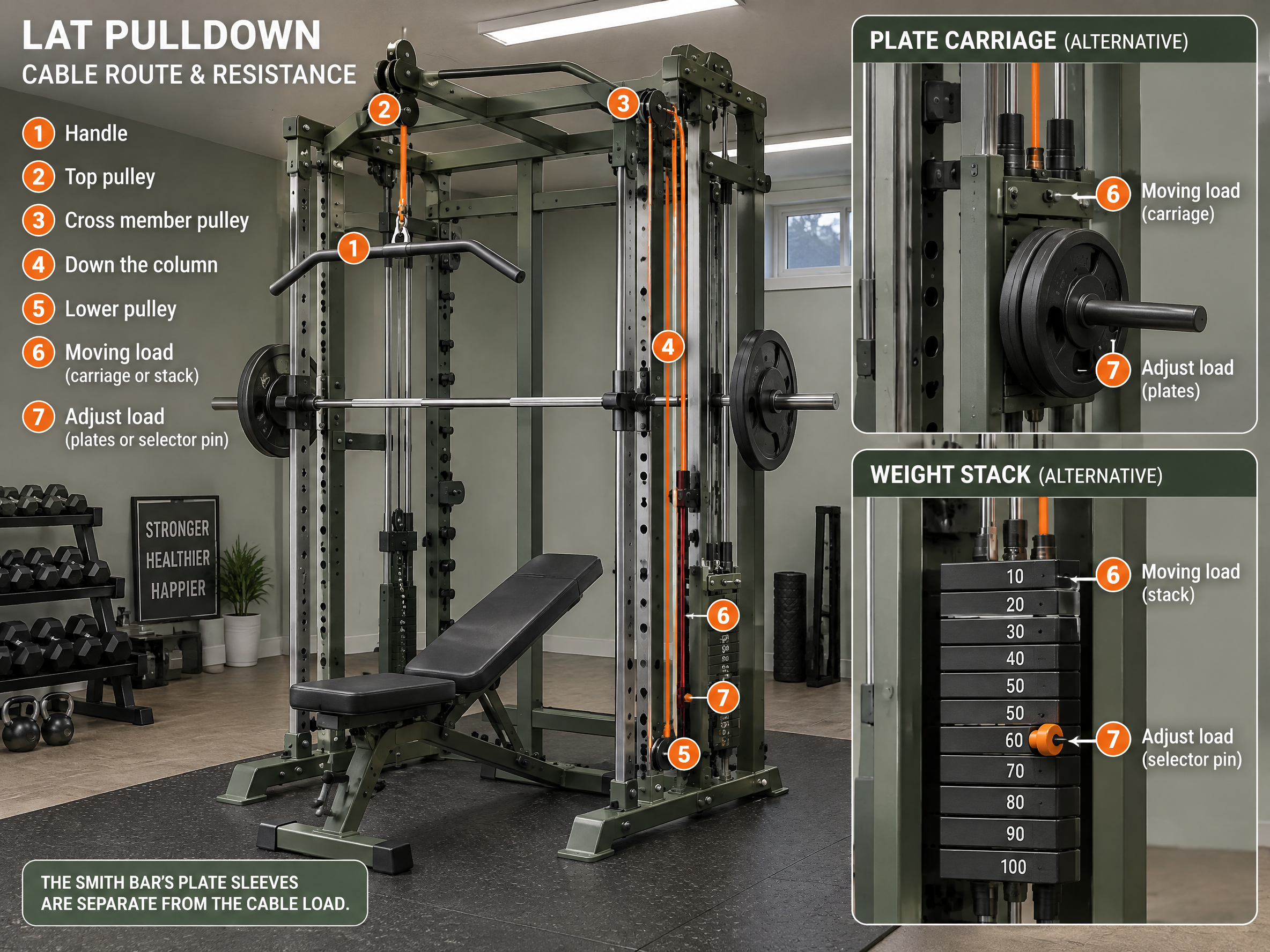
- Start at the handle
Pick the attachment you want to use, such as the lat pulldown bar.
- Follow its cable
Use the machine’s diagram to trace the cable through the pulleys to the part it lifts.
- Find the adjustment
Look at that part to see whether you add plates to a carriage or move a selector pin on a stack.
Standalone machines, half racks, and all-in-one cages
The guided bar does the same basic job in each layout. What changes is what else you can do on or around the frame. These labels can overlap: a cage can have cables and come with a bench, but neither feature is a given.
- Standalone: The Powertec Linear Bearing Smith Machine is an example of a setup built around the guided bar.
- Half-Smith rack: RitFit lists rack attachments including a landmine, which holds one end of a separate barbell so the other end can pivot.
- Cable-equipped cage: The pooboo P43 lists a lat pulldown and dual-pulley crossover. You can use those stations for overhead pulls or other cable movements without moving the Smith bar.
- Bench-inclusive system: The Marcy MD-9010G package lists an adjustable bench, which supports your body for seated or lying lifts. The bench does not change the path of the bar.
What a guided bar changes about a squat or bench press
In a squat, you still have to control your body, but you don’t have to steer the bar to keep it on course. The trade-off shows up when you shift your stance: the rails give you the same line either way, so your feet and body have to work with it.
On a bench press, moving the bench forward or back changes where the bar meets your chest. With a free bar you can adjust its path as you press; with a Smith bar you have to get the bench position right. A guided path isn’t inherently safer or better. If you can try one at a gym, use the unloaded bar to see how the path feels in both movements.
What ownership involves in a home gym
The frame’s footprint isn’t the whole space you’ll use. Leave room beside both sleeves to get plates on and off, room to slide a bench into place, and enough overhead clearance for assembly and any attachments you’ll use. Think about the path from the delivery point to the room, especially if there are stairs or tight turns.
Use the manual for assembly, any required anchoring, and routine care of the guides and latches. If you can’t spare a permanent lifting area, dumbbells and a movable bench cover many squat and press variations. If your goal is free-barbell practice, a rack with properly set safeties lets you work on that skill. And if you only want the guided bar occasionally, gym access may be all you need.
Questions before you commit
Can I use the plates I already own?
Yes, if the center holes fit the moving sleeves and the plates meet the machine’s requirements. Check the sleeve diameter and any clearance restrictions in the manual. A storage peg that fits your plates doesn’t prove the bar sleeves will.
Can I take the Smith bar off and use it as a free barbell?
No. The guided bar is part of the machine and isn’t meant to double as a free barbell. If the frame also supports free-barbell lifting, use a separate bar and the rack hardware intended for it.
Can I leave plates on the bar between sessions?
In a shared home gym, unload the bar after use so the next person starts with a known load. Follow the manual’s unloading instructions and put the plates on designated storage pegs or a plate rack.
Is the same plate weight equivalent on a Smith machine and a free bar?
Not necessarily. The unloaded bar can feel different, and the rails take over some of the work of balancing it. If you log your lifts, note the machine and the plates you added so you can compare sessions on the same setup.
Choose your next step
Put your shortlist side by side
See the differences, tradeoffs and who each model suits.
Compare the products →Your next step
- Locate the hooks and any adjustable stops in the manual.
- Look for an unloaded starting-resistance spec.
- Check sleeve fit against the plates you already have.
- Allow space to load both sleeves and move a bench.
When you try one, notice what happens before the first rep: do you find a comfortable position right away, or do you keep moving your feet or the bench to fit the rails?