Review101
What Is a Pilates Reformer? A Beginner’s Guide to the Machine and How It Moves
A reformer is a Pilates machine with a padded platform that glides on rails against adjustable resistance. Here’s how it moves, what it adds to a session, and what using one at home involves.
Read the article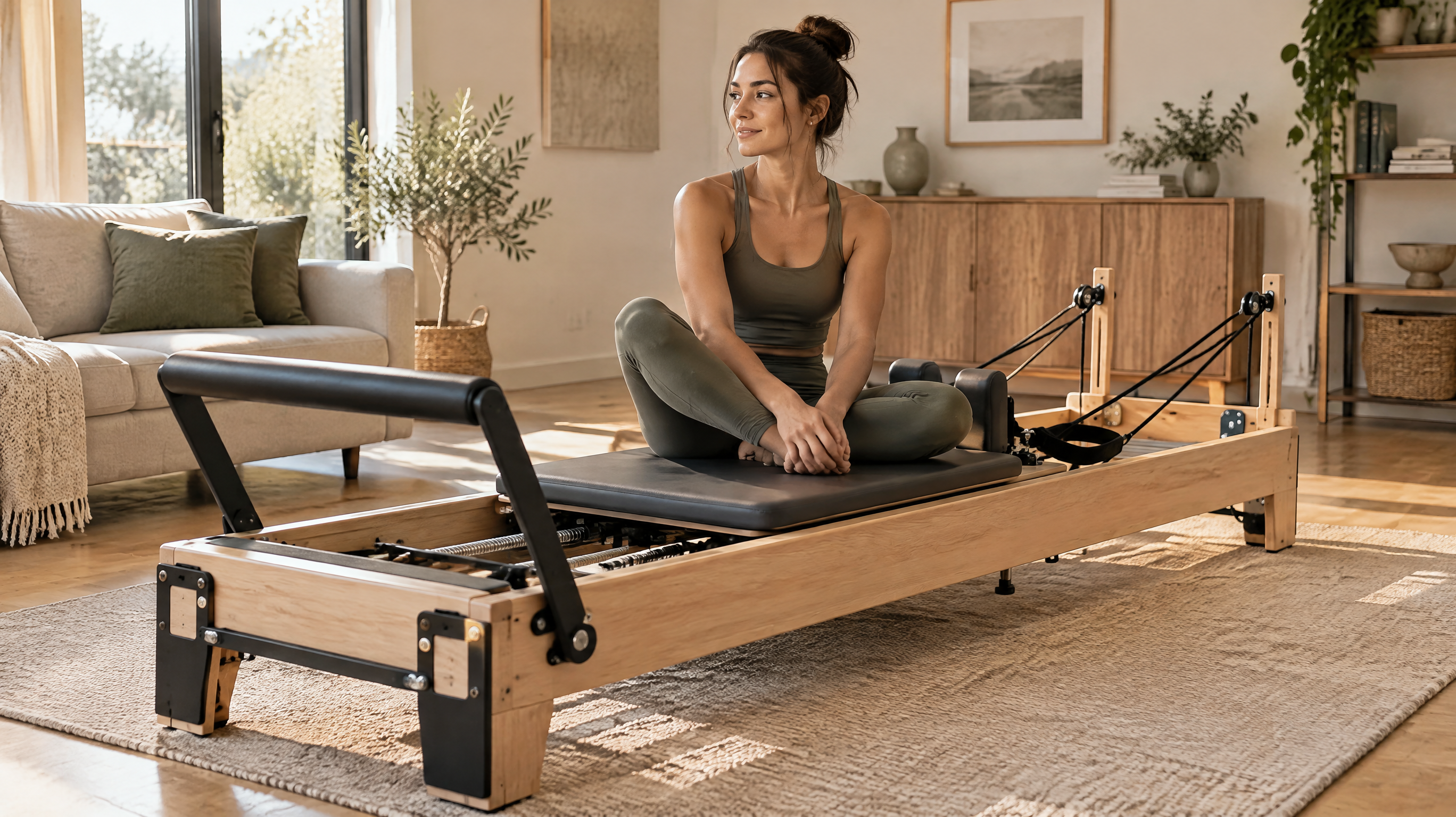
Some links may earn us a commission, at no extra cost to you. How we’re supported
In this article 8 sections
- Meet the carriage, rails, footbar, and straps
- What happens when you press out and return?
- Springs, elastic bands, and dual-resistance systems
- Low frames, stands, towers, and reformer accessories
- What a reformer adds to mat Pilates
- What using a reformer at home involves
- Questions before you commit
- Your next step
Start with your needs
Try an intro class and ask to feel two appropriate resistance settings on the same exercise.
Start on a mat. Add a resistance band if you want something to pull against.
Use a studio reformer rather than relying on a folding frame to solve workout clearance.
As an Amazon Associate, we earn from qualifying purchases. Research-based analysis; no hands-on testing.
The short answer
You don’t need a reformer to do Pilates. If you’re curious about the moving platform, try it in a beginner class before deciding whether it’s something you’d use at home.
Worth considering if
- People who enjoy controlling a moving platform against adjustable resistance.
- People who want to press and pull from several supported positions.
- Regular users with room to move and a setup they can manage independently.
Hold off if
- Getting on and off a moving platform still feels uncertain without guidance.
- Clearing the room and unfolding the frame would get in the way of regular practice.
- You prefer a minimal-equipment routine or rely on an instructor to adjust your setup.
Choose your next step
Ready to compare?
See the differences, tradeoffs and who each model suits.
Compare the products →


Meet the carriage, rails, footbar, and straps
The carriage is the padded platform you lie, sit, or kneel on. It rolls along rails that keep it moving in a straight line. At one end, the footbar gives you a fixed surface to push against. Many footbars can be repositioned between exercises, but the bar stays locked in place while you use it.
At the other end, ropes typically run through pulleys to loops for your hands or feet. Those loops aren’t the parts that create the resistance. The Merrithew At Home SPX, for example, lists double-loop straps and a separate set of springs.
A sliding exercise board can let you move back and forth, and some boards have bands. On a full reformer, the carriage supports your body, the footbar and pulley straps give you different places to push or pull, and the resistance acts on the carriage itself. That setup matters more than whether the listing calls it a reformer.
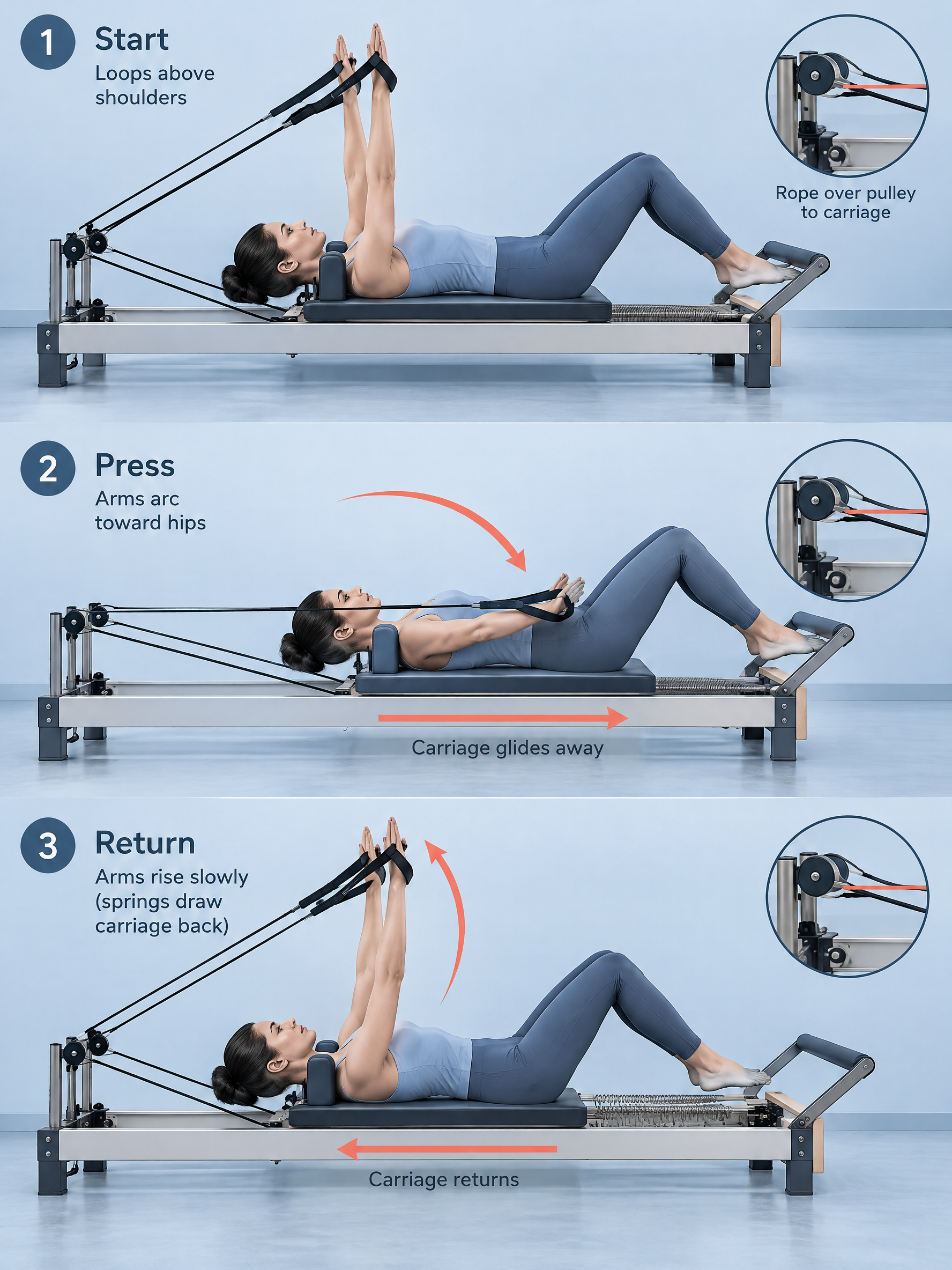
How a hand-loop pull moves the carriage
See the movement
Use a locked side-view loop to contrast the hands’ curved path with the carriage’s straight travel. Show the full press and a slow, controlled return without rope slack.
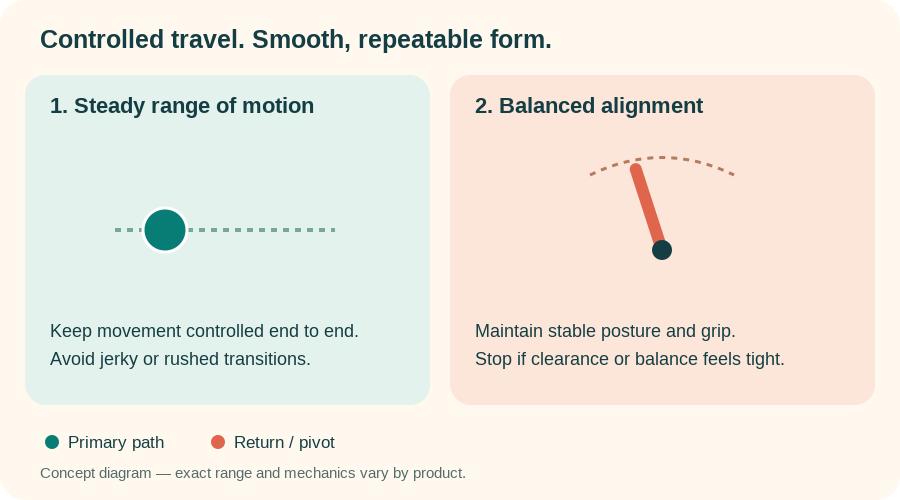
Simplified motion diagram. Exact range and mechanics vary by product.
- Pull the loops
In a lying arm press, you bring the loops toward your hips while your body rests on the carriage.
- Follow the force
The pulleys redirect the pull through the ropes to the carriage. Your arms move in an arc, but the carriage travels in a straight line.
- Ease back
As your arms rise, the resistance draws the carriage back. Move slowly enough to keep the ropes from going slack.
What happens when you press out and return?
Picture basic footwork. You lie on the carriage with your knees bent and your feet on the footbar. As you straighten your legs, the bar stays put and the carriage rolls away from it, stretching the springs or elastic cords. When you bend your knees, the resistance draws the carriage back toward the bar. You control the return so the carriage doesn’t bump into its stop.
A heavier setting generally takes more effort to press out and pulls more strongly on the way back. But harder to move isn’t always harder to use. In an exercise where you shift your weight and try to keep the carriage nearly still, more tension can help hold it in place. A lighter setting may make it easier to move and harder to keep steady.
Choose your next step
Which model fits your needs?
See the differences, tradeoffs and who each model suits.
Compare the products →Springs, elastic bands, and dual-resistance systems
Springs pull back as they lengthen; elastic bands and rubber cords pull back as they stretch. Depending on the machine, you adjust the load by changing which springs or cords are engaged. A dual-resistance machine offers both types, but that doesn’t mean you can combine them in any configuration. Follow the manual for that model.
The word “strap” can mean two different things. An elastic resistance strap stretches to load the carriage. A pulley strap is the loop you hold or put your foot into. The WNPANE band reformer lists both, so seeing “straps” in the specs doesn’t tell you what job they do.
Spring counts and listed tension figures aren’t a shared difficulty scale. Springs on the same machine can have different strengths, and the pull changes as the carriage travels. A setting you used in class may feel different on another reformer, even if the spring count or colors look familiar.
How to tell whether you’re ready to practice on your own
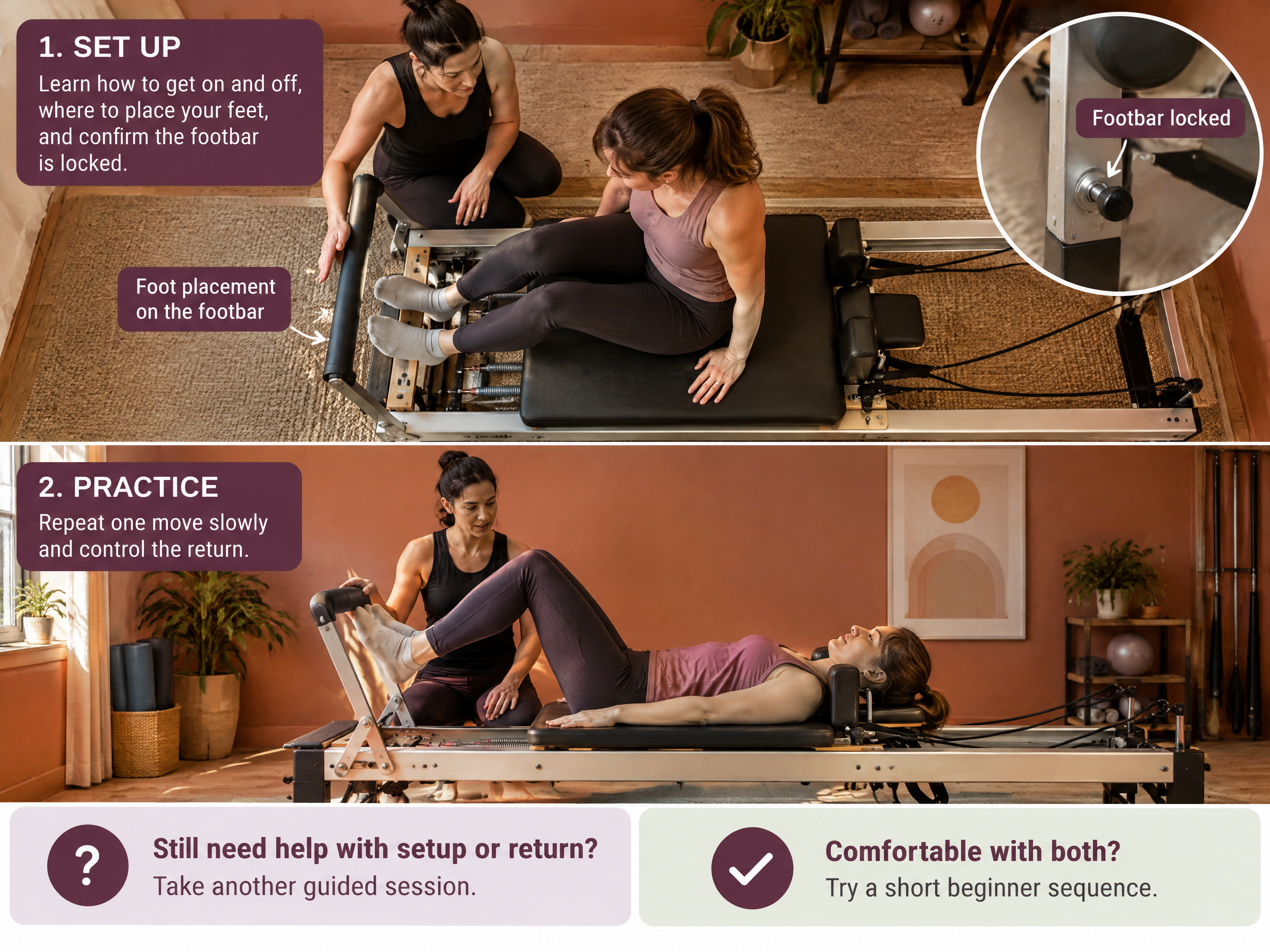
- Watch the setup
Ask the instructor to show you how to get on and off, where to put your feet, and how to tell when the footbar is locked.
- Repeat one move
Ask to repeat an exercise slowly. Notice whether the carriage feels unfamiliar or whether you’re mostly unsure when to move and what to adjust.
- Choose what to practice next
If you still need help setting up or controlling the return, take another guided session. If you can do both comfortably, try a short beginner sequence before committing to a longer routine.
Low frames, stands, towers, and reformer accessories
A low-profile frame keeps the carriage close to the floor. A taller frame or compatible stand raises it, changing how far you have to lower yourself to get on. Folding is a separate feature: it changes how the frame stores, not how much room you need around it during a session.
A tower is an upright attachment that gives you higher anchor points for exercises that pull from different directions. It doesn’t raise the carriage. If you’re working out under a low ceiling, check the tower’s assembled height and the space you’ll need to use it.
A sitting box rests on the carriage and gives you a raised surface to sit or lie on. A jumpboard gives your feet a broad, firm surface to push off during supported jumping exercises. A rebounder has a flexible surface instead. They change how the machine can be used, but don’t assume a board, rebounder, or stand from one model will fit another.
What a reformer adds to mat Pilates
On a mat, the floor stays still. Much of the challenge comes from gravity, your body weight, and where you position your limbs. A reformer lets you press or pull against a selectable load while the carriage supports you. You can work lying down, seated, or kneeling and practice moving the platform smoothly or holding it steady. The rails guide the carriage, not your posture.
If you want a routine you can start by clearing a little floor space, mat Pilates makes more sense. A resistance band can add pulling work without a machine, though it won’t recreate the supported glide. If that glide is what you enjoy but you’d rather not store or maintain a machine, studio sessions are another option.
What using a reformer at home involves
The frame’s footprint is only a starting point. Leave room to approach it, get on and off, and extend your arms or legs past the edges. If you’d fold it after every session, think through where the box or board would go and whether you could comfortably open, secure, and stow the frame on your own.
Keep the manual handy for locking the footbar, changing resistance, and securing the carriage for storage. Follow the maker’s cleaning and inspection instructions. If a cord is frayed, a strap is damaged, or a spring won’t seat properly, stop using the machine until the issue is resolved. Check where compatible replacement parts come from before you need them.
Questions before you commit
Do I need mat Pilates experience before taking a reformer class?
No. Look for an intro or fundamentals class and mention that you’re new. A slower class gives you time to learn the equipment before you have to follow a whole sequence.
Do I need grip socks, or can I go barefoot?
Check the studio’s policy before class: some require grip socks, while others allow bare feet. At home, follow the machine’s guidance and avoid slippery socks when you need secure contact with the footbar or carriage.
Can I tell whether a reformer fits my height from its overall length?
No. Look for usable carriage travel and check whether you can adjust the footbar and ropes for your reach. If you can try the setup, see whether you can finish basic footwork without feeling cramped or hitting the carriage stop.
Can I follow any reformer video on a home machine?
Not necessarily. Choose a beginner video that uses the same type of resistance and equipment you have, then check your manual for how to set up the machine. Skip moves that require an attachment you don’t have rather than improvising a substitute.
Choose your next step
Put your shortlist side by side
See the differences, tradeoffs and who each model suits.
Compare the products →Your next step
- Try a beginner footwork exercise and a strap exercise.
- Mark out the open frame and leave room to step on and reach past it.
- Walk through the setup and storage routine, including any accessories.
- Find the manual and check how to get compatible replacement springs, cords, or straps.
After your first session, notice what you’d miss on the mat. If it’s the way the carriage moves under you, that’s a reason to keep exploring reformer Pilates. If it’s the instructor’s cues, another class may be more useful than a machine at home.