Review101
What Is a Medicine Ball? A Beginner’s Guide to Exercise Ball Types and Uses
A medicine ball is a handheld weight shaped like a ball. Some are made to stay in your hands; others are designed to hit the floor with little bounce, come off a wall for a catch, or rebound for the next throw.
Read the article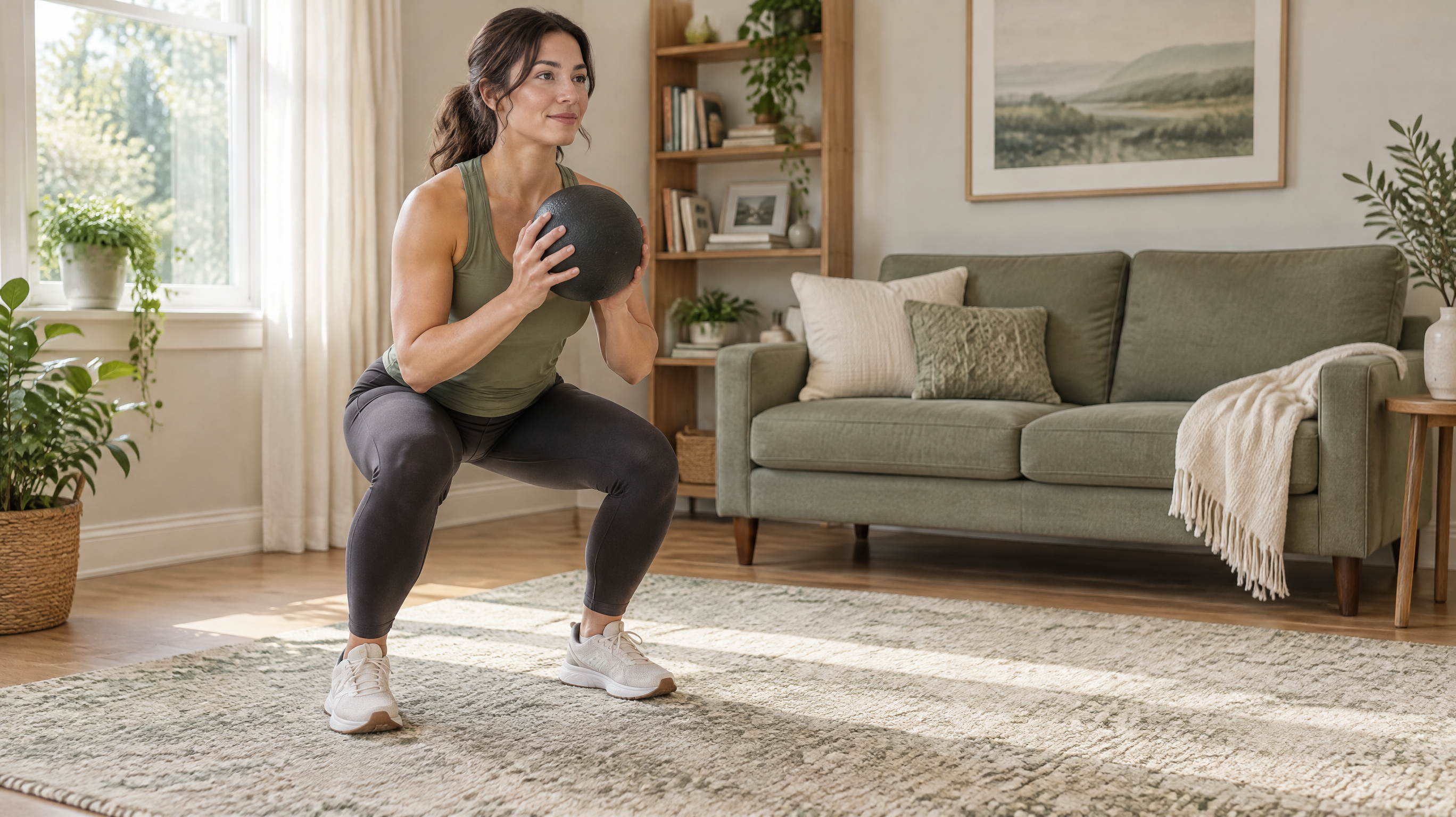
Some links may earn us a commission, at no extra cost to you. How we’re supported
In this article 7 sections
- What makes a medicine ball different from a stability ball?
- How the weight changes a squat, reach, or throw
- Standard, soft-shell, and dual-grip medicine balls
- Why slam balls, wall balls, and rebound balls aren’t interchangeable
- What a medicine ball adds to exercise and what it takes to use one
- Questions before you commit
- Your next step
Start with your needs
Use a weight you already have for held movements. A ball is optional.
Try a suitable ball at a gym before deciding whether you want one at home.
Look at stability-ball exercises, not handheld medicine-ball exercises.
As an Amazon Associate, we earn from qualifying purchases. Research-based analysis; no hands-on testing.
The short answer
You don’t need a medicine ball just to make a squat or reach harder. Its round shape gives you a different way to hold a weight, and a model designed for impact lets you practice throws, catches, or slams that a dumbbell can’t replace.
Worth considering if
- People who like moving one round load with both hands during squats, reaches, or turns.
- Beginners curious about throw-and-catch coordination or slam-based conditioning who have access to a suitable space.
Hold off if
- You already have a weight that feels comfortable for the held movements you want to do.
- You mainly want impact drills but don’t have a permitted surface or enough clearance.
- You’re not sure you enjoy the movement enough to make it part of your routine.
Choose your next step
Ready to compare?
See the differences, tradeoffs and who each model suits.
Compare the products →


What makes a medicine ball different from a stability ball?
A medicine ball is a weighted exercise tool you can hold, carry, or move through a lift. The ball itself supplies the resistance, much like a dumbbell. One compact rubber example weighs 6 pounds and measures 7.6 inches across, small enough to hold in front of your chest.
A stability ball, sometimes called a Swiss ball, is the large inflatable kind. You might sit on it or rest your back or legs on it. It provides a surface that can shift under you rather than a weight you carry. Both can be called exercise balls, but one adds a load and the other changes what supports you.
Can the weight you already own do the job?
See the movement
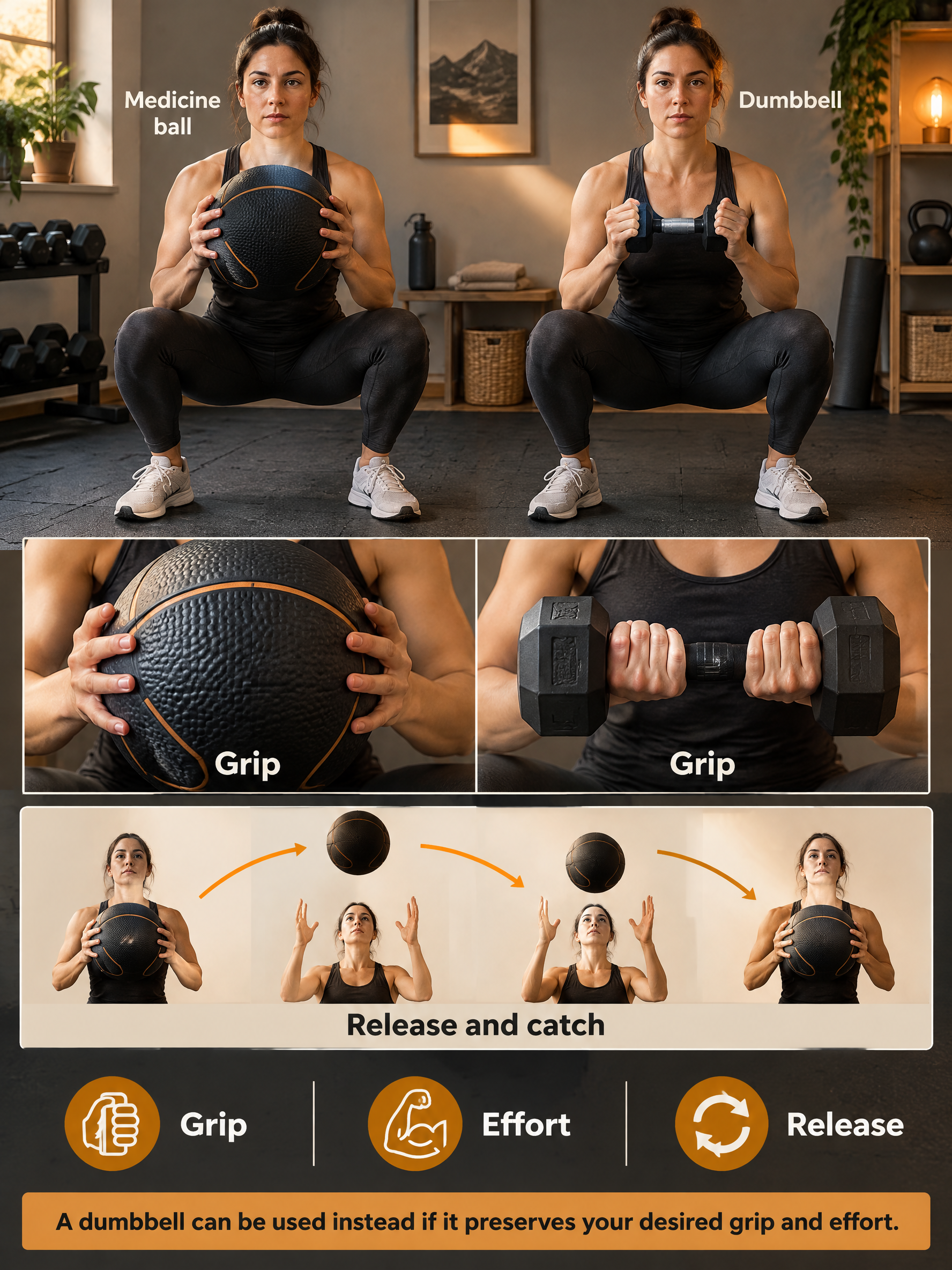
Use a short loop to show the ball staying in both hands through a squat, followed by an animated floor-plan overlay tracing a possible angled rebound in a designated throwing area.
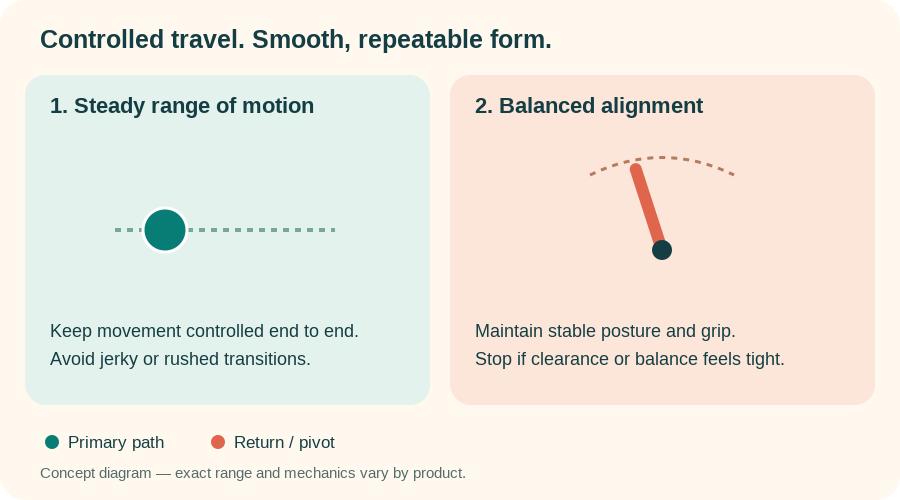
Simplified motion diagram. Exact range and mechanics vary by product.
- Find the key moment
Is the point of the movement to lift a load, to hold it a certain way, or to release and receive it?
- Compare the grip
For a held movement, try a weight you can grip securely. Notice whether your hands can sit where you want them throughout the movement.
- Check what changes
If the substitute preserves the grip and effort you want, use it. If it removes the release or catch, it changes the exercise.
How the weight changes a squat, reach, or throw
In a squat with the ball at your chest, you carry that extra weight down and back up. Reach the same ball out in front of you and the weight hasn’t changed, but it now sits farther from your shoulders. That longer lever generally makes it harder for your shoulders and trunk to hold the ball steady.
A throw changes the task: instead of slowing the ball to a stop in your hands, you speed it up and let go. In a catch, you have to meet the moving ball and slow it down. That’s why being able to hold a ball comfortably doesn’t tell you how easy it will be to catch.
Choose your next step
Which model fits your needs?
See the differences, tradeoffs and who each model suits.
Compare the products →Standard, soft-shell, and dual-grip medicine balls
With a compact rubber medicine ball, you grip the curved shell itself. A stitched soft-shell ball gives your hands a different surface without necessarily being much bigger. For example, the 6-pound Amazon Basics rubber ball measures 7.6 inches across, while the 6-pound Retrospec Core, with its stitched polyurethane shell, measures 7.9 inches.
A dual-grip medicine ball has two built-in handles, so you wrap your fingers around a grip instead of cupping the shell. That gives you a fixed hand position for a controlled lift or turn. With a plain shell, a larger diameter can put your hands farther apart. Two balls of the same weight can therefore feel quite different before you even start moving.
Can you use this space for throws?
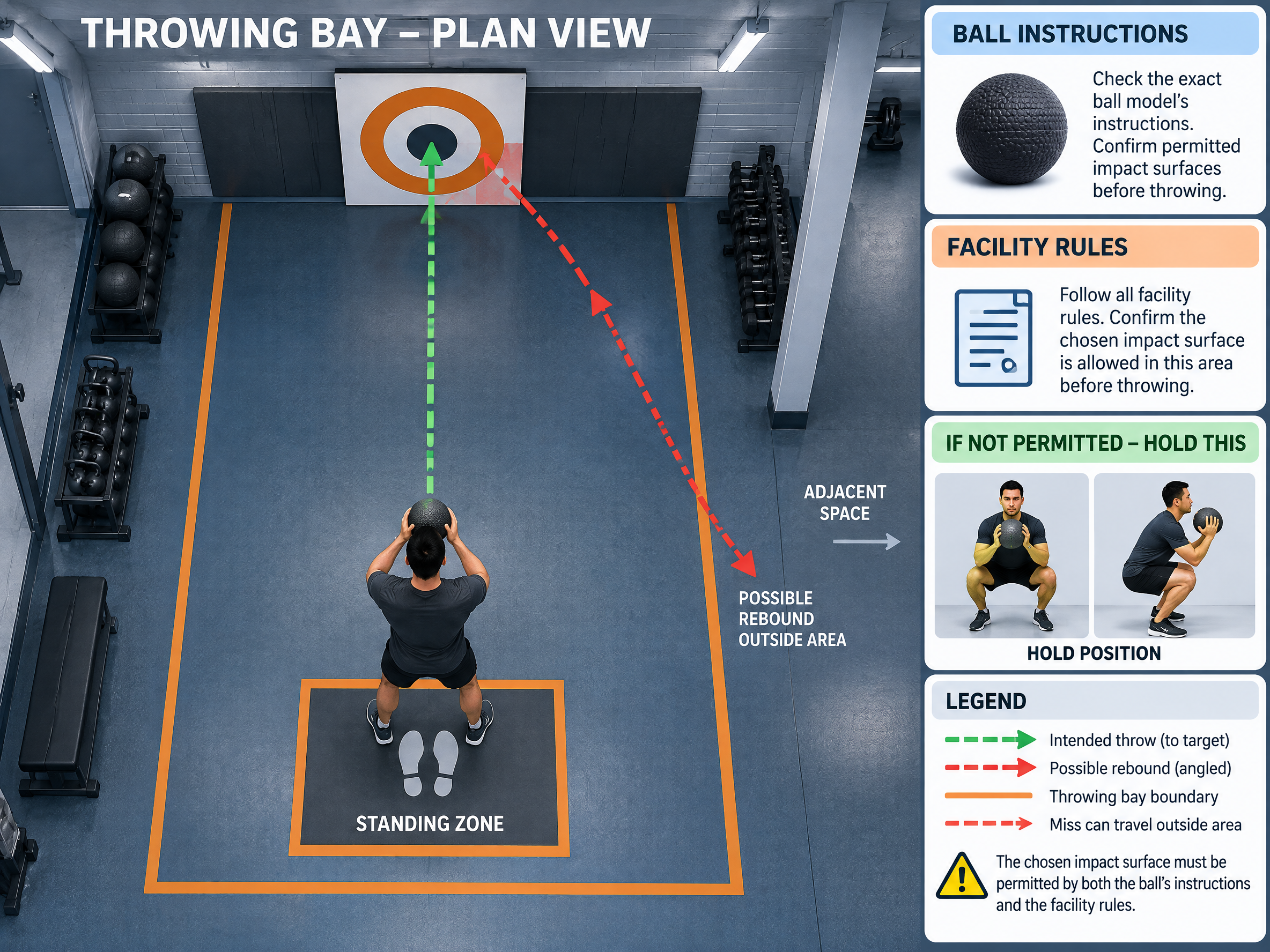
- Trace a missed throw
Look beyond the target. Where could the ball go if you miss or it comes back at an angle?
- Confirm the impact surface
Check the exact ball model’s instructions and the facility or property rules before using a wall, target, or rebounder.
- Choose a fallback
If you can’t keep that path clear or confirm the surface is suitable, use the space for held movements and save throws for a designated area.
Why slam balls, wall balls, and rebound balls aren’t interchangeable
The difference becomes clear after impact: do you want to pick the ball up, catch it as it drops, or have it bounce back? Shell material alone can’t tell you which impacts and surfaces the manufacturer permits for a particular model.
- Slam balls are made for floor impacts and typically rebound very little. The next move is a pickup rather than a catch. The Yes4All sand-filled PVC slam ball is one example.
- Wall balls are made for throws against a suitable wall or target and are often soft-shelled, like the JFit Wall Ball. You catch the ball as it comes away from the target or drops. A soft shell doesn’t mean the ball is built for repeated floor slams.
- Rebound balls are designed to bounce back for return drills. The bounce sets up the next catch, so a ball that lands and stays down won’t do the same job.
What a medicine ball adds to exercise and what it takes to use one
For controlled strength or core work, a medicine ball gives you one load to move with both hands. If resistance is all you want, a dumbbell or kettlebell you already own can serve the same purpose in a held squat. A suitable ball comes into its own when you want to practice the timing of a throw and catch or add a slam-and-pickup movement to a conditioning session.
At home, the ball can take up less room than the movement around it. A held exercise still needs room for your arms to travel, and floor slams can carry noise through the building even when the ball barely bounces. Between uses, keep the ball somewhere it can’t roll into a walkway. If impact drills are the only thing that interests you, using a ball at a gym may make more sense than finding room for one at home.
Questions before you commit
Do I need a partner to use a medicine ball?
No. You can do held movements on your own, and a return drill can use a designated wall or rebounder if the ball is approved for it. You only need a partner for movements that involve passing the ball between people.
Can I use a medicine ball as a base for push-ups?
Use the floor or a stable push-up surface unless the ball’s manufacturer explicitly permits that use. A weighted ball can still roll out from under your hands, and the weight printed on it tells you how heavy it is, not how much it can support.
What should I check on a shared gym ball before using it?
Check the weight and type markings, then look for damage to the shell, seams, or handles. If the markings are rubbed off, ask gym staff what the ball is meant for. If you spot a split seam or loose handle, set it aside and let staff know.
Is a soft-shell medicine ball the same as a soft ball you squeeze in one hand?
No. On a medicine ball, “soft-shell” describes the outer covering of a weighted exercise tool. A hand exerciser is meant to provide resistance as you squeeze it, not to act as a load for a lift or throw.
Choose your next step
Put your shortlist side by side
See the differences, tradeoffs and who each model suits.
Compare the products →Your next step
- Name the movement you want to try: a held lift, a throw and catch, a floor slam, or a rebound drill.
- Think about when and where it would fit into the exercise you already do.
- If you’ll use the ball at home, account for clearance, impact noise, and storage.
If you’re curious about a movement that involves letting go of the weight, try it in a gym or class set up for it. How the ball lands or returns will tell you more about that exercise than the weight printed on the shell.