Review101
What Is a Leg Press and Hack Squat Combo Machine?
A combo gives you a supported leg press and a guided hack squat on one frame. The key difference is what moves with the sled. Here’s how the two setups work and how to tell whether you’d use both.
Read the article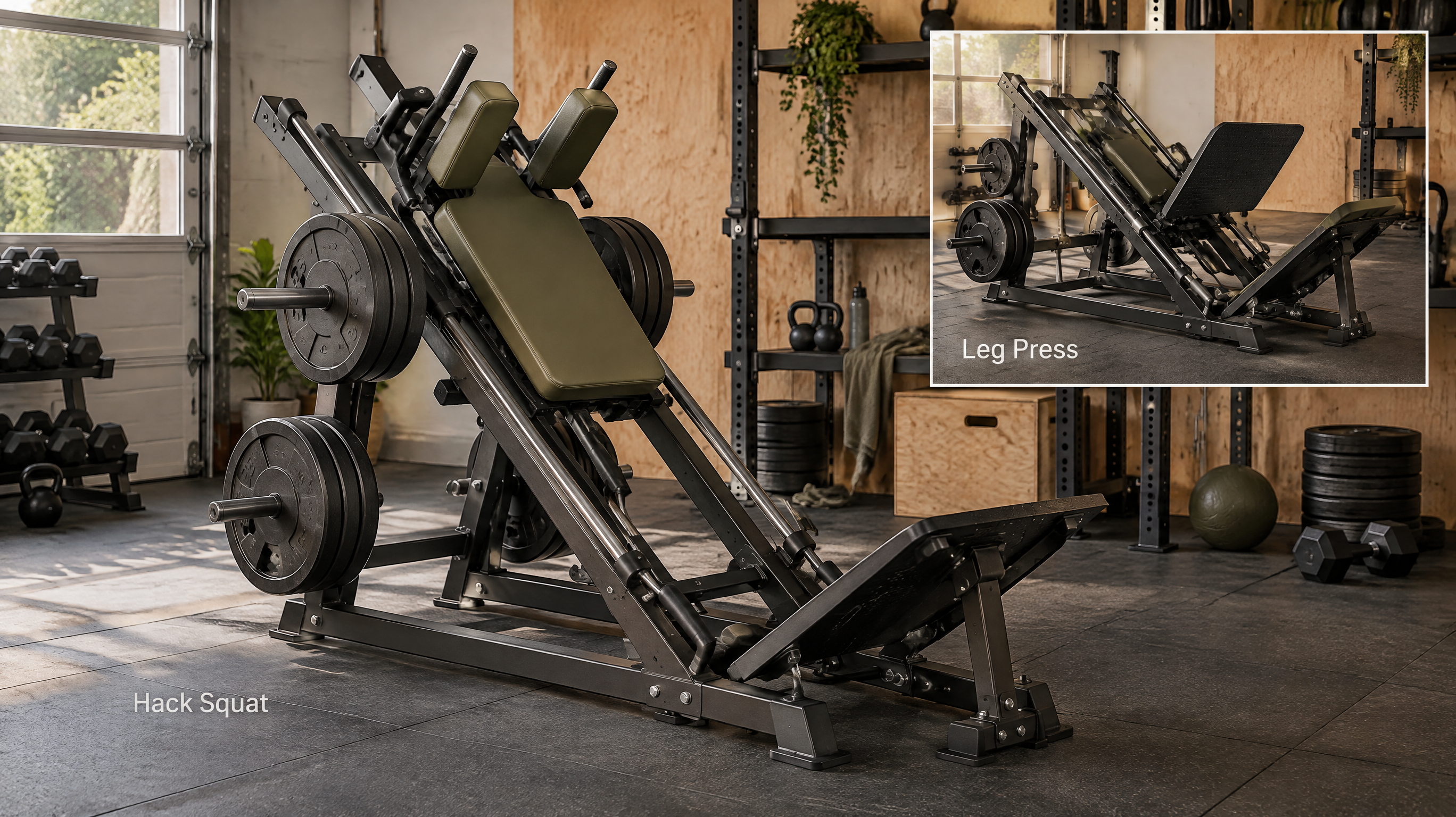
Some links may earn us a commission, at no extra cost to you. How we’re supported
In this article 7 sections
Start with your needs
Consider a combo if both positions fit and you have room to operate it.
Compare a dedicated machine or keep using the one at your gym.
Try both movements at a gym before committing floor space, even if they’re on separate machines.
As an Amazon Associate, we earn from qualifying purchases. Research-based analysis; no hands-on testing.
The short answer
You don’t need a combo machine to train your legs. Consider one if you want both movements at home, can get comfortable in both positions, and have enough room to use the machine—not just park it.
Worth considering if
- Home-gym users who expect to use both a supported press and a guided squat regularly.
- People who have tried both movements and prefer the guided path to balancing free weights.
- Households with room for one frame and enough adjustment for everyone who will use it.
Hold off if
- You already have convenient access to both movements at a gym.
- You haven’t found a sled setup that feels comfortable in both positions.
- The frame would fit, but getting in or loading plates would be awkward.
Choose your next step
Ready to compare?
See the differences, tradeoffs and who each model suits.
Compare the products →


Two exercises on one frame
A leg press and hack squat combo is a lower-body strength machine that converts between two exercise setups. On a typical inclined, plate-loaded combo, both setups share a sled: a moving carriage that carries the weight plates along rails. The changeover rearranges the surfaces you push against and the pads that support you.
The conversion is part of the experience. Depending on the design, you may flip a footplate, reposition a pad, or move a support into a different slot. If you expect to switch often, check the manual for the exact steps, including how the sled must be secured before you change the setup.
Follow the sled: what moves in each mode?
See the movement
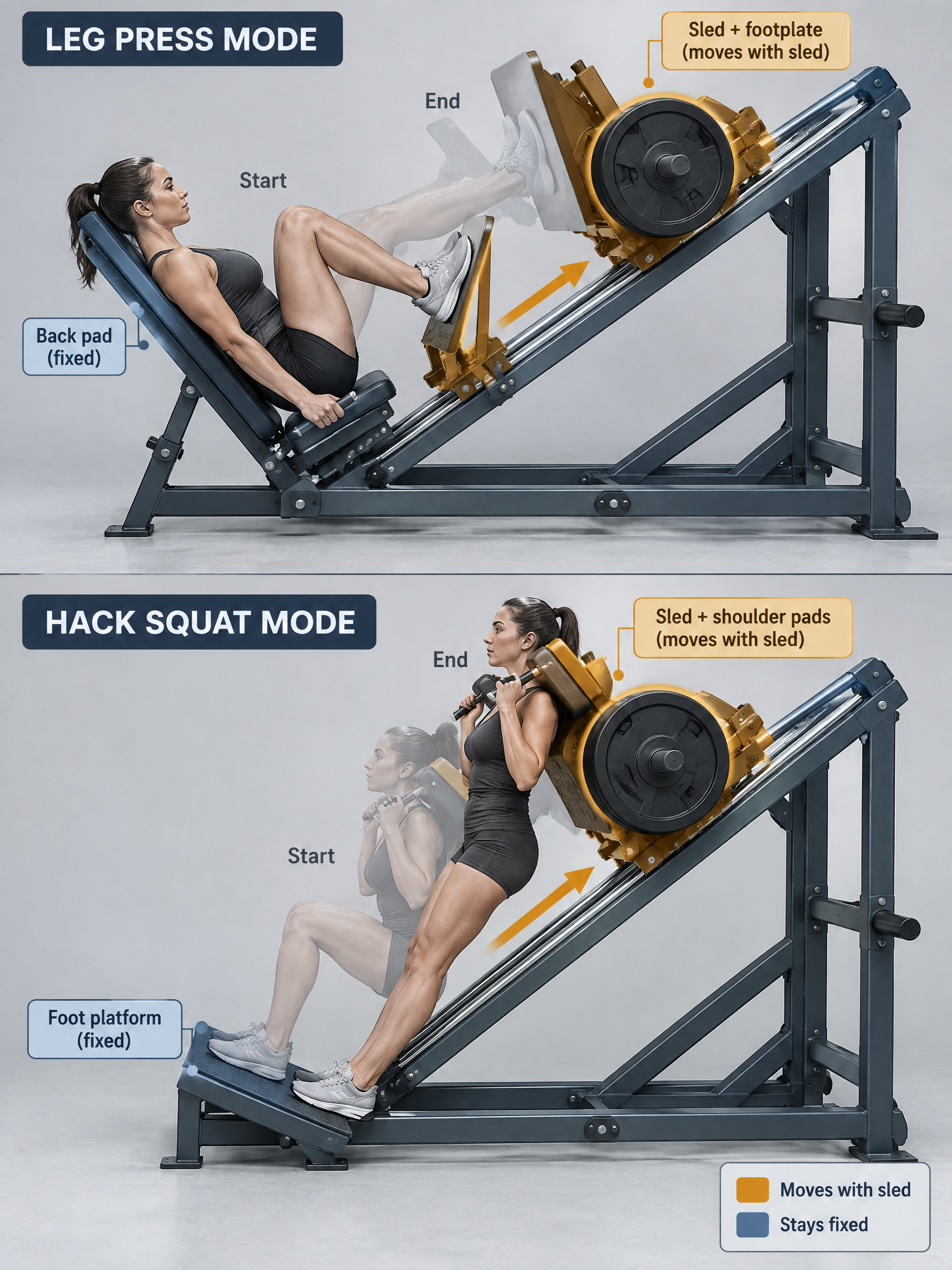
Animate the two modes from a locked side view, highlighting the same carriage traveling along the rails. In leg press mode the footplate moves and the torso stays supported; in hack squat mode the user rises with the carriage while the foot platform stays fixed.
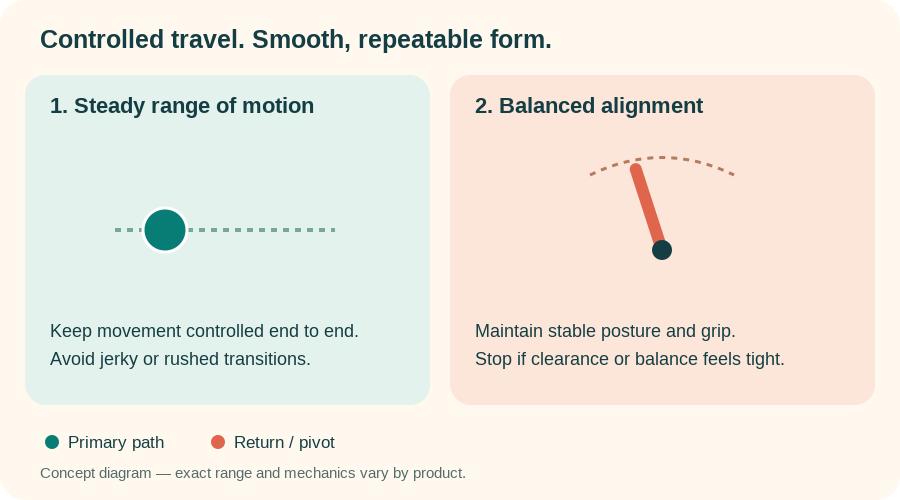
Simplified motion diagram. Exact range and mechanics vary by product.
- Start with the shared sled
The carriage and its weight plates travel together along the rails in both modes.
- Leg press: the footplate moves
Your torso stays against a fixed back pad. As your legs straighten, your feet push the sled-mounted footplate away.
- Hack squat: you move with the sled
Your feet stay on a fixed platform. As you stand up, your body rises with the sled, with your shoulders against its pads.
What the sled angle changes
The rail angle sets the direction the sled travels. FEIERDUN, for example, lists a 45° model. Picture a 30° rail next to a 45° rail, with both angles measured from the floor. Over the same distance along the rails, the sled on the steeper rail rises farther. If the moving weight is the same, gravity pulls harder against uphill travel on the steeper path.
Angle alone won’t tell you which machine feels heavier. Identical plates can feel different if the empty sleds weigh different amounts or if there’s more friction in one guide system. In hack squat mode, you’re also moving your body uphill. And the listed weight of the whole machine includes the stationary frame, so it won’t tell you how hard an empty sled is to move.
Choose your next step
Which model fits your needs?
See the differences, tradeoffs and who each model suits.
Compare the products →Linear bearings, roller guides, and extra exercise modes
The guide system is what keeps the sled on its path. A linear-bearing assembly guides the carriage along a rail or shaft; a roller guide uses wheels or rollers that run against a track. Neither label tells you how smoothly or quietly the assembled machine will run. Alignment and the condition of the moving parts matter, too.
Listing terms can be confusing. The RitFit RF-GAZELLE listing highlights roller bearings but also says “Linear Bearing Strap” in a separate field. If you want to know what actually guides the sled, look for the manufacturer’s parts diagram rather than relying on a single listing field.
A 3-in-1 or 4-in-1 label counts the exercises a seller advertises; it doesn’t describe the guide system or promise a standard set of movements. If you want an extra mode such as calf raises or reverse hack squats, check whether that exercise is named and what setup or attachment it requires.
A three-step fit check before buying
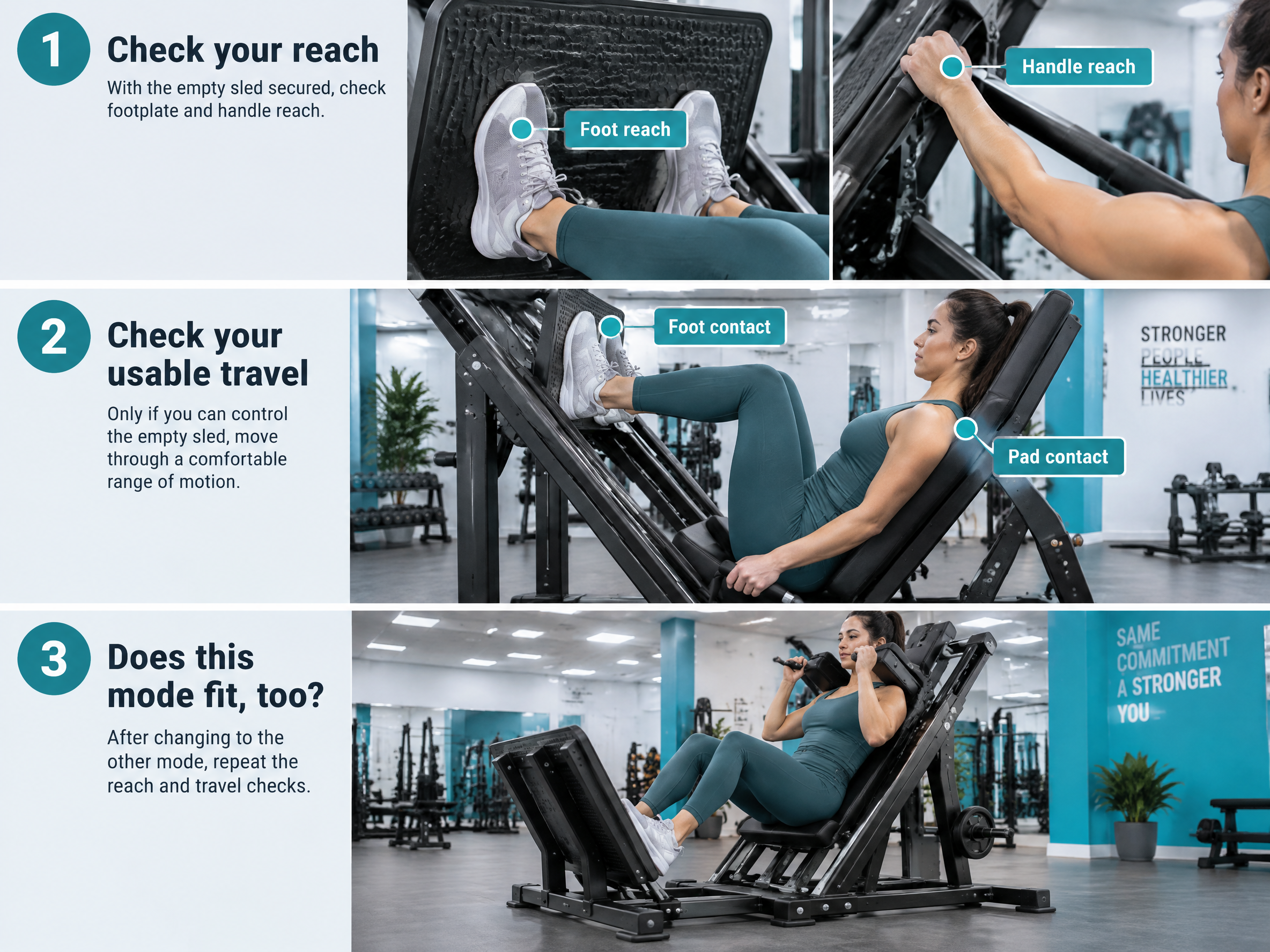
- Check your reach
With the sled secured and no plates added, see whether you can reach the footplate and handles without shifting away from the support pads.
- Check the usable travel
If you can comfortably control the empty sled, follow the machine’s instructions to see how much travel you can use while staying in contact with the pads and platform.
- Switch modes and check again
Repeat the check after the changeover. If only one setup fits comfortably, decide whether that one movement is worth the space.
Why use both movements, and what could you use instead?
Both movements involve straightening your knees and extending your hips. What changes is your body position and how the machine supports you. A leg press gives you a supported position to push from; a hack squat lets you use a squat pattern without balancing a free weight. The rails guide the path in either mode, but that fixed path can also feel awkward if the pads, footplate, or range of travel don’t suit you.
The case for a combo is strongest when you already want both movements and would rather make room for one frame than two. If you only enjoy one, a dedicated machine is worth comparing. If your goal is simply to train your legs at home, dumbbell squats or split squats take less space, though they won’t give you the same support or guided path.
What ownership involves beyond floor space
The assembled dimensions tell you where the frame sits, not how much room you need to use it. Leave room to enter and exit both positions, reach the controls, and slide plates onto the loading sleeves. Check carton dimensions and weights separately, especially if delivery involves stairs or a tight turn.
Before assembly, read the manual sections on lockouts, which hold the sled in place, and travel stops, which limit how far it can move. Check how the manufacturer wants the rails cleaned and whether it calls for lubrication. If multiple people will use the machine, find out how easy it is to reset the pads and stops between users.
Questions before you commit
Can I use the plates I already own?
Yes, if their center holes match the loading sleeves. Check the manufacturer’s plate requirements and usable sleeve length; thick plates can fill the sleeves before you reach the machine’s load limit.
Do weight plates come with the machine?
Only if the exact bundle says so. The supplied Dripex listing explicitly excludes plates, while the GMWD bundle lists plates among its included components. If you’re looking at a machine-only price, budget for compatible plates separately.
Does the listed weight capacity tell me how many plates I can add?
Only if the manufacturer defines that number as added plate weight. A listing can give different figures for “tension supported” and “maximum weight recommendation.” Check the manual for your exact model and follow any separate limits for each mode or loading sleeve.
What if the empty sled already feels too heavy?
Don’t count on being able to set the resistance any lower just by removing plates. Ask the manufacturer for the starting resistance in each mode, or try the exact machine if you can. If you can’t comfortably control the empty sled, look for a different setup.
Choose your next step
Put your shortlist side by side
See the differences, tradeoffs and who each model suits.
Compare the products →Your next step
- Measure the assembled footprint, access and loading clearance, and delivery route.
- Check starting resistance, pad adjustments, and usable sled travel in both modes.
- Confirm plate compatibility and what comes in the exact bundle.
- Read the manual for changeover, lockouts, travel stops, and upkeep.
Before clearing a spot for a combo, think through an ordinary week: when would you use each mode, and would having it at home be more convenient than using the machines you can already access?