 Review101
What Is a Flat, Incline, and Decline Weight Bench?
A flat, incline, and decline bench lets you change the angle of the pad that supports your torso. Here’s how the three positions work, how to tell whether a bench really declines, and when a simpler setup is enough.
Read the article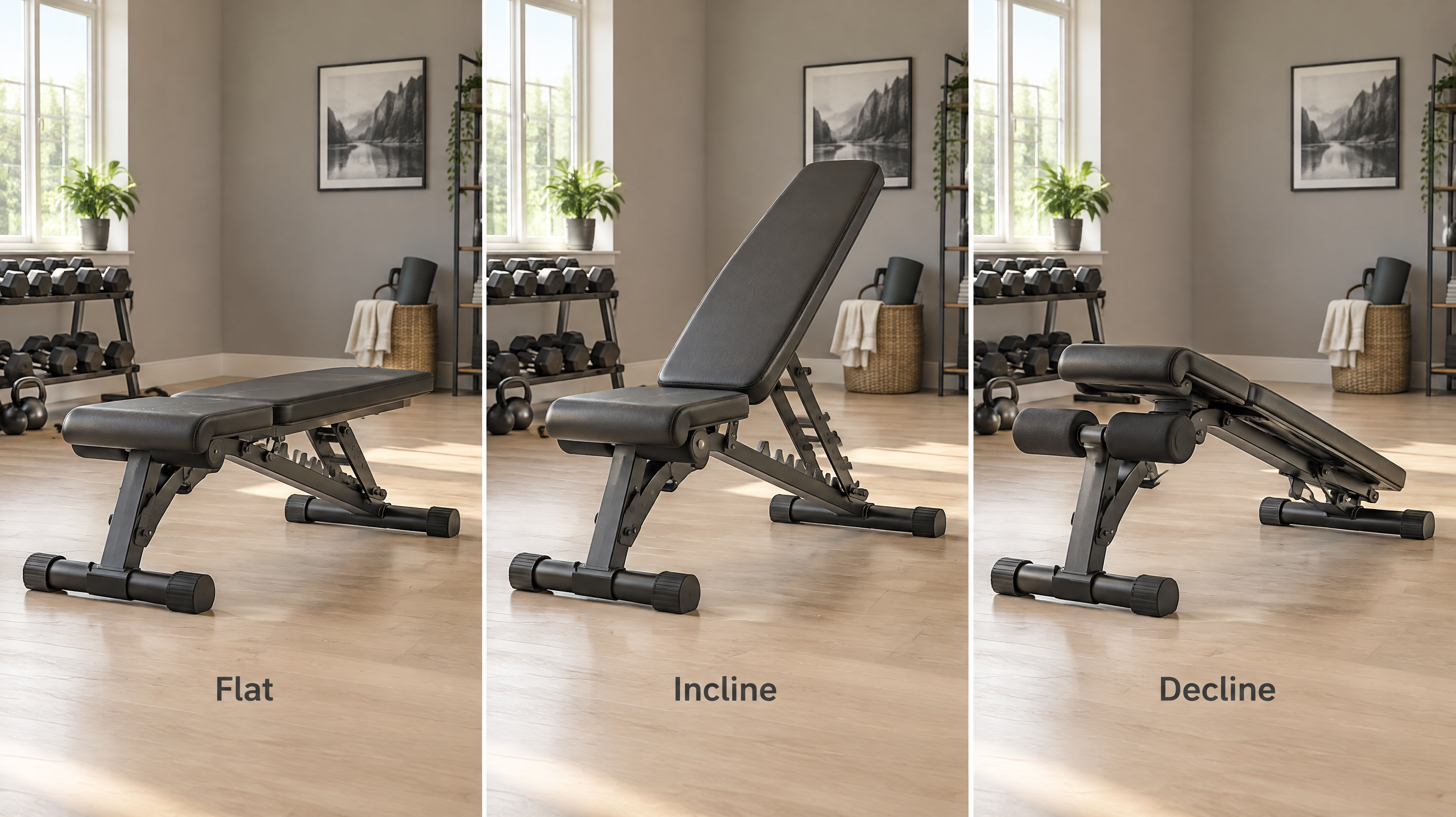
Some links may earn us a commission, at no extra cost to you. How we’re supported
In this article 7 sections
Start with your needs
An FID bench makes sense if you want a head-down setting as well as flat and incline.
A flat-to-incline bench covers flat presses, incline presses, and incline chest-supported rows.
A fixed flat bench may be enough. Try a floor press if you’d rather skip the bench and don’t mind the shorter range.
As an Amazon Associate, we earn from qualifying purchases. Research-based analysis; no hands-on testing.
The short answer
You don’t need a flat, incline, and decline (FID) bench just because you want an adjustable one. A fixed flat bench can cover flat pressing, and a flat-to-incline bench adds raised positions for presses and chest-supported rows. Decline is useful if you want a head-down position as well.
Worth considering if
- Home lifters who want to switch among level, raised, and head-down setups on one frame.
- People who already use decline at the gym and want the same option at home.
Hold off if
- You haven’t tried decline and can’t name an exercise you’d use it for.
- You already have access to a bench when you need one, or you don’t have a clear place to use and store one at home.
Choose your next step
Ready to compare?
See the differences, tradeoffs and who each model suits.
Compare the products →


What flat, incline, and decline mean
The three terms describe the angle of the long backrest, not the smaller seat pad. Flat puts the backrest level with the floor. Incline raises the head end, putting your torso in a more upright position when you lie back. Decline lowers the head end below level so your head sits lower than your hips.
A true FID bench has a supported exercise setting in all three categories. A backrest that goes from flat to nearly upright still doesn’t decline. Neither a tilting seat nor a backrest that drops only when the frame folds creates a usable decline position.
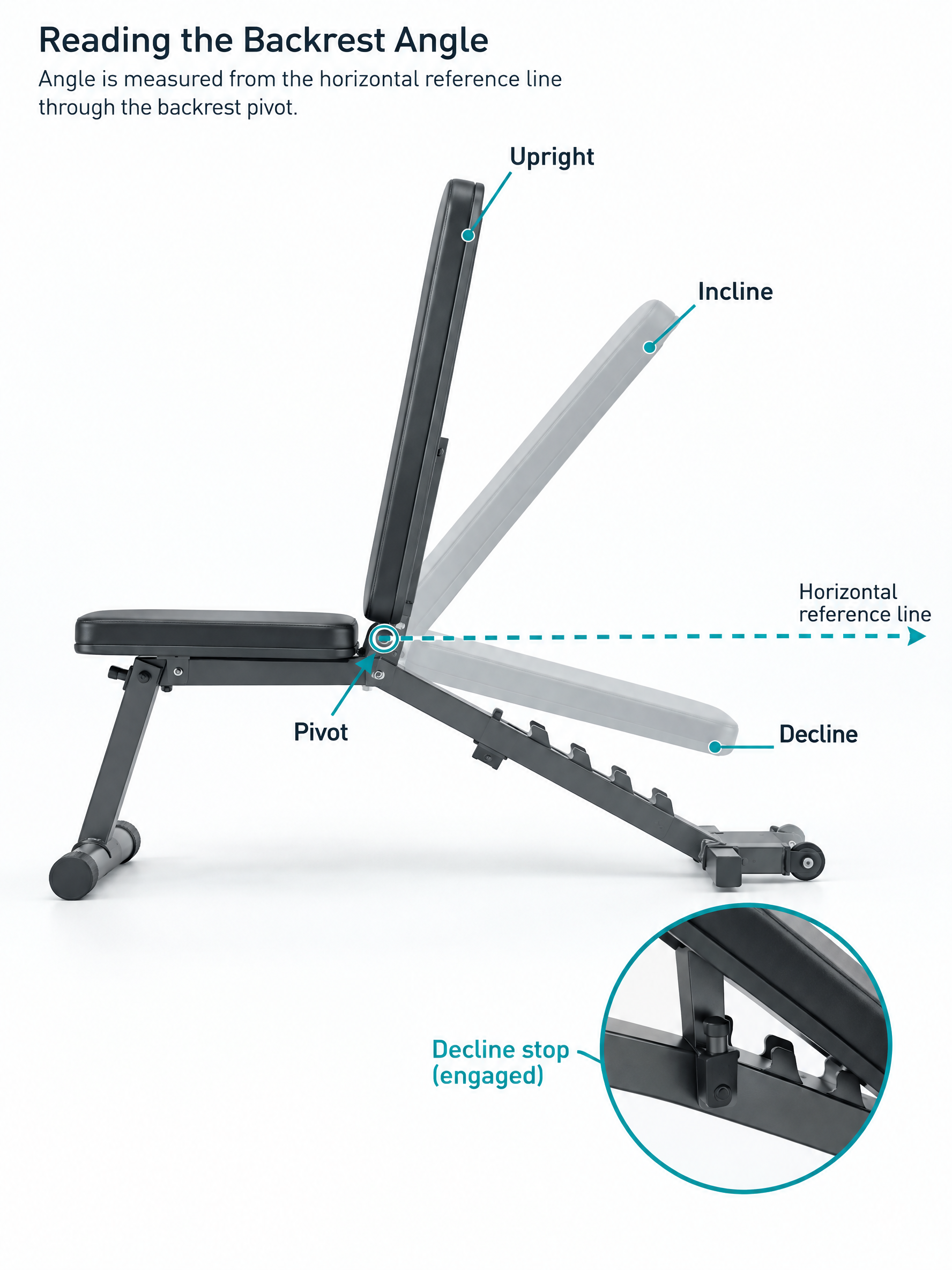
Read a bench angle chart from the side
See the movement
Use a short side-view sequence to show the unloaded backrest settling into each supported position against a fixed horizontal reference. Cut to a high three-quarter view of the empty-hand pickup, rep, and set-down to show clearance.
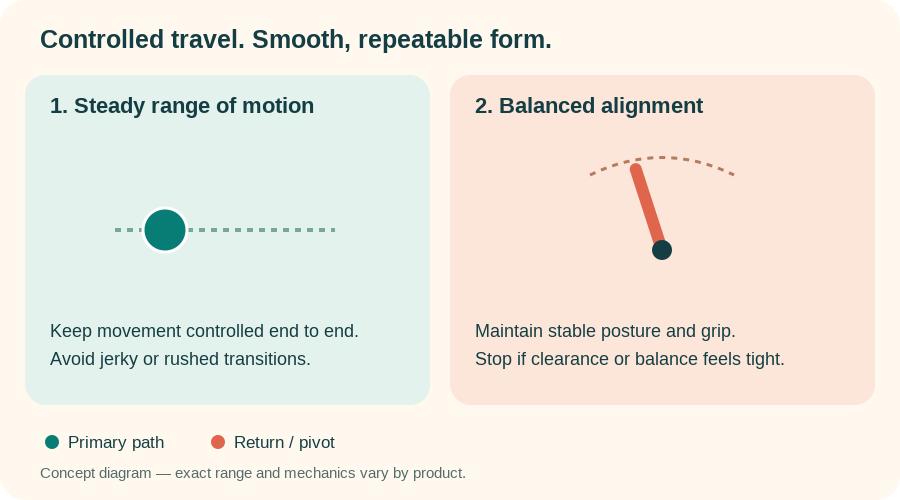
Simplified motion diagram. Exact range and mechanics vary by product.
- Find the reference line
Start at the backrest pivot next to the seat. Imagine a horizontal line extending from the pivot toward the head end of the pad.
- Compare the pad positions
A backrest along that line is flat. A backrest rising above it is incline. A backrest sloping below it is decline.
- Confirm the downward stop
Check that the below-level position is shown with the frame open for exercise and that the manual identifies it as a supported setting, not a storage position.
How the backrest and seat adjust
The backrest typically pivots near the seat. On a ladder-style bench, a support arm settles into a notch. On a pin-style bench, a pin engages a hole at the selected angle. Adjust the bench without anyone on it or weights resting on the pads, and make sure the support is fully engaged before you sit or lie down.
A separately adjustable seat changes the support under your hips without changing the backrest angle. When the backrest is raised, tilting the front of the seat up can help keep you from sliding toward the front edge. RITFIT lists 10 backrest positions and three seat angles; pooboo lists eight backrest positions and three seat positions. Read those counts separately: they describe different parts, and they don’t tell you which combinations the manufacturer intends you to use.
Choose your next step
Which model fits your needs?
See the differences, tradeoffs and who each model suits.
Compare the products →What changes when you use a different angle
On a flat dumbbell press, you lie face up with your torso roughly horizontal. On an incline dumbbell press, the raised pad holds your torso at a steeper angle. In both cases you press the dumbbells upward, but the movement is at a different angle relative to your torso.
For an incline chest-supported dumbbell row, you turn to face the pad. It supports your chest while your arms hang on either side, so you can row without holding yourself in a bent-over position. The setup needs enough clearance for your arms to hang without the dumbbells touching the floor.
Decline gives you a distinct setup for a movement such as a decline press. It isn’t a step up from incline or a position you have to use just because it’s there. If your exercises use flat and raised pads, a below-level setting won’t change what you can do with those exercises.
Try the fit before adding weight
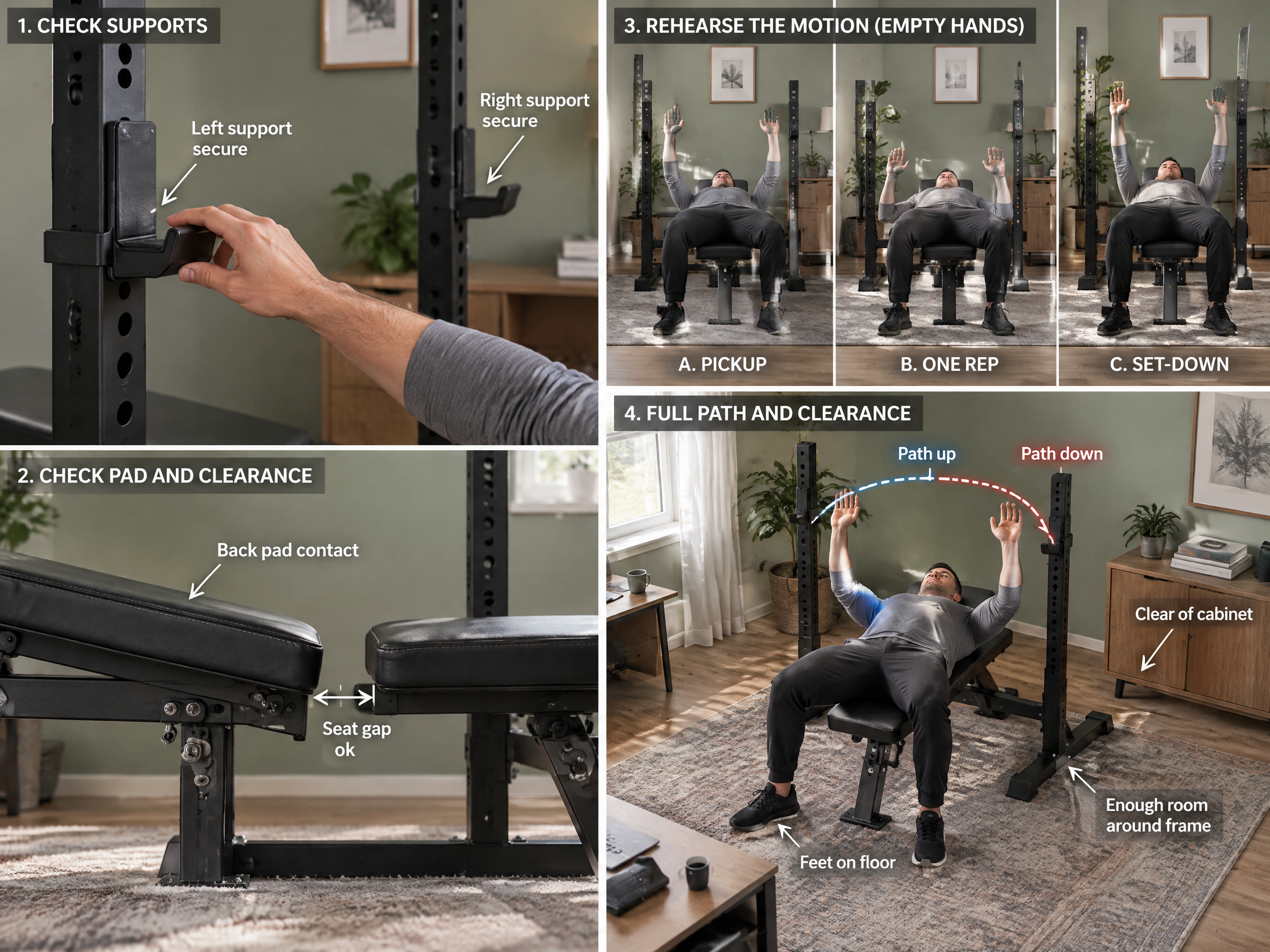
- Set up one exercise
With the bench unloaded, select the backrest and seat positions you expect to use, and check that both supports are engaged.
- Check where you make contact
Get into position and notice where the pad ends and where the gap between the pads falls. Make sure your feet reach the floor or the support intended for that setup.
- Rehearse the whole movement
With empty hands, mimic picking up the weights, doing a rep, and setting them down. Notice whether the frame, floor, or nearby furniture blocks your path.
Folding frames, standalone benches, and attachments
A folding frame changes how a bench packs away; an adjustable backrest changes how it supports you during exercise. Royalatic lists a folding metal frame and eight backrest positions as separate features. For a sense of how different benches can be to move, the standalone REP AB-3000 is listed at 112 pounds. That’s the weight of the bench itself, not its load limit.
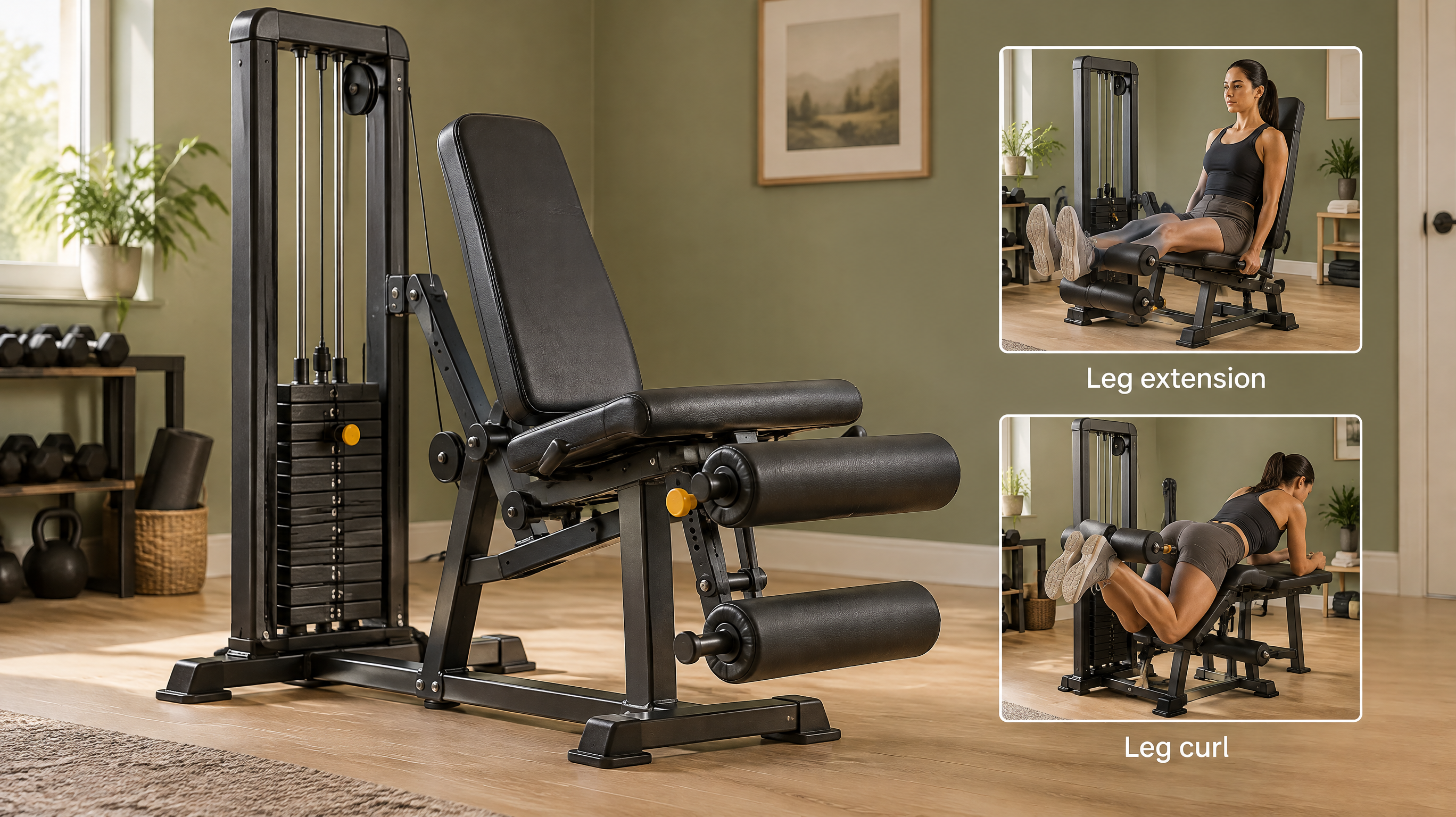
A multifunction bench can add a separate exercise station. For example, JOROTO lists a Roman-chair function, which supports the hips for back extensions. A decline leg brace has a different job: it stays in place during the exercise to help hold your legs in position. A leg developer is a lever that moves against resistance for exercises such as leg extensions or leg curls. Both can have padded rollers, so look at what the rollers do, not just whether they’re there.
What using a bench at home involves
The frame’s footprint isn’t the whole space you’ll need. Leave room to approach the bench with dumbbells, move them on either side of the pad, and set them down clear of furniture. If you’ll put the bench away after each session, think through the route to storage as well as the space it takes up once it’s there.
With a folding bench, opening and securing the frame becomes part of your setup. Follow the manual for setup and storage, and periodically check for loose hardware or play at the pivots. If you only want to press dumbbells at home, a floor press is an alternative: the floor stops your upper arms sooner, so it won’t feel quite like pressing on a bench.
Questions before you commit
Does the bench’s weight limit include me or just the weights?
If the manual gives a total load limit, count your body weight plus the weights you’re using. Check how the manufacturer defines the rating, and don’t assume a limit listed for flat use also applies at other angles or to an attachment.
Can I use a standalone bench for barbell presses?
Yes, if it fits a compatible rack with bar supports and safeties you can set for your pressing position. A standalone bench doesn’t hold or catch the bar. Check your reach and the safety settings with an unloaded bar before adding weight.
Can I make a decline bench by putting one end of a flat bench on blocks?
No. Propping a flat bench on blocks can let the frame shift and doesn’t give you a backrest designed to lock in decline. Use a purpose-built decline setting or stick with a flat variation.
Can I store a bench upright if it doesn’t fold?
Only if the manufacturer says that model is designed for upright storage. Transport wheels help you move a bench, but they don’t tell you whether it can stand securely on end.
Choose your next step
Put your shortlist side by side
See the differences, tradeoffs and who each model suits.
Compare the products →Your next step
- Name the exercises you’d actually use the bench for.
- If decline matters to you, confirm a below-level exercise setting in the manual or angle chart.
- Allow room to handle weights beside the bench and move the bench to storage, if needed.
- Check the manual for the load limit and how to secure the frame and pads.
If you have access to a gym bench, try flat and incline before making room for one at home. A few unloaded reps can tell you more about how the pads fit you than a long list of angle settings can.