Review101
What Are Long Loop Resistance Bands? A Beginner’s Guide to Strength Training With Bands
A long loop can make a row harder and a pull-up easier. It pulls harder as it stretches; whether that pull helps or challenges you depends on its direction.
Read the article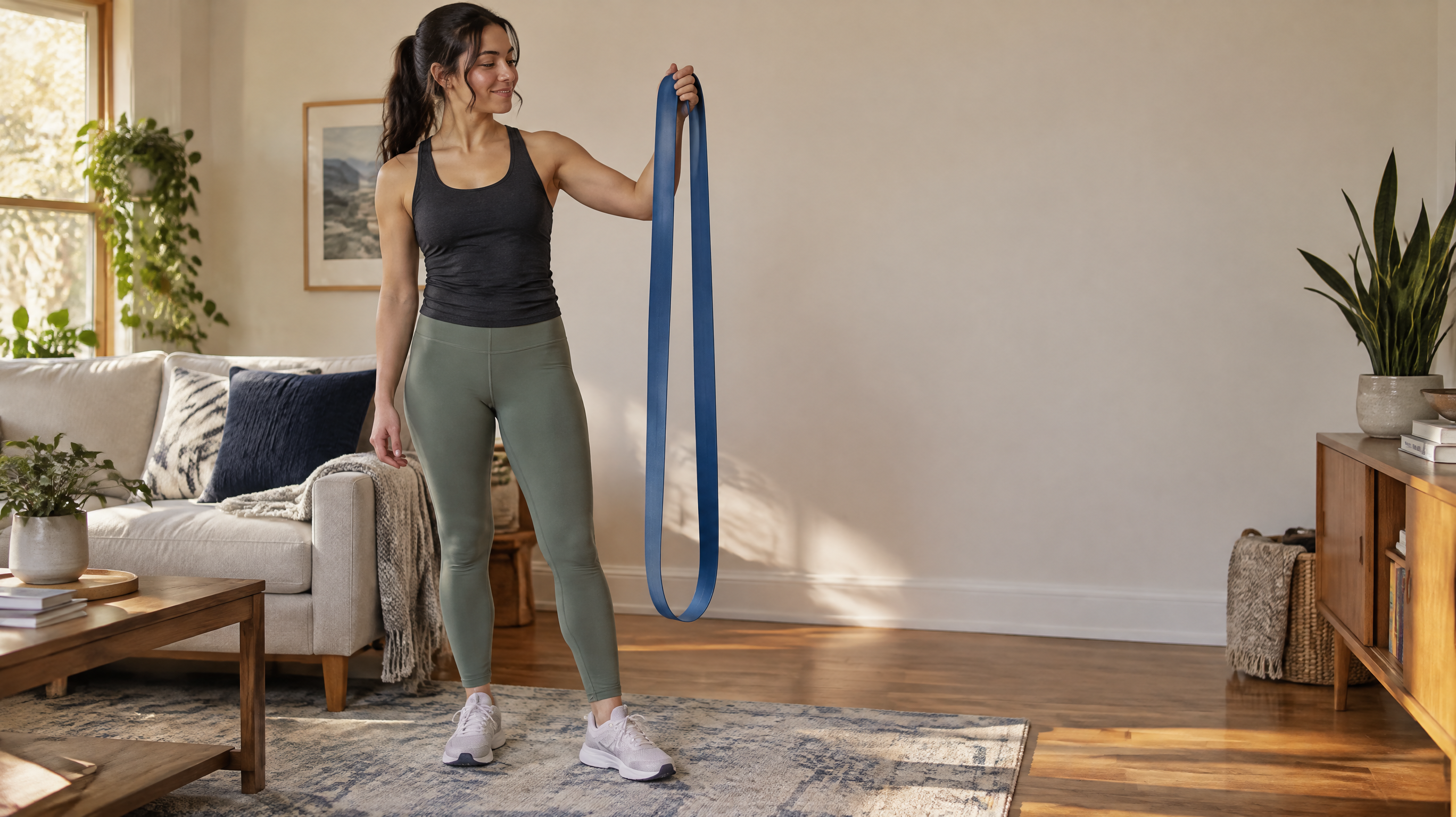
Some links may earn us a commission, at no extra cost to you. How we’re supported
In this article 7 sections
Start with your needs
They’re worth considering if you want strength equipment that’s easy to carry or store.
Stick with dumbbells or gym equipment if tracking a known weight matters more than portability.
If bodyweight movements already give you enough challenge, you don’t need a band to get started.
As an Amazon Associate, we earn from qualifying purchases. Research-based analysis; no hands-on testing.
The short answer
You don’t need long loop bands to get stronger. They’re useful if you want resistance you can pack in a bag or help with a movement such as a pull-up. If bodyweight exercises already challenge you or you prefer lifting a known weight, there’s no need to switch.
Worth considering if
- People who train at home or while traveling and have limited storage.
- People who want one compact tool for several strength movements.
- People who want pull-up assistance and have access to a suitable bar.
Hold off if
- You’re mainly interested in an anchored movement but don’t have a suitable attachment point.
- You want the same labeled load every time you pick up your equipment.
- You need to avoid latex and can’t confirm the exact product’s materials.
Choose your next step
Ready to compare?
See the differences, tradeoffs and who each model suits.
Compare the products →


What makes a band a long loop?
A long loop resistance band is a continuous loop of stretchy material with no loose ends. Laid flat, it forms a long, narrow oval. The extra length gives your hands or body room to move while another part of the loop stays in place.
A mini loop is also closed, but it’s short enough to fit around your thighs or ankles for movements such as side steps. A flat, open-ended band is a strip with two free ends. A resistance tube with handles has dedicated grips; with a plain long loop, the band itself can be the grip.
Gym Salvation and Draper’s Strength both list 41-inch loops. That’s an example of the format, not a universal size standard.
How to read a loop length
See the movement
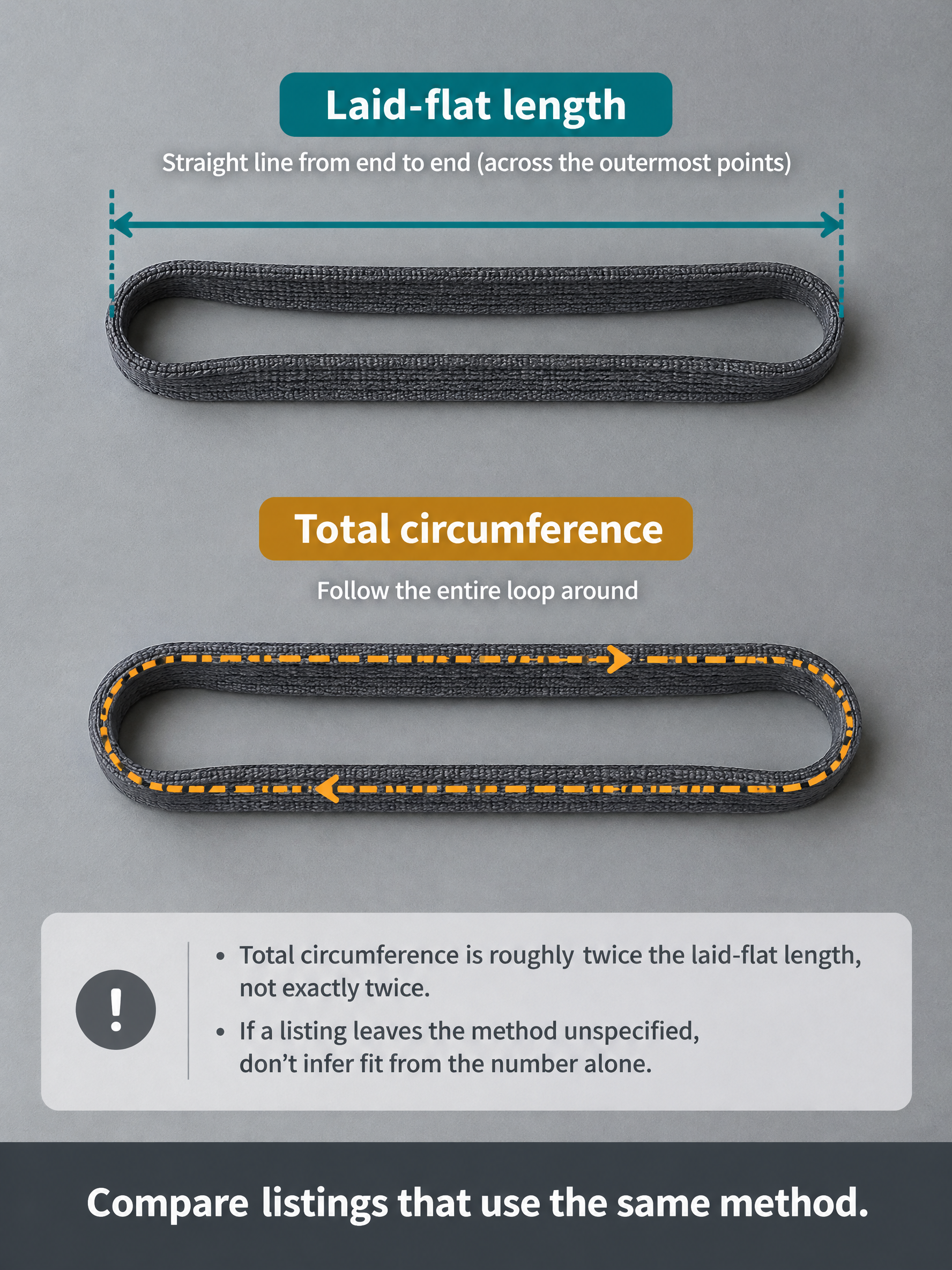
Animate the measurement comparison: draw the straight end-to-end arrow first, then trace one full circuit around the stationary, unstretched loop. Hold both labels on screen long enough to compare.
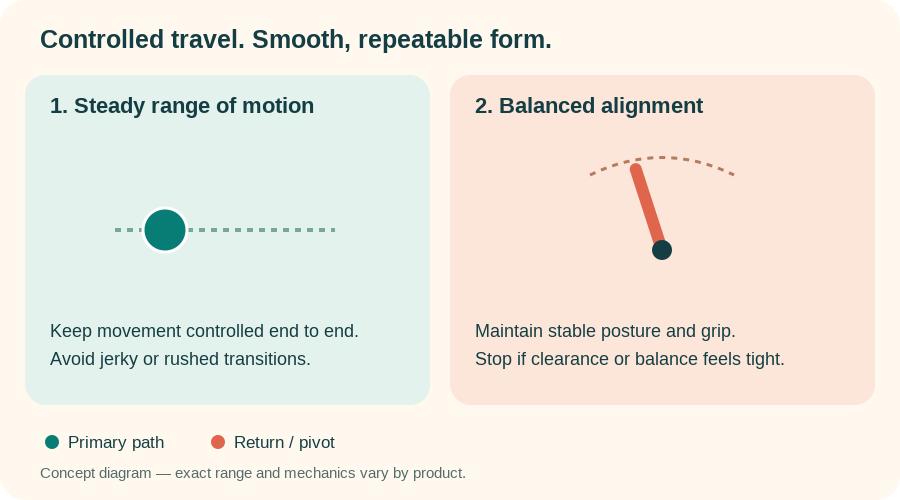
Simplified motion diagram. Exact range and mechanics vary by product.
- Find the measurement method
Look for wording such as “laid-flat length” or “total circumference.”
- Trace the two paths
Laid-flat length runs from one rounded end to the other. Circumference runs all the way around the loop and is roughly twice as long.
- Compare the same measurement
If a listing doesn’t say how it measured the band, don’t assume a larger number means a longer loop.
Why the resistance changes during a rep
A band generally pulls harder the farther it stretches. How much pull you feel depends on how taut the band is at the start and how its length and direction change as you move. The same loop might be nearly slack at the start of one exercise and already pulling firmly at the start of another.
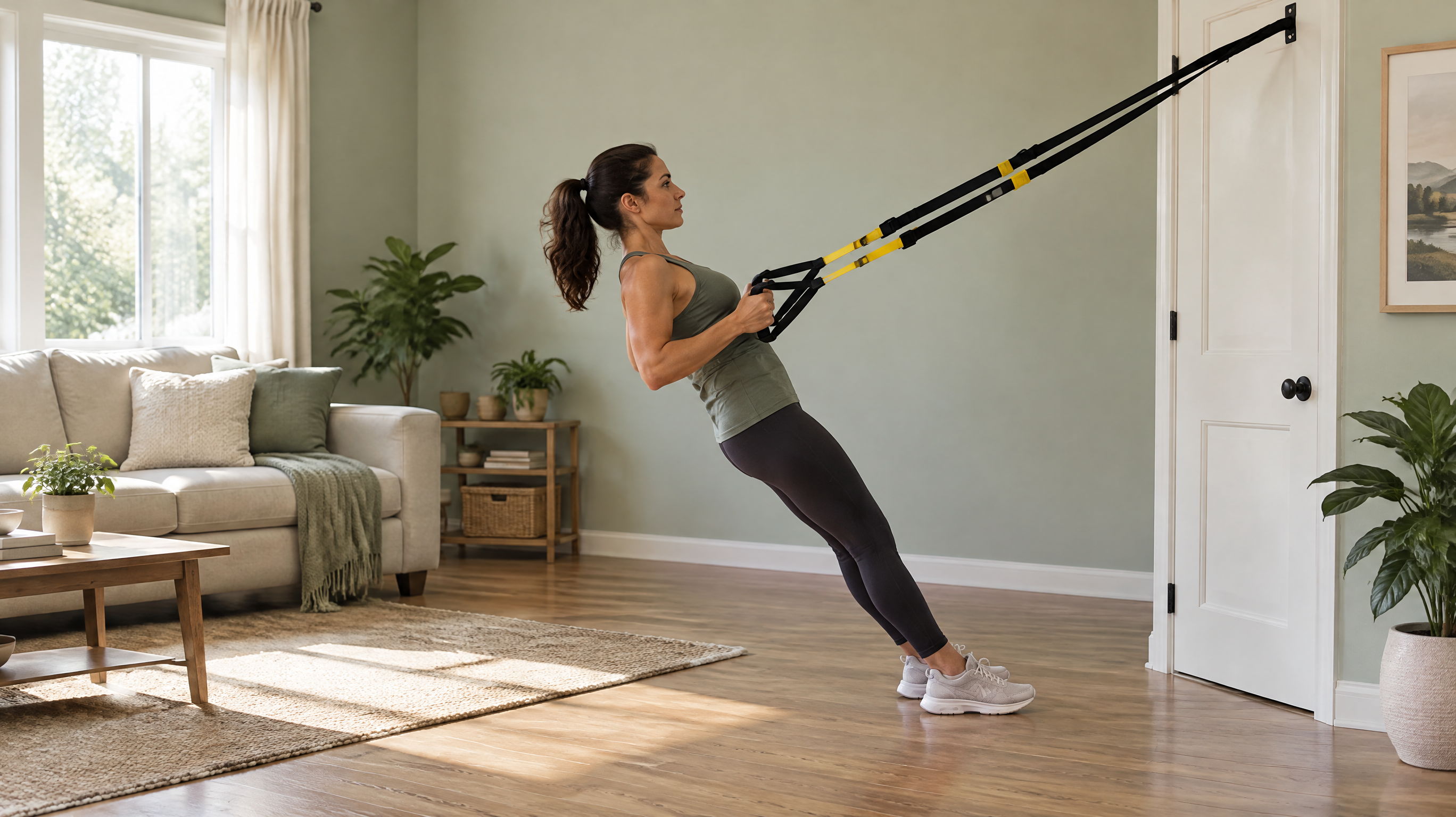
In a row where the band stretches as you draw your hands toward your ribs, it pulls your hands in the opposite direction. That can make the end of the row feel harder than the start. In a typical band-assisted pull-up, the band is most stretched when you’re hanging low. It pulls upward, giving you the most help near the bottom and less as you rise.
An advertised range such as 5–125 pounds for the five-level ROSAPOAR set isn’t a dumbbell equivalent. The range doesn’t tell you how much force a particular band will apply at a particular point in your rep.
Choose your next step
Which model fits your needs?
See the differences, tradeoffs and who each model suits.
Compare the products →Rubber, TPE, and fabric loops
Some long loops use natural rubber, as the ROSAPOAR set does. Others use thermoplastic elastomer (TPE), the material listed for the SPXON set. Knitted elastic loops have a textile surface rather than the feel of bare rubber.
Fabric describes the surface or construction, not necessarily what makes the loop stretch. MitButy’s knitted loops, for example, list latex thread alongside a polyester-cotton blend. If you need to avoid latex, look for an explicit latex-free statement for the exact product. Neither “fabric” nor “TPE” alone is that statement.
Would a loop fit your routine?
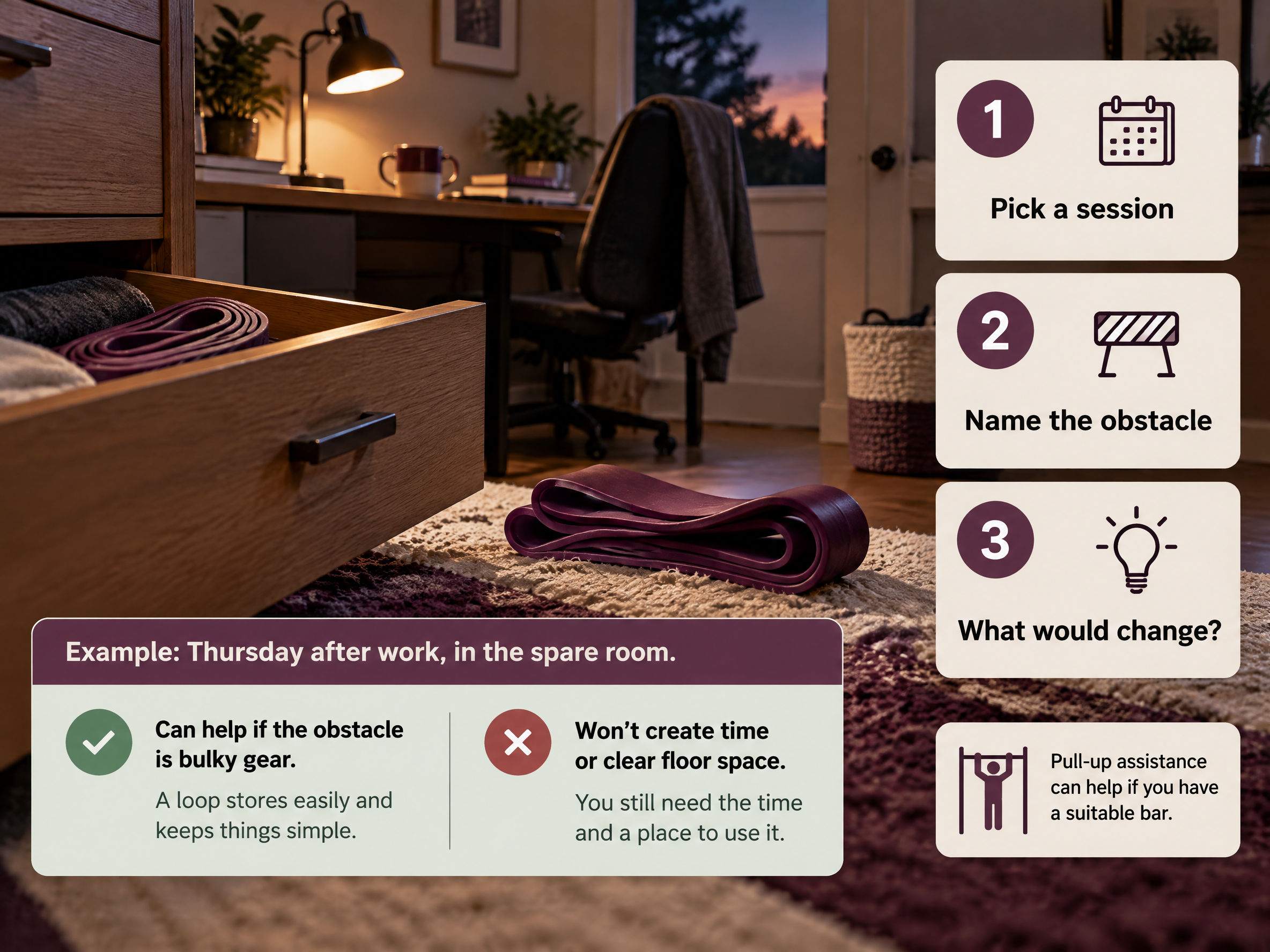
- Picture one session
Pick a day and a place you already train or realistically could.
- Name the obstacle
Is your equipment too bulky, do you lack resistance or assistance, or is the real issue time or room to move?
- Test what would change
A loop can solve an equipment problem. If it wouldn’t change when or where you can train, it may just stay in the drawer.
Why one loop can work for several movements
Change where the loop is held and you change the direction it pulls. That’s why the same basic format can resist a squat, row, or press even though those movements go in different directions. It can also provide pull-up assistance by supporting some of your weight.
A loop can go in a drawer or travel bag instead of taking up the shelf space of a set of weights. A multi-level set gives you several bands with different amounts of pull at comparable stretches. A single-level band still changes tension as it stretches; “one level” doesn’t mean one fixed force. Gym Salvation lists five levels and a carry bag, while the Draper’s Strength example is one loop at one level.
What using and keeping a loop involves
A band takes little room to store, but it still needs room to stretch. Some movements work without a fixed anchor; others depend on a secure attachment point or access to a suitable pull-up bar. If pull-up assistance is the only thing you want and your gym has an assisted pull-up machine, that’s an alternative that doesn’t require owning a band.
Before using a loop, look for cuts, tears, or signs that the material is deteriorating. Retire a damaged band rather than stretching it again to see if it holds. Keep it away from sharp edges and direct sunlight, and follow the maker’s cleaning instructions for the material.
Questions before you commit
Do I need handles or a door anchor to use a long loop?
No. Many movements use the loop itself as the grip and don’t need a fixed anchor. If a movement does require a secure attachment point, that doesn’t automatically mean it needs a door anchor; a pull-up bar serves a different purpose.
Can two people share the same long loop?
Yes, but it may not feel equally challenging to both people. Differences in height, reach, and range of motion can change how far each person stretches the loop in the same exercise.
Does a two-pack always give me two resistance levels?
No. Band count tells you how many loops are in the package, not how many different levels you get. The 4KOR orange pair, for example, lists two loops at one resistance level.
Does band color tell me how strong it is?
Only within the specific product line, if the maker provides a color chart. A black band from one brand doesn’t necessarily pull as hard as a black band from another.
Choose your next step
Put your shortlist side by side
See the differences, tradeoffs and who each model suits.
Compare the products →Your next step
- Name one movement you’d use a loop to resist or assist.
- Check that you have room to move and access to a suitable attachment point if the movement needs one.
- If you avoid latex, verify the claim for the exact product.
- Set aside a storage spot away from sharp edges and direct sunlight.
Start with the movement, not the pound rating: what matters is where the band pulls and whether that pull gives you resistance or assistance.