 Review101
Step Fitness Machines Explained: Mini Steppers, Twist Steppers, and Stair Climbers
On a mini stepper, your feet usually stay on two moving pedals. On a revolving stair climber, you lift each foot onto a new tread. Here’s what moves, what resists each step, and why the difference matters.
Read the article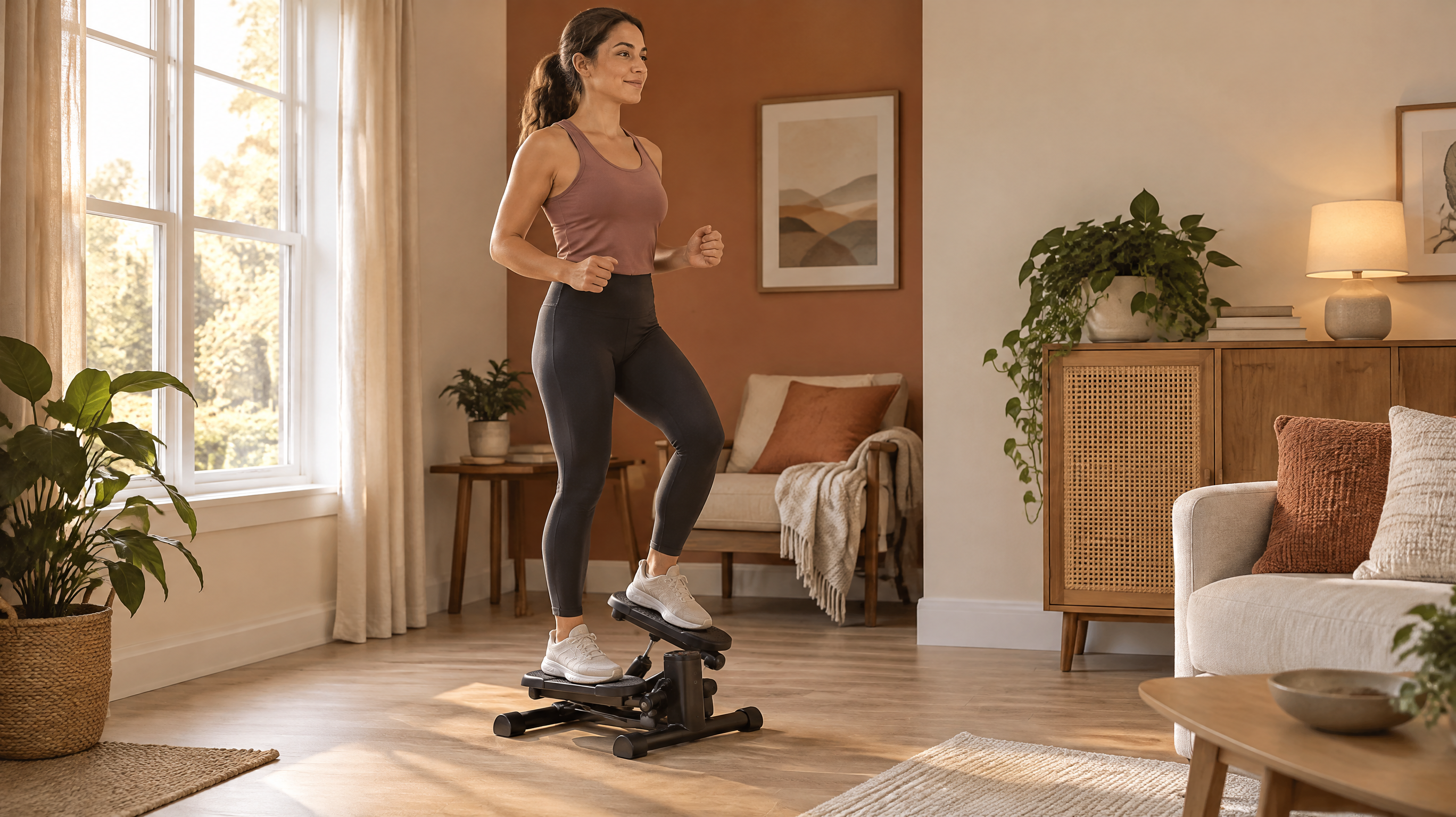
Some links may earn us a commission, at no extra cost to you. How we’re supported
In this article 8 sections
Start with your needs
If you like the rhythm of climbing but don’t have convenient stairs, try a stepper or stair machine when you have access to one.
If the twist or sway is what you’re unsure about, an in-person trial can tell you whether that path feels natural and whether you prefer a fixed handhold.
If stairs, a fixed step platform, or a familiar walking route already give you movement you enjoy, there’s no need to add a machine.
As an Amazon Associate, we earn from qualifying purchases. Research-based analysis; no hands-on testing.
The short answer
You don’t need a step fitness machine to step indoors. Its main appeal is a continuous climbing rhythm without a flight of stairs or a route to follow. If that sounds inviting, try the motion before making room for a machine.
Worth considering if
- People who enjoy a repeating climbing rhythm.
- People who want to move indoors without pacing the room or needing access to stairs.
Hold off if
- You prefer seated movement, a longer walking stride, or a changing route.
- You want a fixed handhold but the design you’re considering offers only bands.
- You don’t have a level spot with room to get on and off comfortably.
Choose your next step
Ready to compare?
See the differences, tradeoffs and who each model suits.
Compare the products →

What is a step fitness machine?
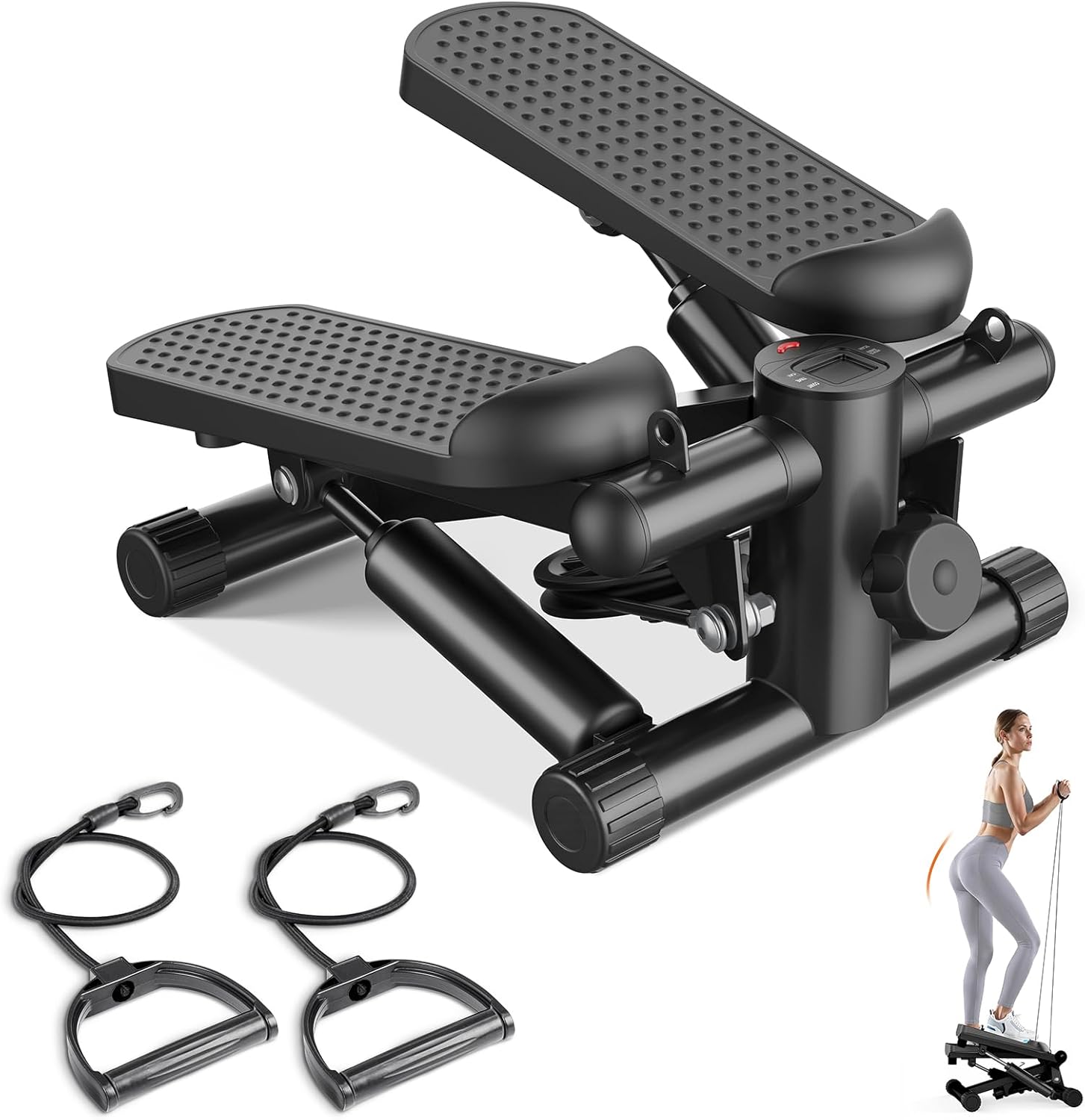
A step fitness machine has moving pedals, foot supports, or stair treads. On a pedal stepper, each foot generally stays on its own pedal as it travels. On a revolving stair climber, the treads move down while you lift your feet onto the next ones, more like climbing an actual staircase. Either way, you stay in one spot.
A fixed aerobic step platform is different: the platform doesn’t move. You lift a foot onto it and step back down to the floor. If what you enjoy is picking up your feet and placing them on a raised surface, a platform or an accessible staircase may give you the part you like without a moving mechanism.
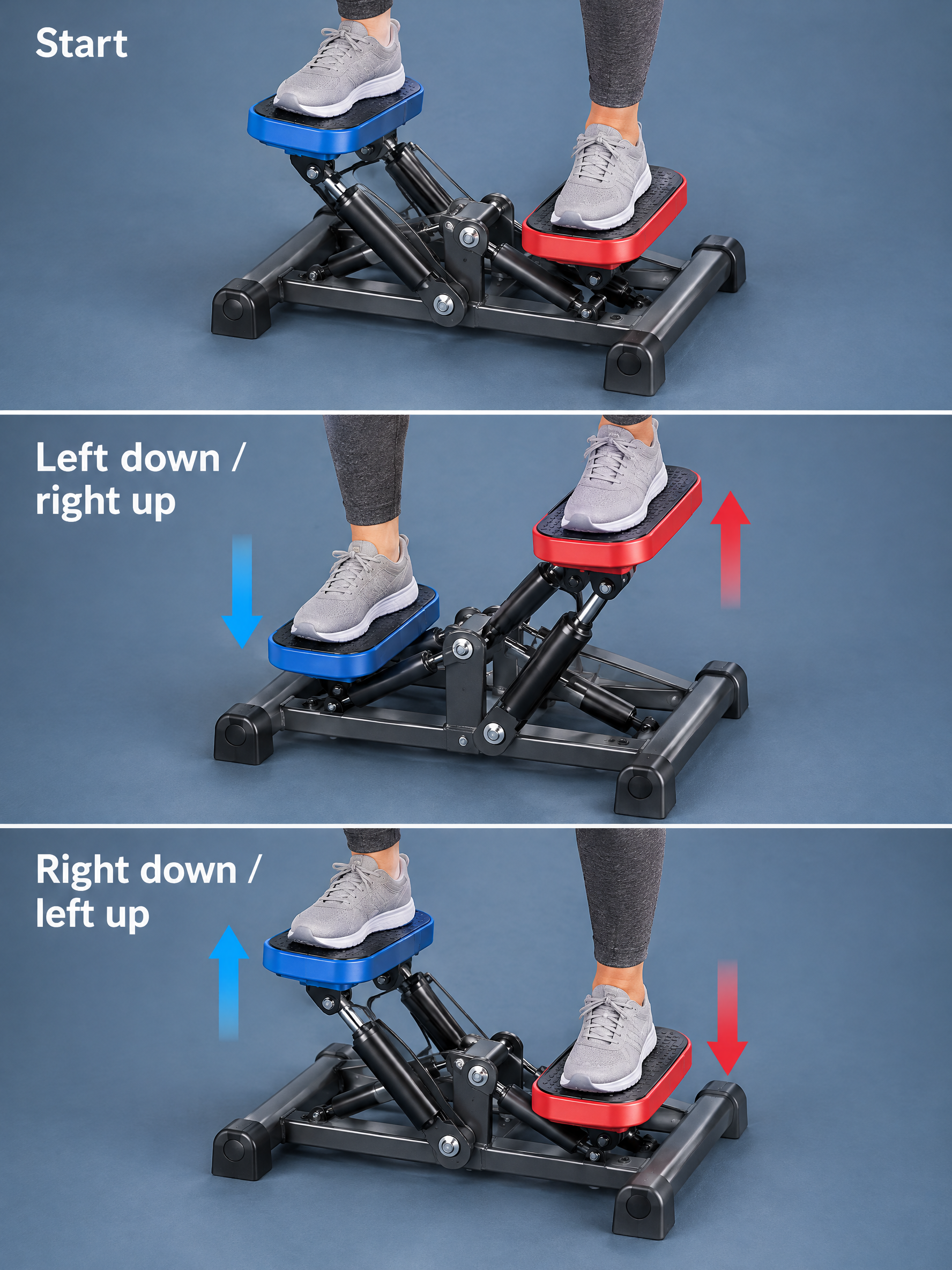
One cycle on a linked two-pedal stepper
See the movement
Loop one full cycle with a fixed camera: the loaded left pedal descends as the right rises, then weight shifts to the right and the pedals reverse. Keep both feet in contact and the base stationary.
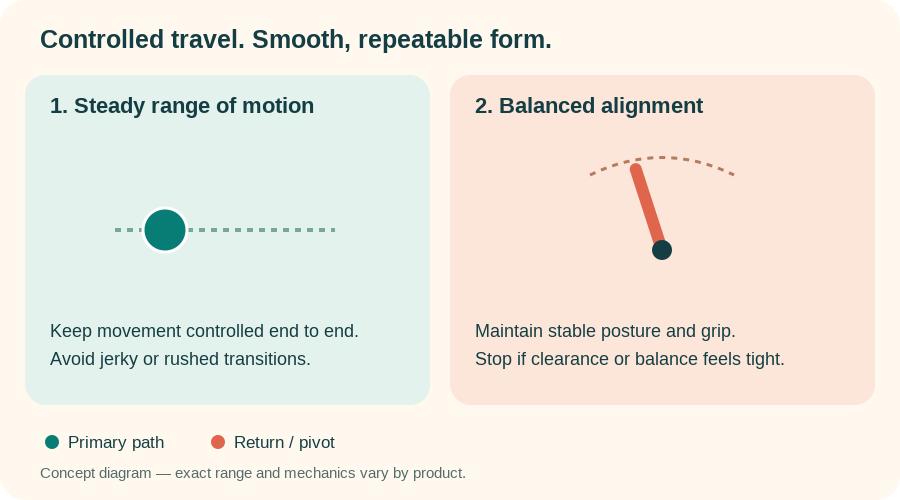
Simplified motion diagram. Exact range and mechanics vary by product.
- One pedal goes down
As your weight shifts onto the higher pedal, it descends against resistance.
- The other pedal comes up
The linkage raises the opposite pedal while your foot stays on it.
- The motion reverses
Your weight transfers to the pedal that just rose, and the two pedals trade directions.
What resists each step?
In a typical hydraulic stepper, pedal movement drives a piston in a cylinder. As fluid is forced through a narrow passage, it resists the piston’s movement. That’s why the pedal pushes back instead of dropping freely under your weight. Sunny Health & Fitness lists hydraulic resistance on its Mini Stair Stepper with Resistance Bands.
Air and magnets can also provide resistance. An air-based design can use air pressure to oppose movement, while a magnetic system can use magnets to create drag on a moving part linked to the pedals. JOROTO lists an air stepper, and YOLEO lists a magnetic stair stepper. Those labels describe the resistance type, not the direction your feet travel or whether you can adjust the resistance.
Choose your next step
Which model fits your needs?
See the differences, tradeoffs and who each model suits.
Compare the products →How do straight stepping, twisting, and rocking differ?
On a straight stepper, your feet travel mostly up and down, even if the pedals trace a slight arc. A twist stepper adds an angled or turning component to the pedal’s path. A rocking stepper adds a side-to-side tilt or sway as your weight shifts. These terms tell you what to look for, not exactly how the motion will feel.
Sweetcrispy calls its compact machine a twist stepper, while MERACH describes its rocking stepper as a balance-board design. A front-view demo makes sideways movement easier to see. A side view shows how far the pedals travel up and down. Both are more informative than the word “stepper” on its own.
Find out what you want from indoor stepping
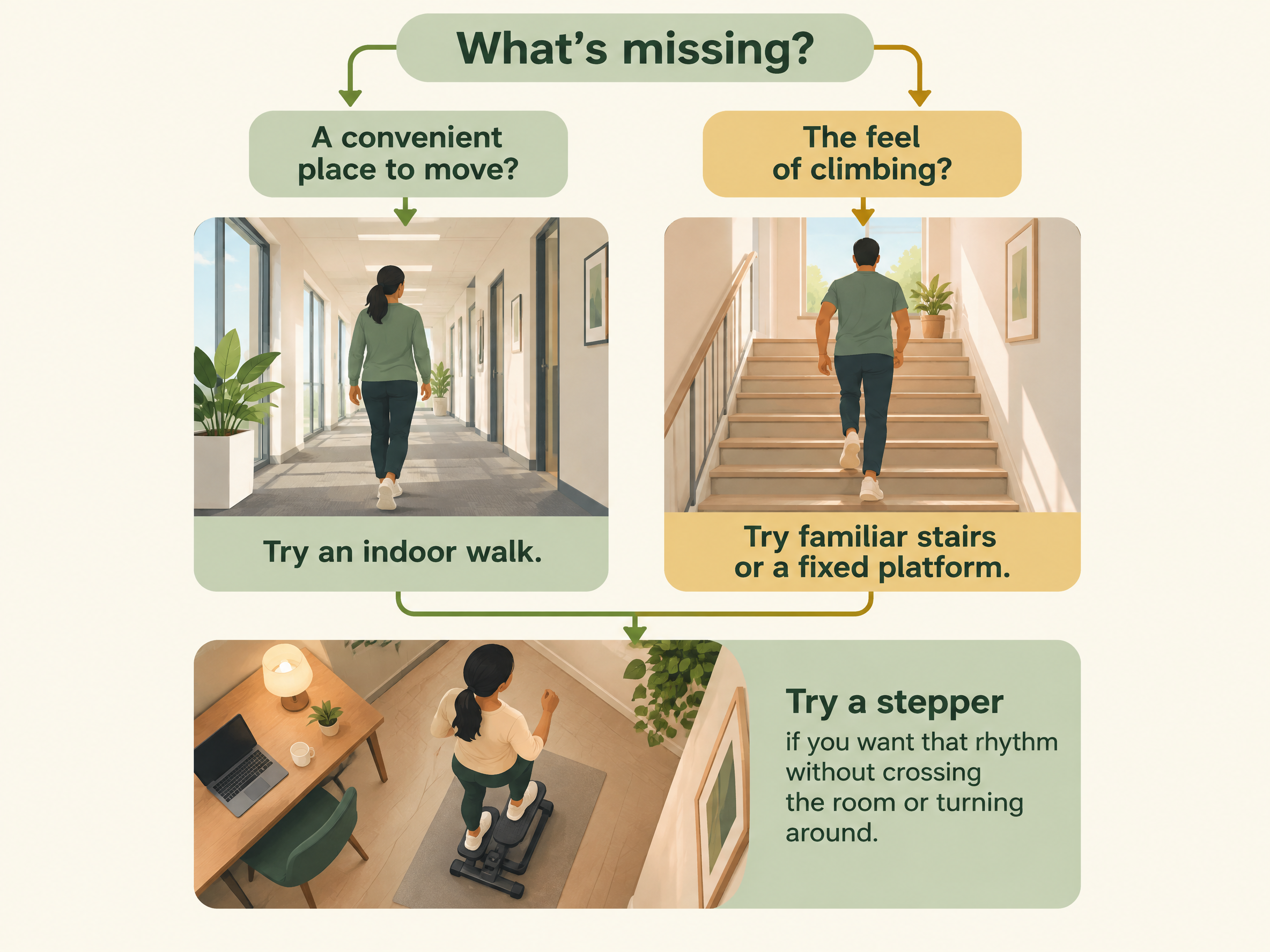
- Name what’s missing
Is the problem finding a convenient place to move, or do you specifically miss the feel of climbing?
- Try the simpler alternative
An indoor walk can answer the access question. Familiar stairs or a fixed platform can tell you whether stepping up is the part you enjoy.
- See what the machine adds
If you want the climbing rhythm without turning around or moving across the room, try a machine and notice whether that difference matters to you.
What changes from a mini stepper to a stair climber?
A mini stepper puts the pedals on a low base. An upright pedal climber has a taller frame but still lets your feet stay on the pedals. Some upright models, such as the MERACH Foldable Stair Climber, fold for storage. What matters in use is how much room the frame takes up when open, not just where it fits when folded.
On an upright climber with a longer stride, each foot can travel farther between the high and low points of a step. One Sunny Health & Fitness stepper-climber lists a 21.5-inch climbing stride and an adjustable handlebar. The bar gives your hands a fixed place to rest, which feels different from keeping them free or holding flexible bands.
Full-size stair machines are on a different scale: Sunny’s commercial-grade stair climber is listed at 84 inches tall and includes a power cord. Some gym-style machines use a revolving staircase, with treads that descend and cycle out of view. But the label “stair climber” also appears on pedal machines. Look for a pair of pedals or a series of moving treads to tell which motion it offers.
What does a stepper add to an indoor routine?
The advantage is access. You have a place to step when the weather is poor, there’s no convenient staircase, or you’d rather move indoors without clearing a route through the room. If a change of scenery or a longer stride is what makes walking enjoyable for you, stepping in place may not offer the same appeal.
Some machines give your hands something to do or give you a way to see how long you’ve been moving. Sunny’s Mini Stair Stepper lists removable resistance bands and an LCD. The bands let you pull against tension, but they don’t double as a firm handhold. A display may show elapsed time or step count, depending on what the model tracks.
What is it like to keep a stepper at home?
Floor footprint is only part of the space you need. Allow for a level spot, room to get on and off, and headroom when you’re standing on the raised pedal or tread. If the machine won’t stay out, think through where it will go and what you’ll have to move each time you bring it back out.
For upkeep, follow the manual’s directions on flooring, cleaning, and hardware checks. Pedals and grips are the surfaces you’ll handle or stand on most. A powered stair machine also needs a suitable outlet and a cord route that stays out of foot traffic.
Questions before you commit
Does a stepper need a wall outlet?
Not always. A hydraulic mini stepper can resist pedal movement without wall power; Sunny’s Mini Stair Stepper lists an LCD and an included LR44 battery, while its commercial-grade stair climber lists a power cord. Check the power requirements for the display separately from those for the rest of the machine.
Will someone downstairs hear me stepping?
They might, even if the mechanism itself sounds quiet. Repeated foot pressure can send vibration through the floor, so what you hear beside the machine may not be what someone hears below. If possible, check from downstairs with the stepper in its intended spot, and follow the manual’s guidance on flooring and mats.
Can I use a regular mini stepper while sitting at a desk?
Only if the manufacturer says it’s suitable for seated use. A standing mini stepper is designed around shifting your weight over the pedals. If you want to move without getting out of your chair, look for a seated pedal exerciser instead.
Does adjustable step height mean adjustable resistance?
No. Step height changes the amount of pedal travel; resistance changes how strongly the mechanism opposes that travel. Either can change how a step feels, but a height adjustment doesn’t establish that resistance can be adjusted separately.
Choose your next step
Put your shortlist side by side
See the differences, tradeoffs and who each model suits.
Compare the products →Your next step
- Identify what moves underfoot: pedals, a rocking base, or revolving treads.
- Notice where your hands would go: on a bar, on bands, or free at your sides.
- Allow room to step off and enough headroom at the highest point you’ll stand.
- Picture where the machine would live between uses.
When a listing calls something a “stair stepper,” watch what happens to one foot through a full cycle. Whether it stays planted or lifts onto the next tread tells you more about the experience than the name does.