Review101
Standing Elliptical Cross Trainers: How They Work and What to Expect
On a standing elliptical, your feet stay on the pedals as they trace a repeating loop. Learn what makes that motion different from walking, what the controls change, and whether it’s a workout you’d want to do at home.
Read the article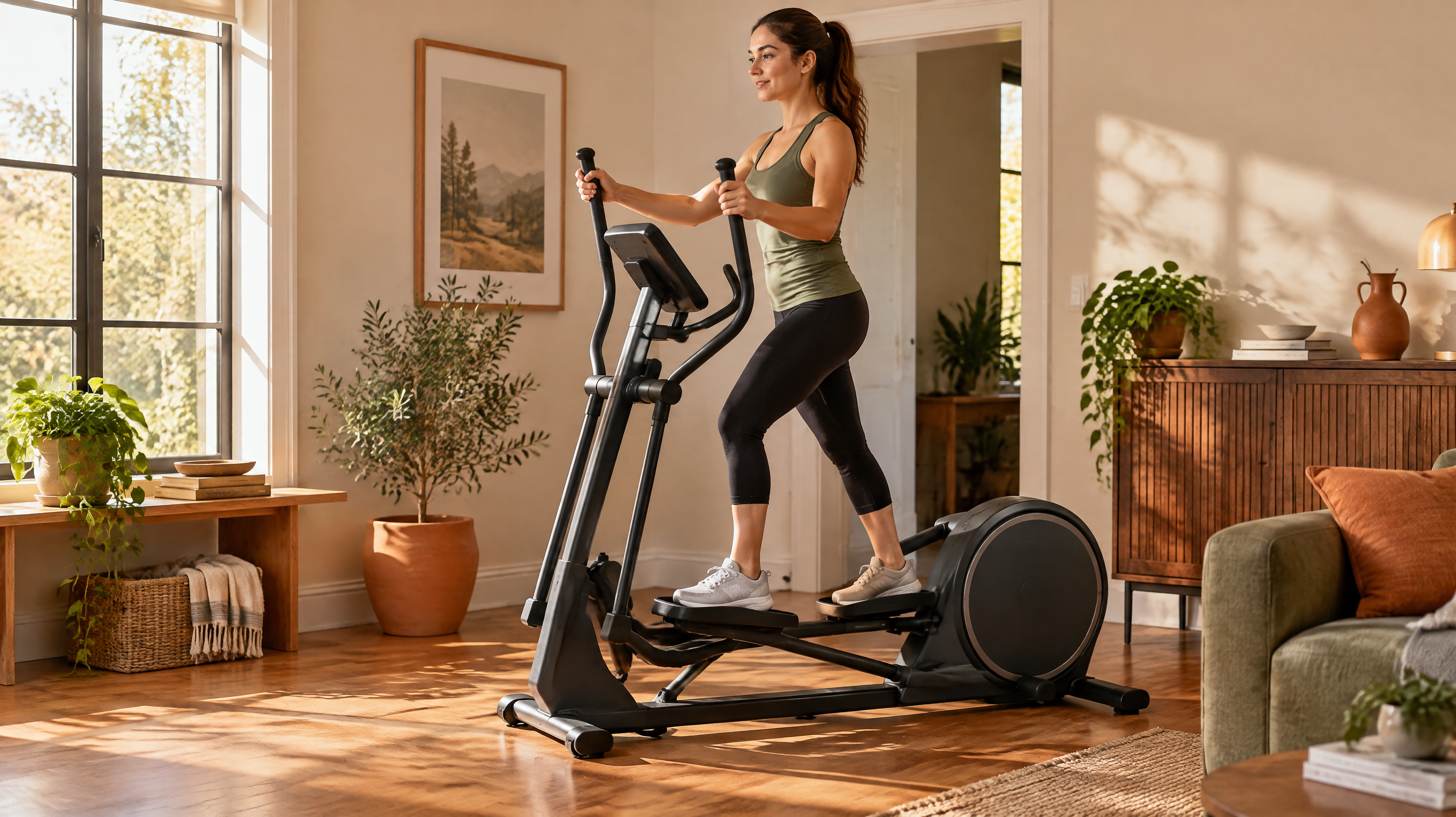
Some links may earn us a commission, at no extra cost to you. How we’re supported
In this article 8 sections
- What makes an elliptical a standing cross trainer?
- Follow one stride: what the pedals and handles do
- What magnetic resistance changes—and what it doesn’t
- Compact upright, foldable, and incline: what the labels describe
- What the movement offers in a home workout
- What ownership takes beyond floor space
- Questions before you commit
- Your next step
Start with your needs
Use a standing elliptical before deciding whether you want that guided motion at home.
Consider a home machine if travel, gym hours, or weather regularly gets between you and a workout you enjoy.
If walking, cycling, or using equipment you already have access to fits your week, there’s no need to add an elliptical.
As an Amazon Associate, we earn from qualifying purchases. Research-based analysis; no hands-on testing.
The short answer
You don’t need an elliptical to do cardio at home. It’s worth considering if you enjoy the guided standing motion and having the machine nearby would make it easier to exercise regularly. Try one at a gym or showroom before committing floor space.
Worth considering if
- People who enjoy a guided standing stride and want indoor cardio they can do on their own schedule.
- People who like switching between leg-focused movement and active push-pull arm work on a machine with both grip options.
Hold off if
- You mainly want to pedal while seated or working at a desk.
- Mounting, standing, or reaching the moving handles feels awkward during a trial.
- The only workable setup involves moving furniture or hauling the machine out every session.
Choose your next step
Ready to compare?
See the differences, tradeoffs and who each model suits.
Compare the products →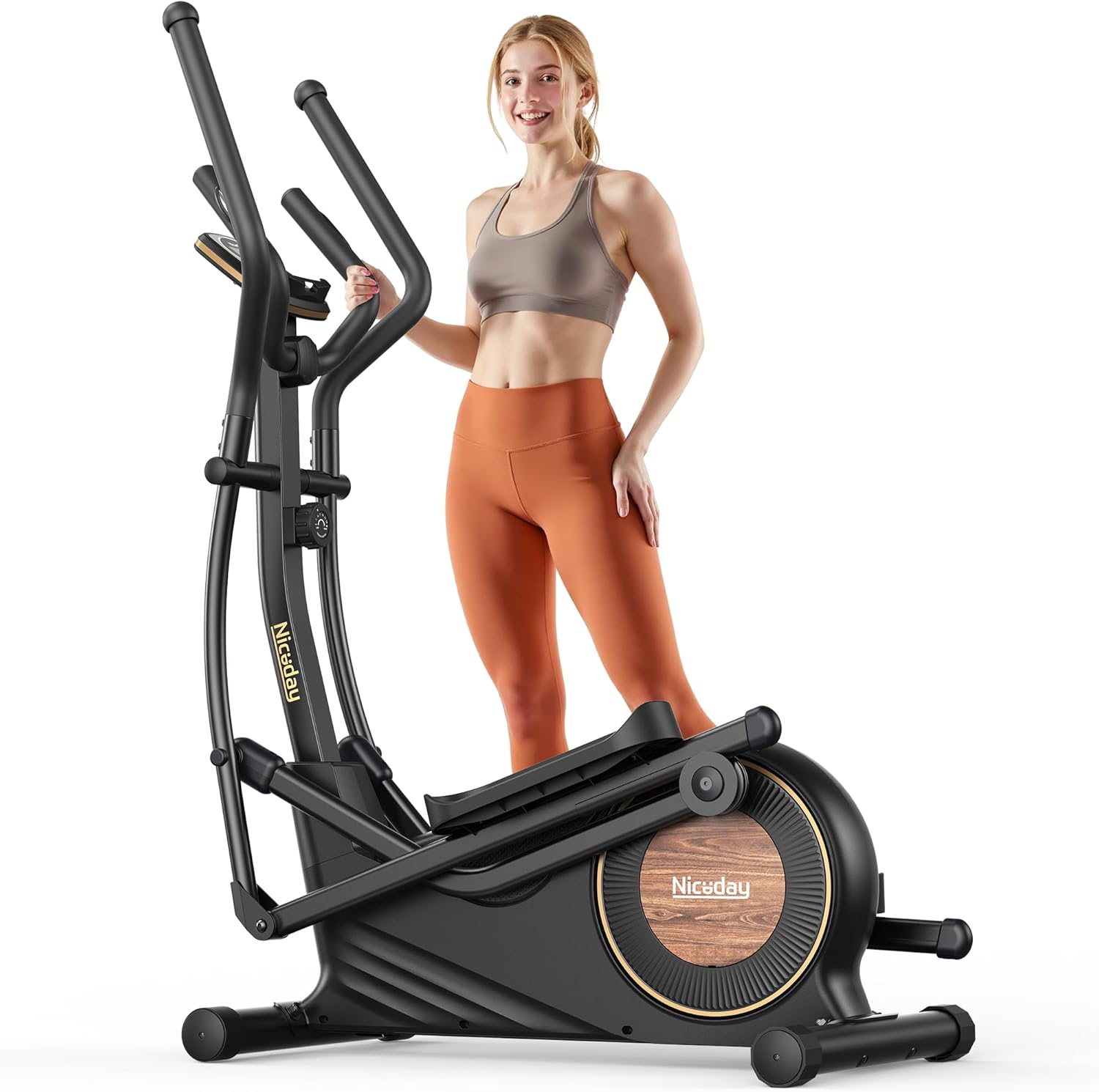


What makes an elliptical a standing cross trainer?
You stand on two foot platforms and drive them through a repeating loop. As one pedal moves forward, the other moves back. It feels somewhere between stepping and gliding: your legs keep moving, but your feet don’t have to lift and land with each stride.
A recumbent elliptical has a built-in seat, while an under-desk exerciser is designed to be pedaled from a separate chair. Neither asks you to stand over moving pedals. An air walker does, but its suspended pedals typically swing in arcs rather than tracing an elliptical loop. If you’re curious about the standing elliptical stride, none of these is a substitute for trying it.
Use a trial session to separate fit from effort
See the movement
Follow the two pedal positions, then the back-and-forth handle movement.
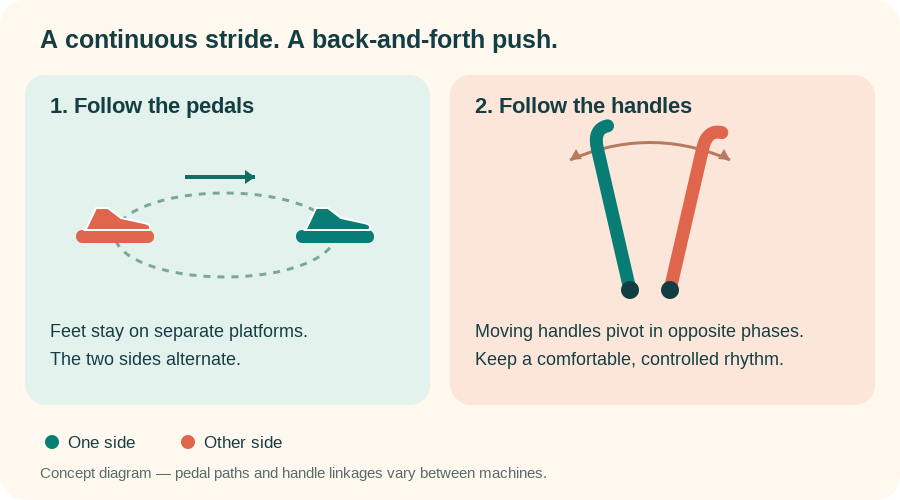
Simplified motion diagram. Actual linkage and pedal paths vary by model.
- Find an easy rhythm
Start at light resistance. Use the fixed grips if available and find a pace you can hold without leaning on them.
- Notice where you reach
Check whether the stride makes you stretch at the front or feel crowded at the back. Try the moving handles and notice whether you have to twist to follow them.
- Change one control
Keep your pace steady and raise the resistance. Notice what feels like extra effort and what still feels awkward about the path itself.
Follow one stride: what the pedals and handles do
The pedals travel forward and back while rising and falling. On machines with linked moving handles, you can push and pull to help drive the same motion. Fixed grips, where provided, let you steady your hands and leave the work to your legs.
Stride length describes the pedal’s front-to-back travel. The Sunny Health & Fitness Smart Upright SF-E905SMART lists an 11-inch maximum stride; the Niceday CT11S-18-Black lists 18 inches. Neither number tells you how high the pedal rises or how far apart your feet sit. A longer glide might feel natural to one person and like a reach to another.
Choose your next step
Which model fits your needs?
See the differences, tradeoffs and who each model suits.
Compare the products →What magnetic resistance changes—and what it doesn’t
On a magnetic elliptical, a brake resists the flywheel’s rotation. At the same pedaling pace, turning up the resistance makes each cycle harder to drive. Cadence is how fast you turn those cycles over. Incline is different again: it changes the angle of the pedal path, so the stride can feel different even at the same cadence and resistance setting.
The MERACH 19-inch Classic Black variant lists eight magnetic resistance levels; the Niceday CT11S-18-Black lists 16. Those counts tell you how many settings each machine has, not how big the jump is between settings or which machine is harder at the top setting. They don’t tell you which machine is quieter, either.
Test whether an elliptical would fit your week
- Pick a real workout slot
Choose a time you could realistically exercise and check who else uses the room then.
- Walk through the setup
Trace what you’d have to move or unfold before starting and what you’d have to put back afterward.
- Compare your fallback
On a busy day, would you still set it up, or would a walk, bike ride, or gym visit be easier to start?
Compact upright, foldable, and incline: what the labels describe
Upright describes how you use the machine. Compact describes its size, but there’s no standard compact footprint. Foldable tells you the machine can change shape for storage, not how much space it needs while you pedal. YOSUDA’s Black-Foldable variant is also described as compact; check the open and folded dimensions separately rather than relying on either label.
Adjustable incline means the pedal path can be set at different angles. The Acezoe E10, for example, lists three incline settings separately from its 16 resistance levels. Power incline tells you how the angle changes: a motor makes the adjustment instead of you repositioning the mechanism by hand. SOLE’s shared E-Series listing identifies power incline for the E25 and E35 specifically. These labels aren’t mutually exclusive: a compact machine can fold, and a machine with incline doesn’t have to.
What the movement offers in a home workout
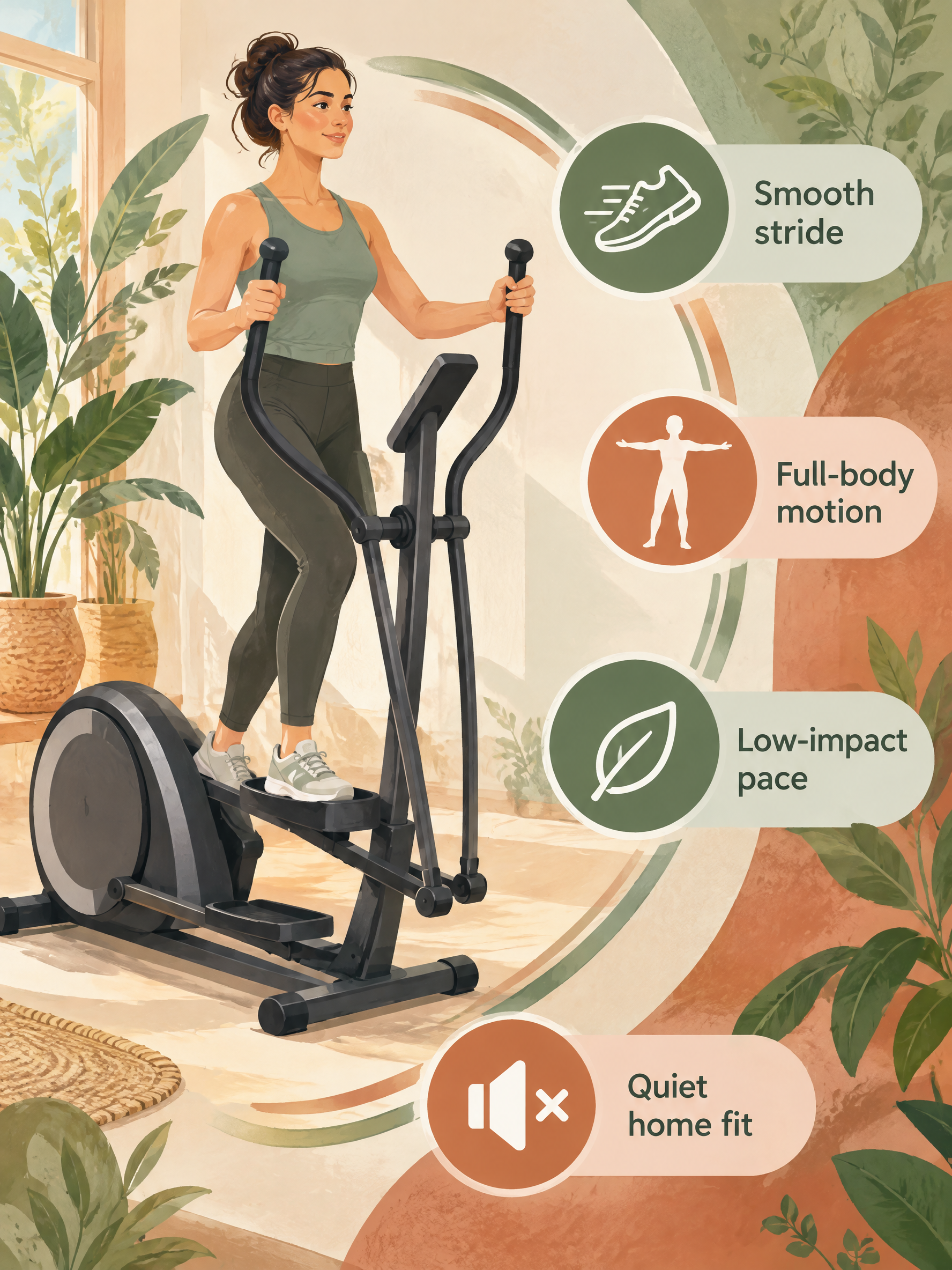
The draw is continuous standing cardio without repeated foot landings. You can settle into a steady glide, change pace or resistance when you want more effort, and add push-pull arm movement if the machine has linked handles. The lack of repeated landings is what makes the motion low impact; it doesn’t guarantee a pain-free workout or make the machine a rehabilitation tool.
If you’d rather sit, a stationary bike is a closer match for a dedicated cardio session, while an under-desk unit suits pedaling from a chair. If you already walk regularly or have easy access to a gym elliptical, a home machine mainly changes where and when you can exercise. Think about which sessions it would make possible that you tend to miss now.
What ownership takes beyond floor space
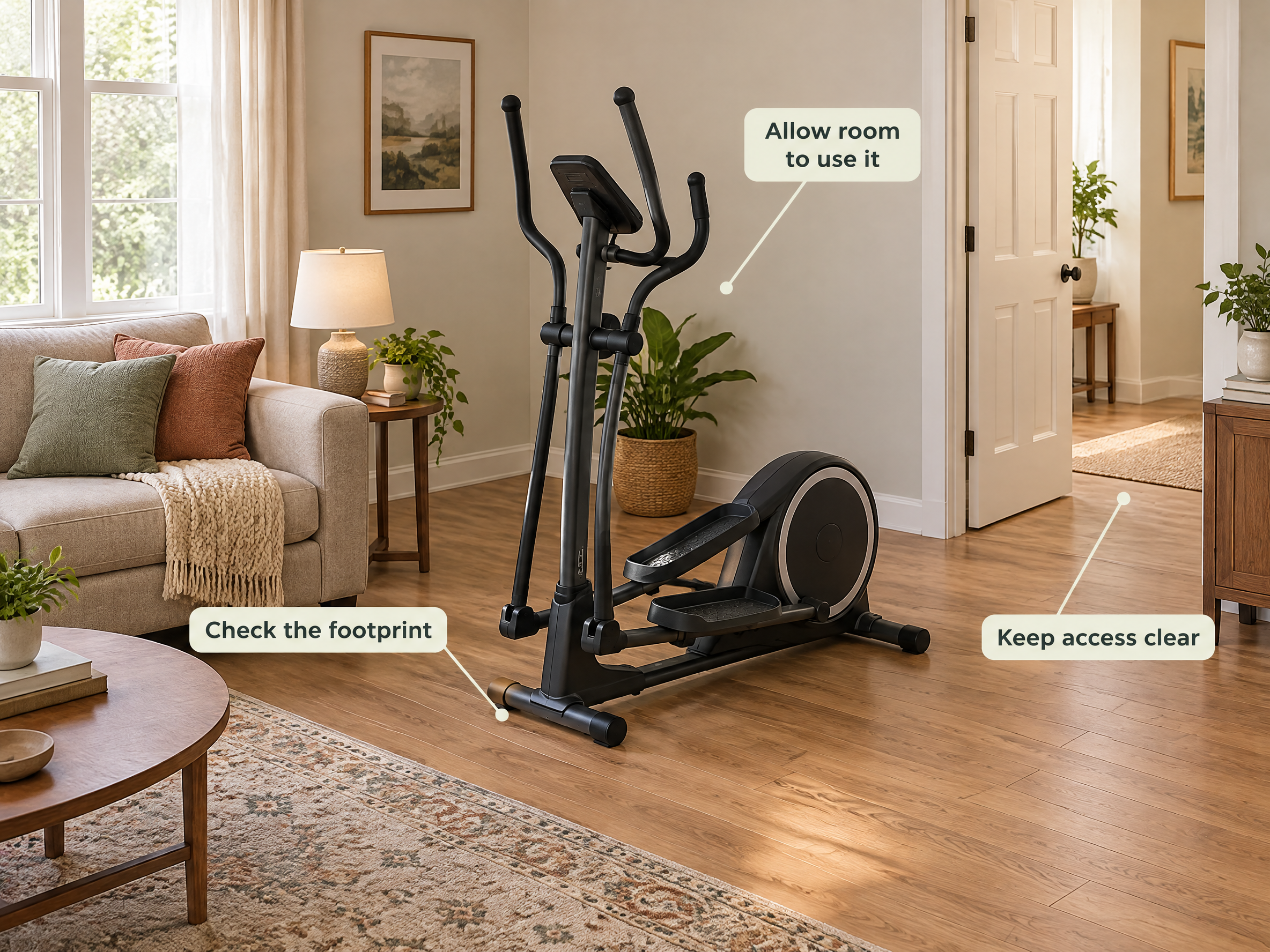
A frame that fits in a corner can still be awkward to use there. Leave room for the handles to swing and for you to get on and off. Check headroom while standing on the pedals, including at the highest incline you’d use. Follow the manual’s operating clearances rather than treating the frame dimensions as the whole workout area.
Before delivery, check the route through doors, stairs and tight turns, and find out what assembly requires. Confirm what needs batteries or a wall outlet, including the console and any powered adjustments. Set the machine on a stable, level surface and follow the manual for cleaning and hardware checks.
Questions before you commit
How do I get on if the pedals move when I step on them?
Use the model’s mounting instructions and hold the fixed grips if provided. If the manual calls for stepping onto the lower pedal first, let it settle before shifting your weight onto it. Wait for the pedals to stop before stepping off.
Can two people of different heights share one elliptical?
Yes, if the pedal path and handle reach work for both people and both are within the machine’s user weight limit. Have each person try getting on, pedaling, and reaching the moving handles. Changing resistance won’t fix a stride that feels too stretched or cramped.
Will a magnetic elliptical bother my downstairs neighbors?
It might: magnetic braking doesn’t eliminate linkage noise or vibration through the floor. Set the machine on a stable, level surface and, if possible, have someone listen downstairs while you pedal at your usual pace.
Can I use a smart elliptical without an app?
It depends on the model. If you want to leave your phone aside, check the manual to see whether you can start pedaling, adjust resistance, and see basic workout information without pairing a device or signing in. An app-connectivity label alone doesn’t tell you what works offline.
Choose your next step
Put your shortlist side by side
See the differences, tradeoffs and who each model suits.
Compare the products →Your next step
- Measure the usable workout area, including headroom and room to mount and dismount.
- If it folds, confirm the storage dimensions and how you’ll move it into place.
- Check the exact variant’s user weight limit, power needs, and assembly instructions.
Picture your next ordinary workout, not your ideal week. A machine you can step onto when you have time is more useful than one you have to clear the room to use.