 Review101
Fitness Trampolines for Adults: What Rebounders Are and How They Work
A fitness rebounder is a mini trampoline for marching, shifting your weight, or bouncing in place. Here’s what makes the mat move, how the main designs differ, and how to tell whether you’d actually use one.
Read the article
Some links may earn us a commission, at no extra cost to you. How we’re supported
In this article 8 sections
Start with your needs
If the bounce is the appeal, borrow a rebounder or try a beginner class before committing.
If you mainly want an indoor routine set to music, try marching or dancing without equipment.
Hold off if you don’t have enough clearance or putting the frame away would be a chore every time.
As an Amazon Associate, we earn from qualifying purchases. Research-based analysis; no hands-on testing.
The short answer
You don’t need a rebounder for home cardio. Try one before buying if the springy surface is what appeals to you. If you mainly want to move indoors to music, start with a floor-based routine.
Worth considering if
- People who enjoy rhythmic, upright movement and want an indoor routine they can do in one spot.
- People who like the feel of a moving mat and have a clear place to use it.
Hold off if
- You feel unsteady during gentle weight shifts or prefer a firm surface underfoot.
- You lack overhead clearance or can’t check how much vibration carries through a shared floor.
- You already enjoy your indoor routine and aren’t especially interested in the bounce.
Choose your next step
Ready to compare?
See the differences, tradeoffs and who each model suits.
Compare the products →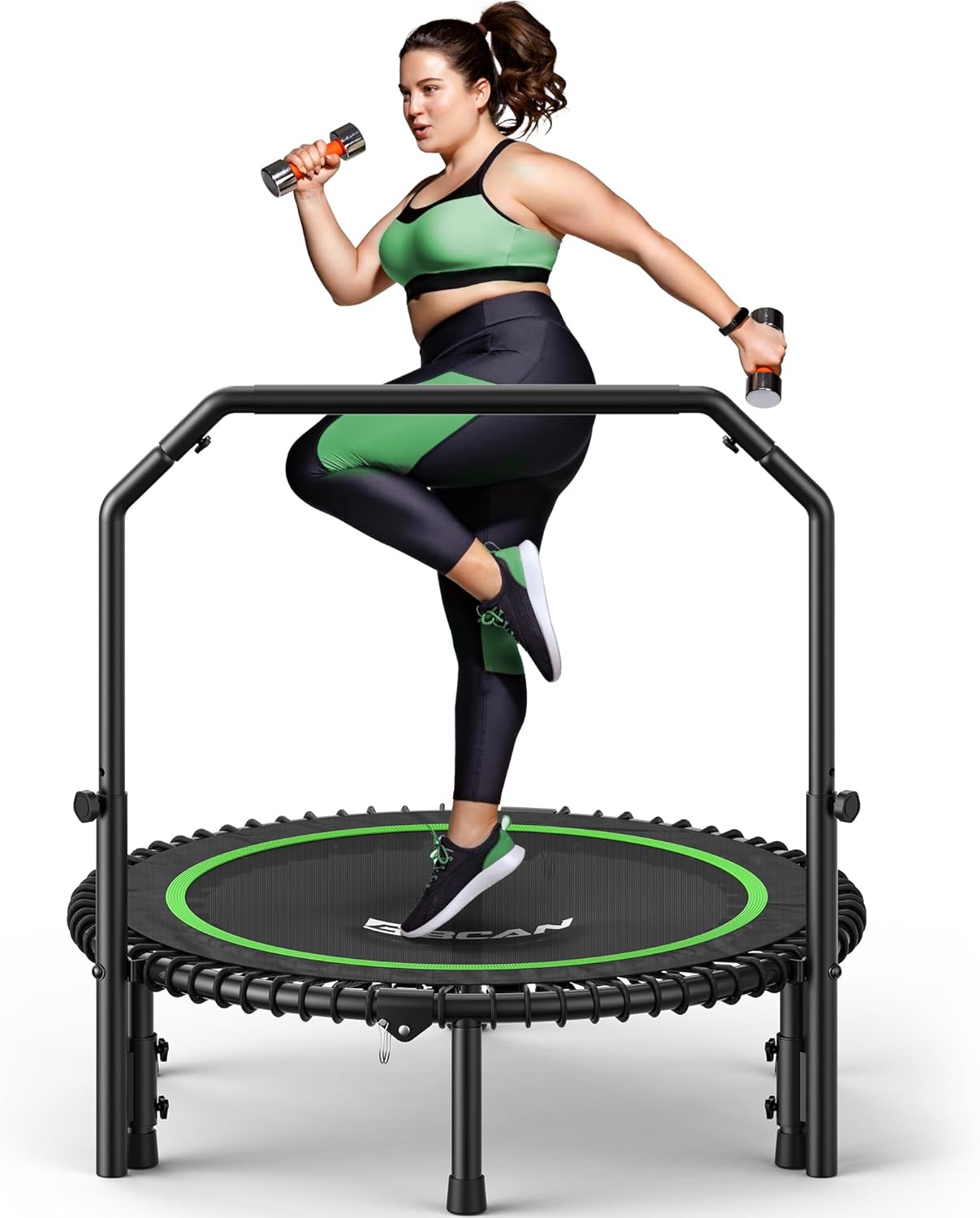


What is a fitness rebounder?
A fitness rebounder is a compact exercise trampoline designed for movement in place. The rigid outer frame anchors the suspension, which holds the flexible mat inside the frame. The legs lift the frame off the floor so the mat has room to dip when you step on it.
A handlebar is separate from the suspension. It gives you a place to steady yourself if the model includes one, but it doesn’t create the bounce. If you want a handhold, check what comes with the exact version and how the manufacturer says to use it.
How to go from a march to a gentle two-foot bounce
See the movement
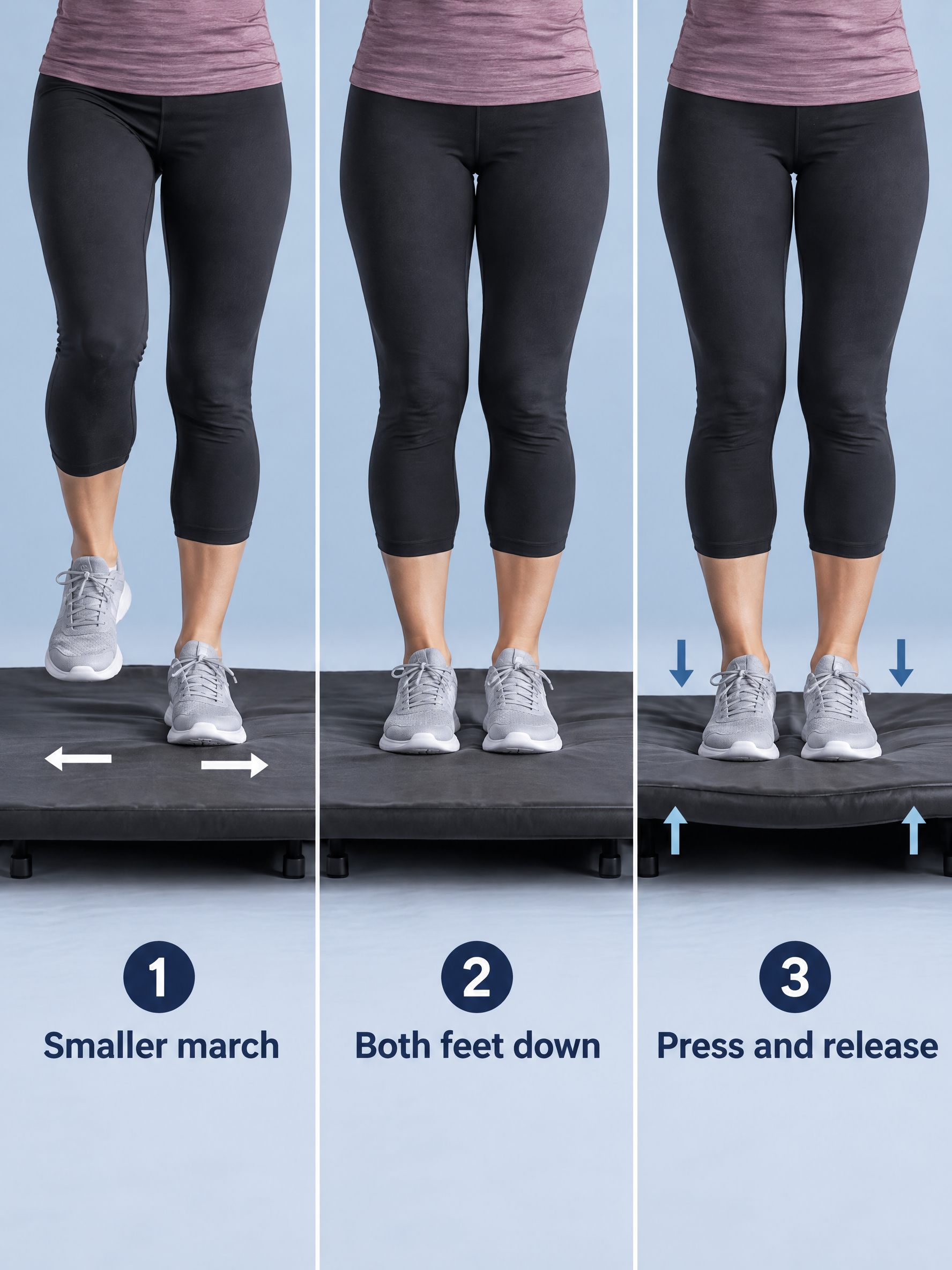
Use a short, fixed-camera clip to show the march getting smaller, the pause with both feet planted, and the mat dipping and returning under a gentle press and release.
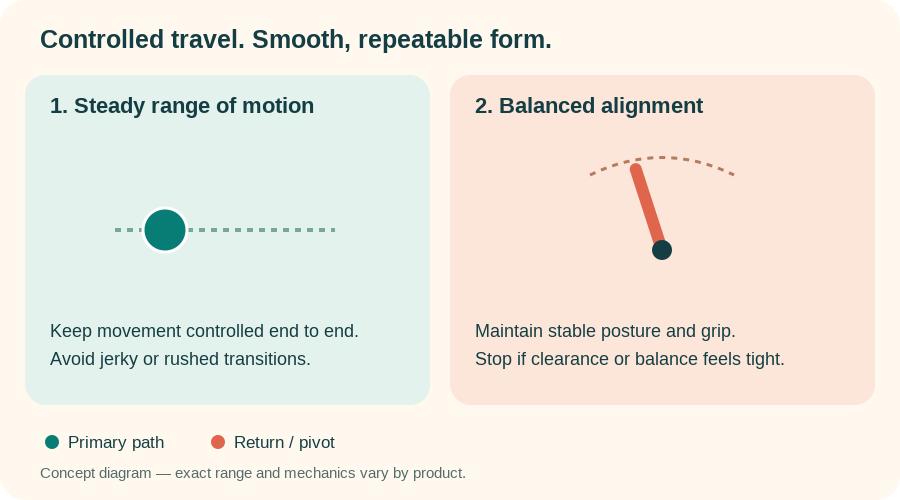
Simplified motion diagram. Exact range and mechanics vary by product.
- Make the march smaller
Lift each foot less until you’re mostly shifting weight from side to side.
- Set both feet down
Pause near the center of the mat with your weight shared evenly between both feet.
- Press and release
Press gently through both feet, then ease off and let the mat rise without trying to jump.
What happens when you press into the mat?
Put weight on the mat and it dips as the suspension stretches. Ease off and the suspension recoils, pulling the mat back up. That return is what feels different from taking the same step on a solid floor.
You don’t have to jump high, or even leave the mat. A gentle side-to-side weight shift, a march in place, and a small two-foot bounce are all ways to move on a rebounder. Start with a movement you can control rather than trying to match the speed of a workout video.
Choose your next step
Which model fits your needs?
See the differences, tradeoffs and who each model suits.
Compare the products →Bungee cords and metal springs: two ways to suspend the mat
Elastic bungee cords and metal coil springs do the same job: they connect the mat to the frame, stretch under load, and pull the mat back up as you ease off. If a listing has a generic “Number of Springs” field, read the component list too. That field can appear even on a model that explicitly comes with bungees.
On models with adjustable suspension tension, the maker provides a way to change how much the mat gives under a press. That’s different from adjusting handlebar height. Neither “bungee” nor “spring” tells you on its own how firm the bounce will feel, how noisy it will be, or how comfortable you’ll find it.
How to test the routine before buying
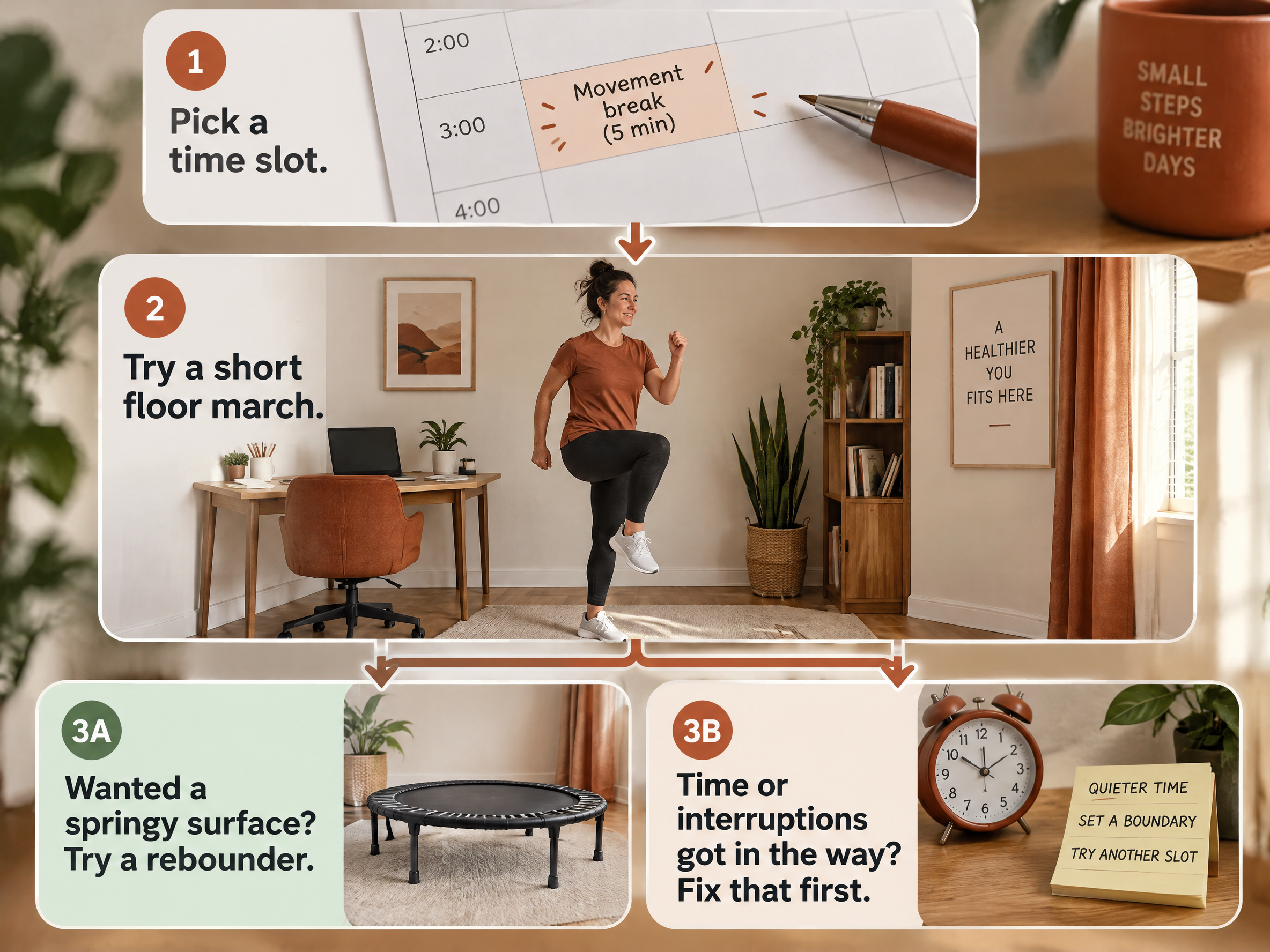
- Pick a time you already have
Choose a realistic opening in your week rather than planning around a new daily schedule.
- Try that time slot on the floor
Do a short march or follow-along session and notice what makes it easy or hard to get started.
- Decide what’s missing
If you enjoyed the session but wanted a springy surface, try a rebounder. If time or interruptions got in the way, solve that first.
Round, polygonal, folding, and one-piece frames
Rebounders come in round and polygonal shapes, including hexagons and octagons. The advertised frame size describes the outside of the equipment, not the space available for footwork. The suspension and any edge covering take up room. If you want to step from side to side, look for the clear mat width rather than judging from the frame size alone.
A folding frame can take up less storage space. A one-piece frame keeps its full outline even if its legs are removable. If you plan to tuck the rebounder under a bed, check the folded dimensions and find out whether the handlebar or legs need to come off first. A fold that’s fine for occasional storage may be more work than you want after every session.
Why choose rebounding for home cardio?
You can follow a beat, vary your pace, and stay in one spot indoors. You still need clear space around and above you, but you don’t need a route across the room. The distinctive part is the feel of the moving mat, not a promise about calorie burn or pain relief.
If you’re curious about that motion, ask whether a local studio offers a beginner class or try a friend’s rebounder. If you’d rather move on a firm surface, try a walking or dance video. If you’d prefer to sit and pedal, a stationary bike is another indoor option, though it takes up space of its own.
What ownership involves between workouts
Follow the manufacturer’s setup instructions and use a level floor. Leave space to step on and off and move your arms without hitting anything. When you check overhead clearance, account for the height of the mat and room to move. A ceiling fan or low light fixture can rule out a spot even if the frame fits.
Before using it, check that the legs and any fitted handlebar are secure and that the mat and suspension show no signs of damage. Use the manual for opening and folding the frame. If the rebounder won’t stay out, check its weight and your storage route: carrying it through a narrow doorway is a different chore from sliding it into a nearby closet.
Questions before you commit
Will a rebounder bother my downstairs neighbors?
It might, even if the suspension itself sounds quiet. Repeated presses can send vibration through the floor. If you can test one in the room where you’d use it, ask someone downstairs what they hear during gentle movement.
Should I wear shoes, socks, or go barefoot?
Follow the footwear instructions for your specific mat. If the manual allows socks, don’t assume smooth everyday socks will grip like socks made for traction.
Can I use a rebounder without a class or subscription?
Yes. A class or video gives you cues and a pace to follow, but neither is required to use the equipment. If you want guidance, look for a beginner video that demonstrates the movements slowly enough to follow without rushing.
Can two adults use the same rebounder at once?
No. Take turns, even if your combined weight is below the listed limit. Check that the exact model is suitable for each user individually.
Choose your next step
Put your shortlist side by side
See the differences, tradeoffs and who each model suits.
Compare the products →Your next step
- Confirm the user weight limit in the manual for the exact model and size.
- Check the usable mat width as well as the outside frame dimensions.
- Measure the workout spot, including side and overhead clearance.
- Check the storage dimensions and what needs to come off before folding.
- Find out whether replacement bungees, springs, or other wear parts are available.
Before you buy, picture where the rebounder will live and when you’ll use it. A setup you can manage on an ordinary day matters more than a feature you’ll rarely use.