Review101
Dumbbells for Beginners: What They Are and How They Work
A dumbbell puts a free weight in one hand. Here’s how the same weight works in a curl, row, or press, and what changes when you use a fixed or adjustable design.
Read the article
Some links may earn us a commission, at no extra cost to you. How we’re supported
In this article 7 sections
Start with your needs
Use dumbbells you already have access to and notice which movements you’d want to repeat.
Consider keeping dumbbells at home if they fit your routine and getting to shared equipment is the main obstacle.
Stick with bodyweight work, bands, or shared weights if they already let you do what you want.
As an Amazon Associate, we earn from qualifying purchases. Research-based analysis; no hands-on testing.
The short answer
You don’t need dumbbells to start strength training, and you don’t need to own them to try them. They’re useful when you want each hand to carry its own weight or want to train one side at a time.
Worth considering if
- Beginners who want to try one-sided movements.
- People who want each hand to support and guide its own load.
- Home exercisers who would use weights more often if they were close at hand.
Hold off if
- You already have convenient access to dumbbells elsewhere.
- You’re still working out which exercises you want to do regularly.
- You don’t have a clear place to lift and set down the weights.
Choose your next step
Ready to compare?
See the differences, tradeoffs and who each model suits.
Compare the products →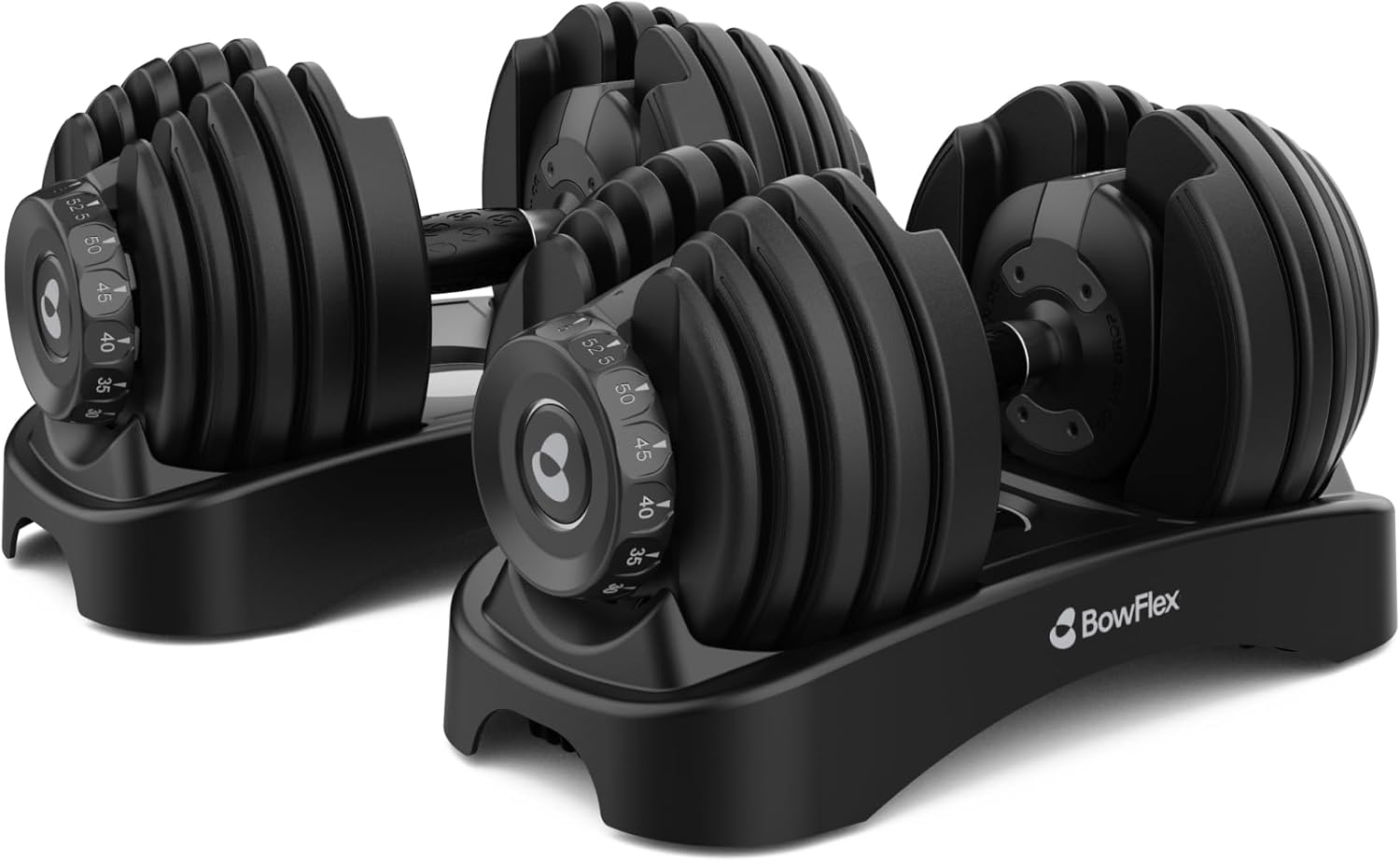

What is a dumbbell?
A dumbbell is a free weight with a short handle between two weighted ends. Your hand goes around the middle, with weight on either side of your grip. Unlike a machine handle that runs along a track or pivots around a fixed point, a dumbbell leaves you in charge of where it goes.
A single dumbbell lets you load one hand at a time. A matched pair gives you two weights of the same size, so you can hold one in each hand. If you pick up two 10-pound dumbbells, each hand holds 10 pounds and you’re moving 20 pounds in total.
On a listing, the weight and the quantity tell you different things. The Amazon Basics 30-pound Rubber Hex listing describes one 30-pound dumbbell. The BowFlex Results Series 552 listing describes two dumbbells, each adjustable from 5 to 52.5 pounds. CAP’s 40-pound adjustable cement kit uses 40 pounds to describe the whole set, not the load on either handle.
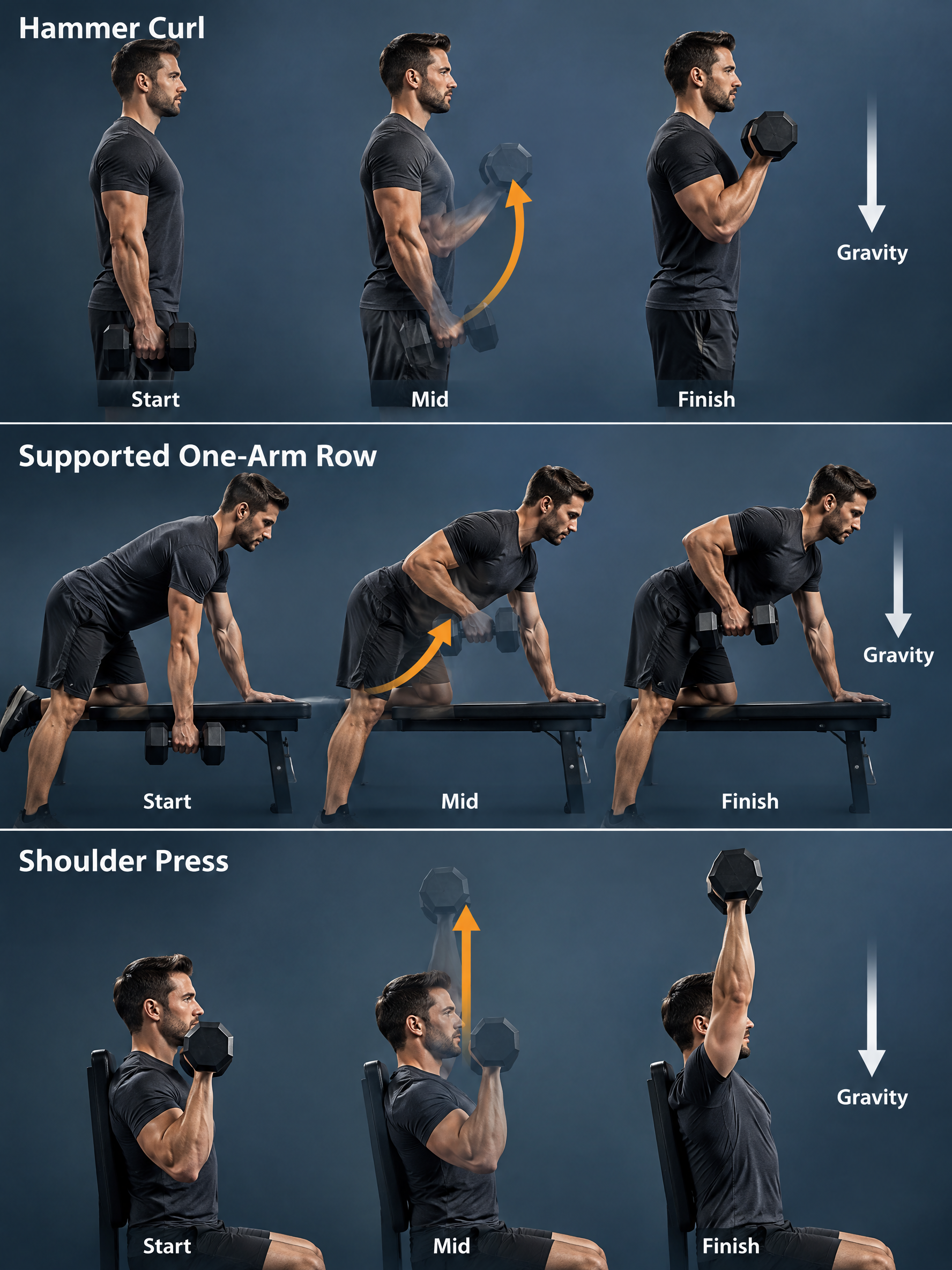
Follow the dumbbell: three lifting paths
See the movement
Follow the controlled vertical lift path and level cradle return.
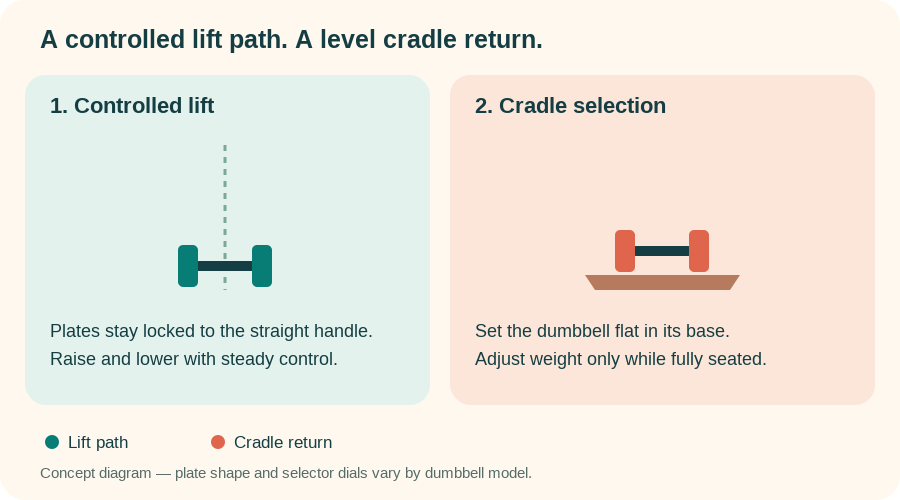
Simplified motion diagram. Plate shape and selector dials vary by model.
- Hammer curl: forward and up
Beside the thigh → forward and up in an arc → near the shoulder. The weight traces a curve around the elbow.
- One-arm row: up and back
Below the shoulder → up and back → beside the torso. The path has both an upward and a backward part.
- Shoulder press: mostly up
Near the shoulder → upward → overhead. The path is mostly vertical. Gravity points down in all three examples.
How the weight moves in a curl, row, or press
Gravity pulls the dumbbell straight down regardless of the path your hand takes. If a movement takes the weight both up and back, it’s the upward part that raises it against gravity. On the way down, your muscles can still work to slow the descent.
The number on the dumbbell stays the same even when the effort changes. In a hammer curl, for example, the weight generally has more leverage around your elbow when your forearm is horizontal than when it hangs straight down. That’s why the middle of the curl can feel harder than the start without any change in weight. The diagram traces the weight’s path in three movements; it isn’t a form lesson.
Choose your next step
Which model fits your needs?
See the differences, tradeoffs and who each model suits.
Compare the products →Fixed weights, plate-loaded sets, and selector adjustables
All three designs give you a weight to lift against gravity. The difference is how you make that weight lighter or heavier.
A fixed dumbbell has a permanent weight. To change the load, you set it down and pick up a different one. The CAP rubber-coated hex dumbbell is an example: its flat-sided heads resist rolling when you set it down. The trade-off is that every weight you use is a separate dumbbell to store.
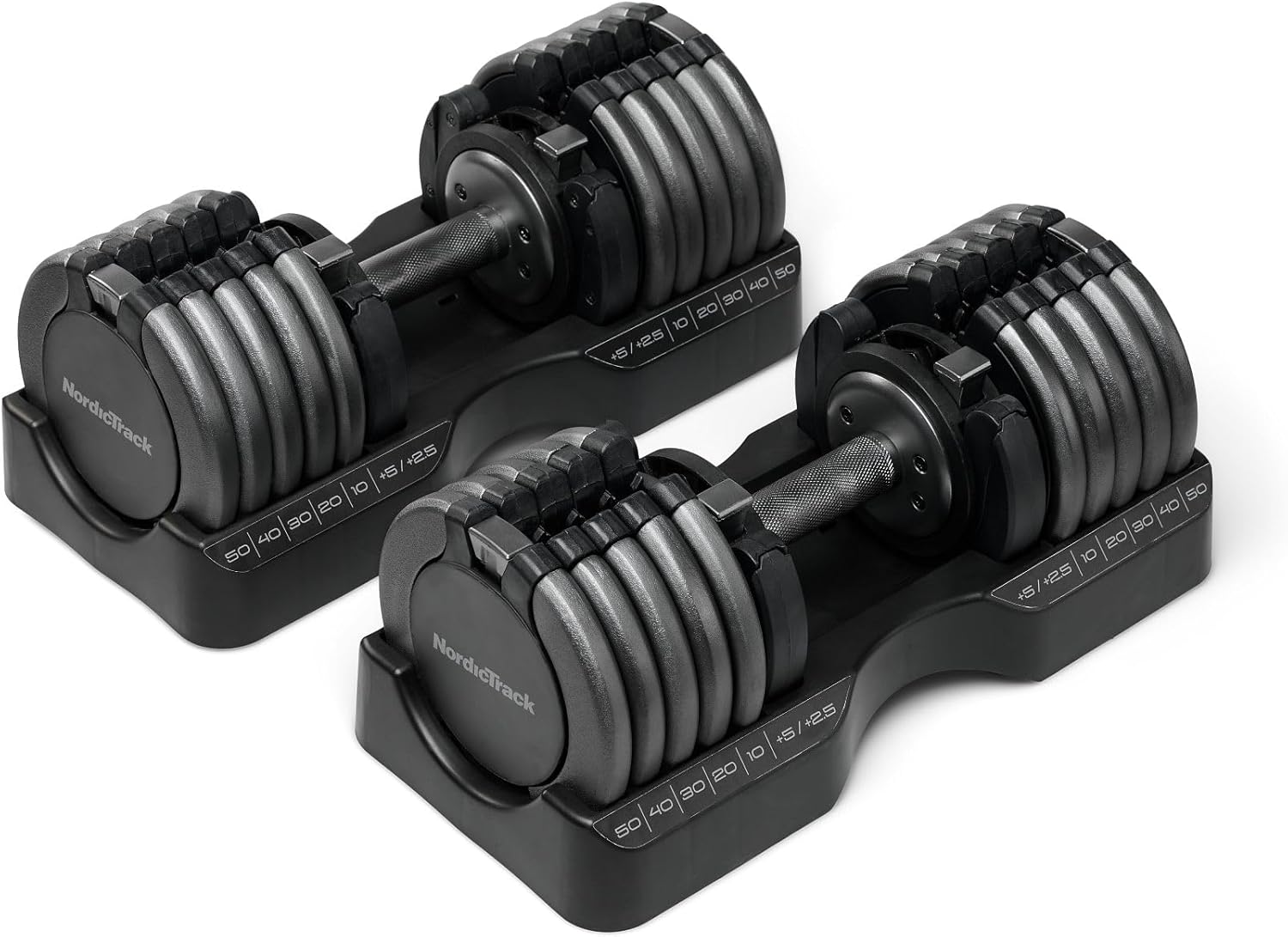
A plate-loaded dumbbell has a handle that takes removable plates. You add or remove plates by hand, and collars keep them from sliding off. CAP’s adjustable cement kit illustrates the design with two handles, removable plates, and collars. A change in load means taking the collars off and securing them again, not just reaching for a different weight.
A selector adjustable lets you choose which weights come up with the handle while the rest stay behind. The PowerBlock Elite EXP uses a magnetic selector pin. You keep the same handle across settings instead of storing a separate dumbbell for each load.
Decide whether two exercises need the same load
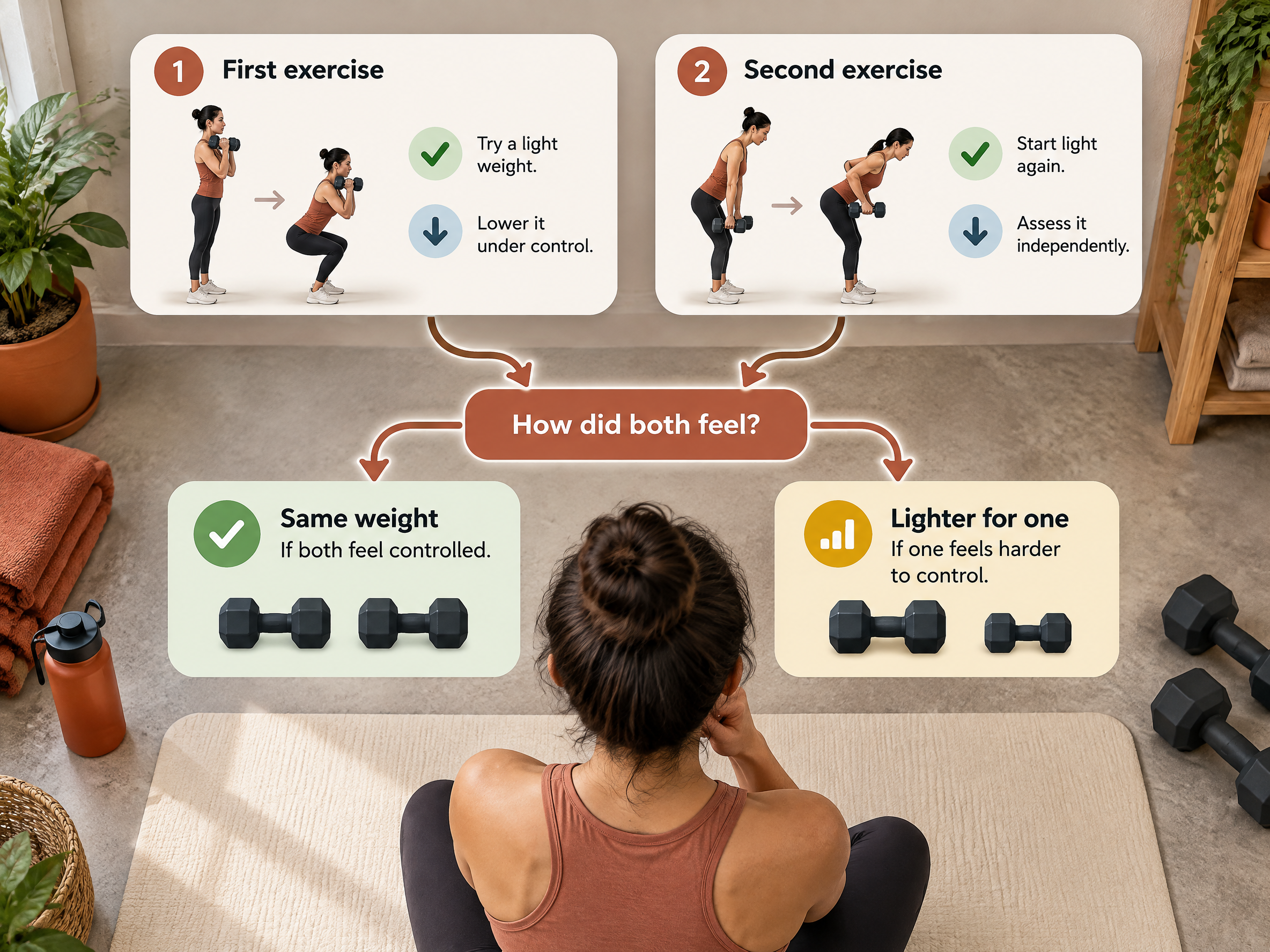
- Find a starting load
For the first exercise, try a light weight that you can move smoothly and lower under control.
- Check the second movement on its own
Start light again rather than carrying over the first weight by default. Notice whether the second movement feels harder to control.
- Keep or split the loads
Use the same weight if it’s manageable for both. If it’s hard to control in one of them, use a lighter weight for that movement.
Why use dumbbells instead of one shared weight?
Both hands guide the same bar when you lift a barbell. With a dumbbell in each hand, each side supports and guides its own weight. You may notice that one hand takes a slightly different path because the two weights aren’t linked. You can also use just one dumbbell for a movement such as a one-arm row.
A load that feels manageable in an incline dumbbell press might feel much harder in a lateral raise. In the raise, the weight travels out to the side on a relatively extended arm, giving it more leverage around the shoulder. The incline press uses a different path and also calls for a suitable incline bench.
If separate hand loads aren’t important to the movements you want to do, a barbell can provide a shared load. Resistance bands offer another way to resist a press or pull, but their resistance changes as they stretch. Bodyweight exercises are an option if you’d rather start without equipment.
What owning dumbbells involves
Check the spot where you’d actually lift, not just where the weights would fit in storage. A lateral raise needs room to the sides; an overhead press needs clearance above. If you use a bench, leave room around it to pick up and set down the weights without blocking a walkway.
Give the weights a stable place to rest between sets so you’re not setting them down wherever there’s space. With a plate-loaded set, keep the loose plates and collars together and check that the collars are secure before lifting. With a selector model, follow its instructions and check that the selector is fully engaged.
If a gym or community center you already visit has dumbbells, try them there before making room at home. What matters is whether you’d use them in a routine you can repeat, and whether having them at home would make that routine easier to keep.
Questions before you commit
Can I try the movements before I have dumbbells?
Yes. Trace the movement with empty hands first. A small, securely capped water bottle you can grip comfortably can add a little resistance, though it won’t tell you what a heavier dumbbell feels like.
Can I use dumbbells in an upstairs apartment?
Yes, if your building allows it and you can set the weights down without disturbing neighbors. A firm protective mat can help prevent scuffs, but it won’t make a dropped weight quiet. Choose a spot where you can place the weights down gently every time.
Can I use a plate-loaded handle with no plates on it?
Yes, if the manufacturer’s instructions allow that setup. The handle itself has weight, so it can give you some resistance before you add plates.
Can I use one dumbbell and switch hands instead of using a pair?
Yes, for movements that work one side at a time, such as a one-arm row. For a movement usually done with two weights together, using one changes how you balance the load, so it isn’t quite the same exercise.
Choose your next step
Put your shortlist side by side
See the differences, tradeoffs and who each model suits.
Compare the products →Your next step
- Name a movement you’d actually use dumbbells for.
- Work out whether it uses one dumbbell or a matched pair.
- Check clearance for the movement and a stable place to set down the weights.
- On a listing, confirm the quantity and whether the stated weight is per dumbbell or for the whole set.
The first useful thing to learn isn’t how much you can lift. It’s what feels different when each hand has a weight of its own.