 Review101
BalanceFrom 3-in-1 Foam Plyometric Jump Box Review: Who Should Buy the BFJB-1L?
The BalanceFrom BFJB-1L is a good fit if you want one foam plyo box you can move between workouts and 20 inches is already a practical starting height. Choose something else if you need a lower platform or can’t confirm that the manufacturer approves your intended exercise and load. This is a research-based review, with no hands-on testing.
Read the article
Some links may earn us a commission, at no extra cost to you. How we’re supported
In this article 9 sections
- BalanceFrom 3-in-1 Foam Plyometric Jump Box: at a glance
- Our assessment
- Which height and footprint fit your workout space?
- How do you change heights and put the box away?
- What can foam construction and a non-slip claim tell you?
- What does the 250-pound weight recommendation cover?
- What’s included, and when is the 3-in-1 design worth buying?
- When an alternative makes more sense
- Before you order
Review summary
Buy the BFJB-1L if you can use its 20-inch starting height, have room to train around it, and can confirm the applicable load limit for your workouts. Skip it if you need a lower setting or if the listed 250-pound maximum weight recommendation leaves a question about your intended use.
As an Amazon Associate, we earn from qualifying purchases. Research-based analysis; no hands-on testing.
BalanceFrom 3-in-1 Foam Plyometric Jump Box: at a glance
One 10-pound foam box with nominal heights of 20, 24 and 30 inches. Its main appeal is getting three settings from a single block you can put away between workouts.
Pros
- Shared workout spaces where the box needs to move between sessions
- Buyers who can start at 20 inches and want taller settings without storing separate platforms
Cons
- No setting below 20 inches
- The advertised non-slip surface doesn’t verify grip on your floor
- The listed 250-pound recommendation isn’t a documented jump-landing limit
Our assessment
Editorial judgments based on the listed specifications, not a lab-test score.
Height range
Useful if 20 inches fitsThe outer dimensions give you three nominal heights, but turning the box can’t give you a setting below 20 inches.
Portability
Practical to repositionThe listed 10-pound weight is an advantage if you expect to turn or stow the box often, though you still need space for the full block.
Landing feel and grip
UnverifiedFoam construction and an advertised non-slip surface do not establish firmness, traction on a particular floor or stability under an off-center landing.
Load guidance
Confirm for your exerciseThe 250-pound figure is listed as a maximum weight recommendation, with no documented jump-landing limit.

BalanceFrom 3-in-1 Foam Plyometric Jump Box
Check price on Amazon →Which height and footprint fit your workout space?
Check for model BFJB-1L before ordering. The dimensions in this review apply to that exact model, not to every BalanceFrom box sold under the 3-in-1 name. The three nominal heights come from turning the same rectangular box onto a different face, so the height and footprint change together.
The lowest setting takes up the most floor space. If that’s the height you’ll use for step-ups or box jumps, mark out a 24 × 30-inch rectangle and check how much clear space remains to approach and step off. The tallest setting takes up less floor space, but gives you less overhead clearance. The top-face measurements below come from the listed outer dimensions; they aren’t measurements of the usable landing area.
- 20 inches high: nominal top face of 24 × 30 inches.
- 24 inches high: nominal top face of 20 × 30 inches.
- 30 inches high: nominal top face of 20 × 24 inches.

How do you change heights and put the box away?
Height adjustment is a matter of reorienting the box. That means you need room to turn the whole block, not just room for the footprint it occupies once it’s in place. The listed 10-pound weight gives you a concrete sense of what you’ll lift or turn if you switch heights during a session or clear the room afterward.
For a home gym that shares space with another room, measure the storage spot as well as the workout area. Reorienting the box can change how it fits, but it doesn’t make the block itself smaller. Check the exact-model instructions for approved orientations and floor requirements before setting it up.
What can foam construction and a non-slip claim tell you?
The listing identifies foam as the construction material and advertises a non-slip surface. It doesn’t establish how firm the top feels underfoot or how much it compresses. And traction under your shoes is a separate question from whether the underside grips your flooring.
The box has a smaller base at 30 inches than at 20 inches, but dimensions alone don’t show how it responds to an off-center landing. The supplied external search results did not establish an independent testing consensus for the BFJB-1L. Firmness, floor grip and stability in each orientation remain unverified.

What does the 250-pound weight recommendation cover?
The listing gives 250 pounds as the maximum weight recommendation. It doesn’t explain how that figure was established or document a dynamic landing-load test. Don’t treat it as proof that the box supports repeated jump landings at that weight or that the same guidance applies in every orientation.
The listing advertises step-ups and agility training, but that doesn’t answer exercise-specific load questions. If you plan to do repeated box jumps or hold dumbbells during step-ups, ask BalanceFrom whether that use is approved for the BFJB-1L, whether carried weight counts toward the recommendation, and whether the limit changes with orientation. Get the answer before ordering if it determines whether you can use the box as intended.
What’s included, and when is the 3-in-1 design worth buying?
The listing names one jumping box and a two-year warranty. It doesn’t establish whether the cover or padding is removable, whether replacement parts are available, or what the warranty covers. Ask for the cleaning instructions and written warranty terms. Check the seller’s return policy separately: a warranty listing doesn’t tell you whether you can return the box if the surface feels different from what you expected.
The value of the 3-in-1 design depends on whether the extra heights will earn their space. If your workouts call for more than one setting, one block can take the place of separate platforms. If you’ll use only one height, judge the purchase on how well that particular height, footprint and surface suit your routine. The two unused settings don’t improve the one you train on.
When an alternative makes more sense
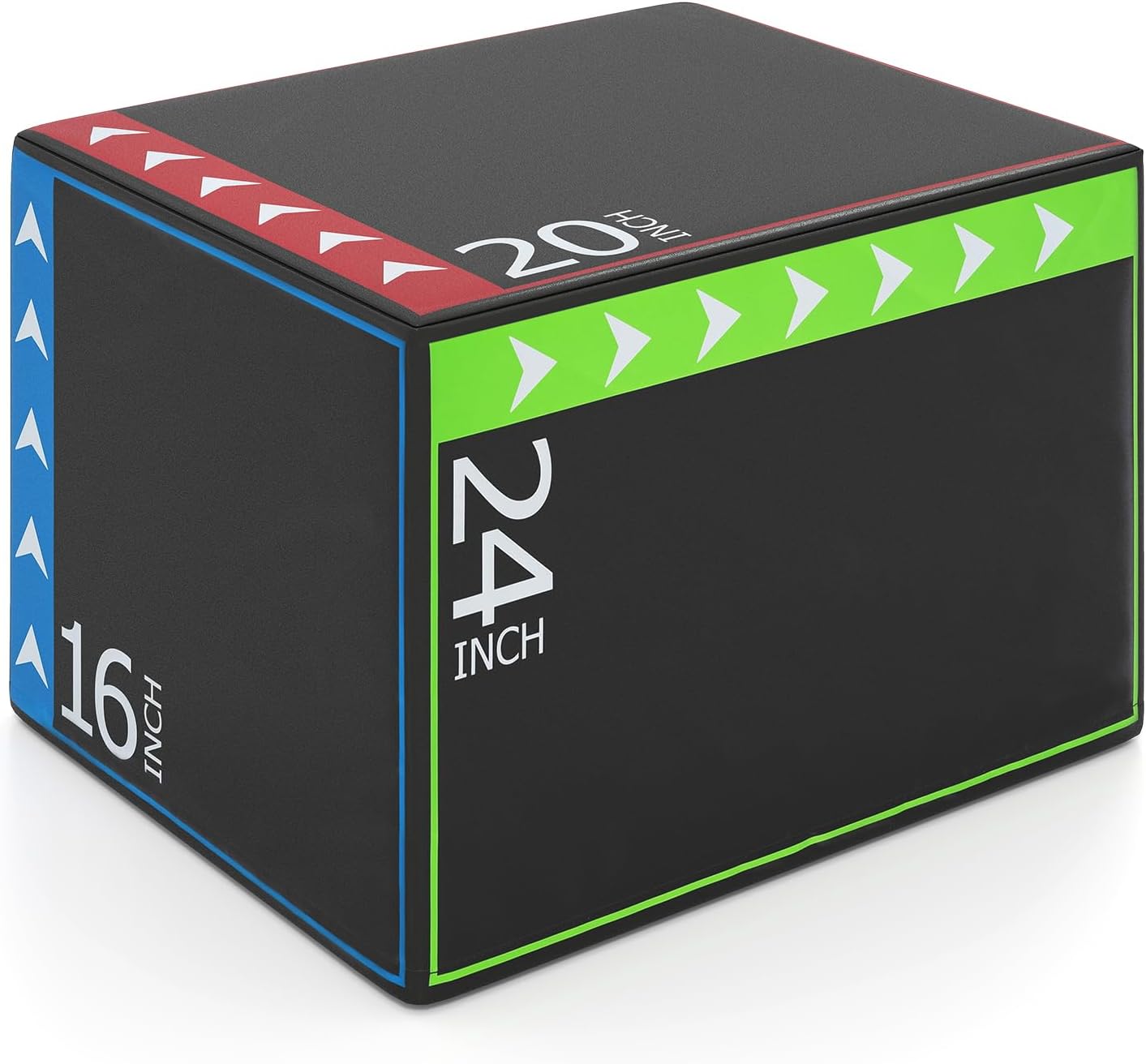
Goplus 3-in-1 Soft Foam Plyo Box, 16/20/24 in.
Consider the Goplus 3-in-1 Foam Plyo Box if you want to stick with a single foam block but carry less between workouts. It’s listed at 7 pounds. If starting height is also a deciding factor, confirm the shortest setting for this exact variant; the supplied dimensions are for the package, not the box.
Compare this alternative →
VEVOR Steel Plyometric Jump Box
Consider the VEVOR SS-B-12-18-24 if your priority is a lower starting height and you prefer rigid steel platforms. The listing specifies three separate alloy-steel boxes at 12, 18 and 24 inches, so you can start below 20 inches without rotating a foam block.
Compare this alternative →Choose your next step
Put your shortlist side by side
See the differences, tradeoffs and who each model suits.
Compare the products →Before you order
- Confirm BFJB-1L is the model on your order.
- Check that 20 inches works for the exercise you’ll do most.
- Measure the footprint, room to turn the box, approach and step-off space, and overhead clearance.
- Get the exact-model instructions and confirm approved exercises, orientations and load limits.
- Check the care instructions, written warranty coverage and seller’s return terms.
Base the decision on the workout you’ll do most often. If it calls for a lower platform or a load the manufacturer won’t confirm for that use, don’t count on the extra heights to make up for it.


